



01. Edit your form online
Type text, add images, blackout confidential details, add comments, highlights and more.

Type text, add images, blackout confidential details, add comments, highlights and more.

Draw your signature, type it, upload its image, or use your mobile device as a signature pad.

Send it via email, link, or fax. You can also download it, export it or print it out.
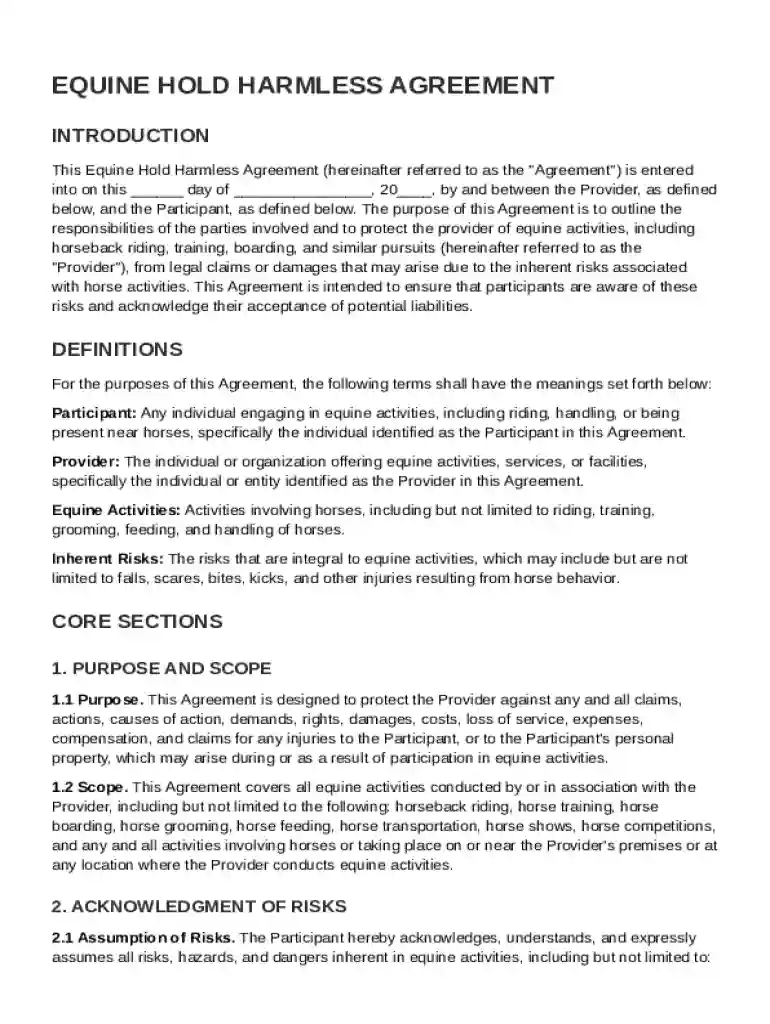
The Equine Hold Harmless Agreement Template is a legal document commonly used in the equine industry to protect service providers from liability. This agreement outlines the terms under which participants engage in activities involving horses, detailing both parties’ responsibilities. The document aims to mitigate risks associated with equine activities, acknowledging the inherent dangers involved and emphasizing the participant's voluntary assumption of risk.
Key elements often include the release of liability, indemnification clauses, and an affirmation that participants understand the risks associated with horse-related activities. Such agreements safeguard providers from potential legal claims arising from accidents or injuries that occur during equine events.
An effective Equine Hold Harmless Agreement Template should comprehensively cover various aspects to ensure robust legal protection:
Parties Involved: Identifies the Provider (individual or business offering equine activities) and the Participant (individual engaging in these activities).
Assumption of Risk: Clearly states that the Participant acknowledges the risks associated with equine activities, including but not limited to falls, kicks, and unpredictable animal behavior.
Release of Liability: Outlines that the Provider is not liable for injuries or damages incurred during the activities except in cases of gross negligence or willful misconduct.
Indemnification Clause: Ensures that Participants agree to indemnify the Provider against claims arising from their participation.
Safety Responsibilities: Details the Participant's duty to follow safety guidelines and wear appropriate safety gear.
Governing Law: Specifies the state laws that govern the agreement, useful for legal clarity.
Employing the Equine Hold Harmless Agreement Template involves a few straightforward steps:
Customization: Modify the template to reflect the specifics of your equine activities, including the nature of services provided and any unique terms.
Detail Filling: Enter details of the parties involved, ensuring the accuracy of names and contact information.
Explanation to Participants: Explain the document to participants, emphasizing the risks and their responsibilities.
Signatures: Ensure that both parties sign the agreement for it to be legally binding. Electronic signatures are often accepted.
Storage: Store a signed copy for reference in case of legal disputes.
Completing the Equine Hold Harmless Agreement Template requires attention to detail:
Gather Information: Collect necessary information about the parties involved and the nature of the equine activities.
Identify Risks: Clearly outline the inherent risks of participating in equine activities.
Fill Out the Template: Complete the template with all required details, ensuring clarity and accuracy.
Discuss and Clarify: Discuss the terms with participants to ensure understanding and consent.
Execute the Agreement: Both parties must sign the document, and a witness may be required to validate the signatures.
Documentation and Storage: Keep the signed documents well-organized, either digitally or physically.
This agreement is a protective measure aimed at reducing liability for equine activity providers. In legal terms, it serves as evidence that participants were informed of and accepted the risks of horse-related activities. While it cannot wholly prevent litigation, it provides a substantial defense in liability cases, especially when drafted correctly and clarified to protect both the provider and participants effectively.
Understanding the terminology used in the Equine Hold Harmless Agreement Template is crucial:
"Provider": The individual or organization offering equine activities.
"Participant": The person engaging in the equine activities, subject to the terms detailed in the agreement.
"Inherent Risk": The known dangers associated with equine activities, such as falls and injuries due to horse movements.
"Indemnification": A promise by the participant to secure the provider from any claims resulting from their participation.
"Governing Law": The jurisdiction under whose laws the agreement is enforced, often reflecting state-specific legislation.
Different U.S. states may have specific statutes governing equine activities and liability protection. For example:
Equine Activity Laws: Many states have enacted statutes limiting liability for equine activity providers if they comply with specific signage and wording requirements in agreements.
Variance in Law Application: The application and interpretation of these agreements may vary based on state law, emphasizing the need to familiarize oneself with regional rules.
Providers should consult with legal professionals to tailor their agreements according to state-specific regulations, ensuring compliance and maximizing protection.
This template is primarily used by:
Equine Facility Owners: Those offering riding lessons, training, boarding, or horse rentals to protect against liability.
Event Organizers: Facilitators of horse shows, trail rides, or competitions who need participant waivers.
Horse Trainers and Instructors: Professionals providing guidance and training to riders.
Equine Service Providers: Any business entity involved in the equine industry where interaction with horses could present a risk.

At DocHub, your data security is our priority. We follow HIPAA, SOC2, GDPR, and other standards, so you can work on your documents with confidence.


Nov 20, 2020 Hold Harmless Agreement shall bind the members of my family and spouse, if any, if I am alive, and my heirs, assigns and personal
You agree to defend, indemnify and hold harmless kidney.wiki, its affiliates, licensors and service providers, any claims, liabilities, damages, judgments,
Equine Release of Liability agrees to indemnify, defend (with counsel and hold harmless County, and Countys employees, ) and shall assume entire


