
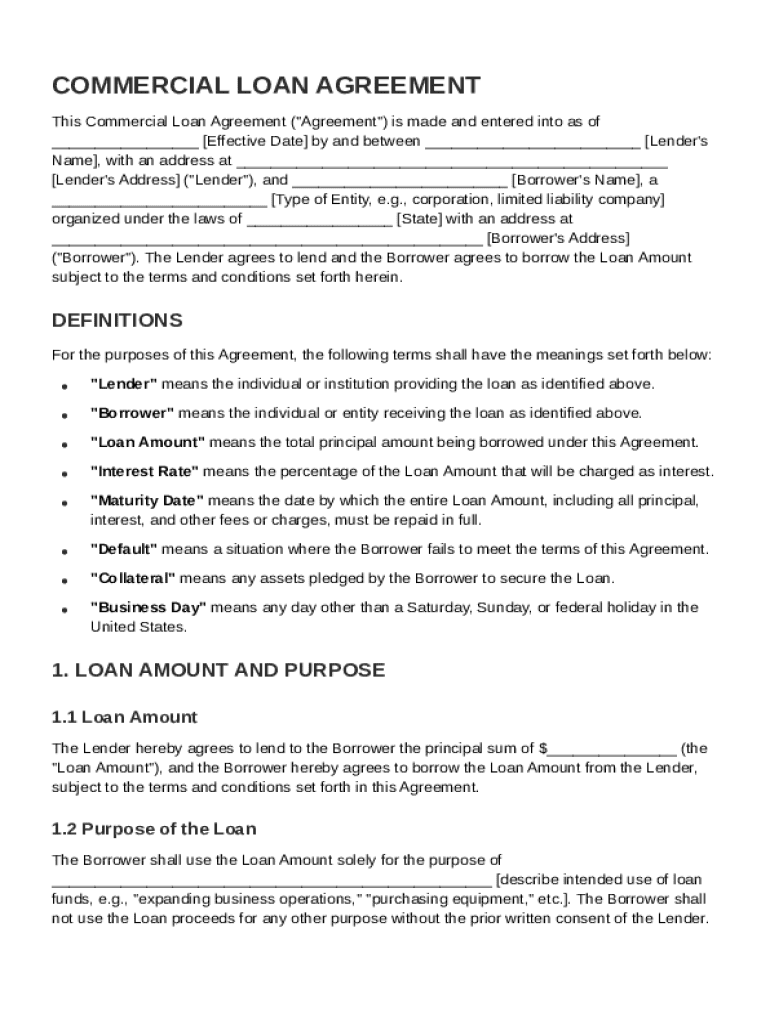







Definition and Meaning of Commercial Loan Agreement Template
A Commercial Loan Agreement Template is a pre-structured document used to outline the terms of a loan between a lender and a borrower, typically for business purposes. This agreement sets clear expectations regarding the loan amount, interest rates, repayment schedules, collateral requirements, and more. Such a template serves as a legal safeguard, detailing the responsibilities of both parties and specifying the conditions under which the loan must be repaid. By employing a predefined template, businesses and financial institutions can ensure that all necessary contractual elements are included, facilitating a smoother negotiation and implementation process.
Key Components
- Loan Amount: Specifies the principal amount borrowed.
- Interest Rate: Details the rate applied to the loan, which could be fixed or variable.
- Payment Schedule: Defines how and when payments are to be made.
- Collateral Requirements: Outlines assets pledged by the borrower to secure the loan.
- Representations and Warranties: Statements of fact by both parties that are asserted to be true.
- Covenants: Ongoing obligations that the borrower must fulfil.
- Events of Default: Specifies conditions that constitute a breach of the agreement.
- Governing Law: Indicates the jurisdiction governing the agreement terms.
- Miscellaneous Provisions: Additional terms that don't fall into the main categories but are crucial for legal rigour.
How to Use the Commercial Loan Agreement Template
Utilizing a Commercial Loan Agreement Template effectively involves several key steps that ensure both relevance and legality. While templates provide a base, customization is crucial to reflect the specific circumstances of the loan.
- Download the Template: Acquire the document from reliable platforms like DocHub, compatible with various file formats.
- Review Template Contents: Examine each section of the template to understand all clauses and determine necessary adjustments.
- Customize Key Sections: Modify sections such as loan amount, interest rate, and repayment terms to match the specific loan arrangement.
- Insert Parties' Information: Include detailed information of both the lender and the borrower, ensuring accuracy of names, addresses, and contact details.
- Validate Legal Clauses: Confirm that legal terms and conditions comply with applicable laws.
- Seek Legal Counsel: Consult with a legal advisor to review the tailored agreement for potential inconsistencies or pitfalls.
- Execute the Agreement: Once the template is customized and validated, both parties should sign the document to make it effective and binding.
Practical Example
Consider a small business seeking a $50,000 loan to expand operations. Using the template, the business adjusts the interest terms to match current market rates, details its repayment capacity, and secures the loan with inventory as collateral. A legal review ensures compliance with state laws, preventing legal conflicts during the loan term.
Key Elements of the Commercial Loan Agreement Template
Successful usage of a Commercial Loan Agreement Template depends on including certain critical elements. These components not only ensure legal compliance, but also provide operational clarity.
- Descriptive Titles: Heading sections such as “Loan Amount” and “Payment Obligations” should be clearly labeled.
- Detailed Definitions: All terms should be defined explicitly to avoid ambiguous interpretations and disputes.
- Rates & Fees: Clear articulation of interest rates, service fees, and any penalties for late payments.
- Reporting Requirements: Obligations for the borrower to periodically provide financial statements or reports.
- Insurance Requirements: Often necessitated by lenders, borrowers may be required to maintain insurance on collateral assets.
- Amendment Procedures: A process for how changes to the agreement can be made, including mutual consent stipulations.
Case Study
Imagine a tech startup acquiring a loan to purchase equipment. The agreement stipulates quarterly financial reports be sent to the lender to illustrate fiscal health, and failure to do so triggers an event of default. By pre-defining these terms, both parties maintain transparency and accountability.
Steps to Complete the Commercial Loan Agreement Template
Finalizing a Commercial Loan Agreement involves several methodical steps, ensuring comprehension and agreement between the involved parties.
- Initial Drafting: Use the template as the foundation to draft initial terms.
- Negotiation: Discuss terms with the lender (or borrower) to arrive at a mutually beneficial agreement.
- Completion: Fill out all relevant fields with precise figures and terms.
- Documentation: Gather any supportive documents like financial records or proof of collateral.
- Review: Conduct a comprehensive review alongside stakeholders and legal advisors.
- Approval: Both parties, along with witnesses (if required), sign the agreement.
- Archiving: Store both digital and hard copies of the signed agreement for future reference.
Edge Cases
Certain scenarios, like economic downturns impacting the borrower's ability to repay, must be considered. Including clauses for restructuring the loan under such conditions can mitigate risk for both parties.
Legal Use of the Commercial Loan Agreement Template
Ensuring the legal soundness of a Commercial Loan Agreement Template involves compliance with relevant legislative frameworks. This includes licensing, registration, and adherence to financial regulations specific to loan agreements.
- Compliance with ESIGN and UETA: For digital agreements, ensure electronic signatures are legally recognized.
- State Laws and Regulations: Each state might have specific mandates affecting loan agreements; adherence is critical for enforcement.
- Enforcement Clauses: Clearly outline the legal recourses available to both parties in case of default or dispute.
- Legal Jurisdiction: Specifies the state laws under which the agreement will be governed.
Practical Application
A lender from California and a borrower in Florida should ensure the loan agreement is valid in both jurisdictions, verifying that local usury laws are not violated, potentially voiding the agreement.
State-Specific Rules for the Commercial Loan Agreement Template
Different states have distinct guidelines affecting commercial loan agreements. These differences often relate to interest limits, disclosure requirements, and borrower protections.
- Interest Rate Caps: Some states impose maximum interest rates on loans, influencing how terms should be structured.
- Disclosure Requirements: States may dictate what financial information must be disclosed in the agreement.
- Statutory Limits and Protections: Each state provides varying levels of protection for borrowers against predatory practices.
Example
When drafting a loan agreement in New York, assume lower interest rate limits compared to Texas, influencing the financial feasibility and attractiveness of the loan terms for both parties.
Versions or Alternatives to the Commercial Loan Agreement Template
Apart from Commercial Loan Agreement Templates, several alternatives may fulfill unique business needs. These documents may vary in complexity or specificity.
- Promissory Notes: Less formal, typically used for smaller or intra-company loans.
- Term Sheets: Outline essential terms but are less binding, used during initial negotiations.
- Credit Facility Agreements: For more extensive, ongoing credit lines as opposed to lump-sum loans.
Use Case
A startup seeking funds for short-term operational costs may opt for a promissory note to simplify legal overhead. Conversely, a large-scale construction project may require a comprehensive credit facility agreement to cover varied and unforeseen financing needs.




