
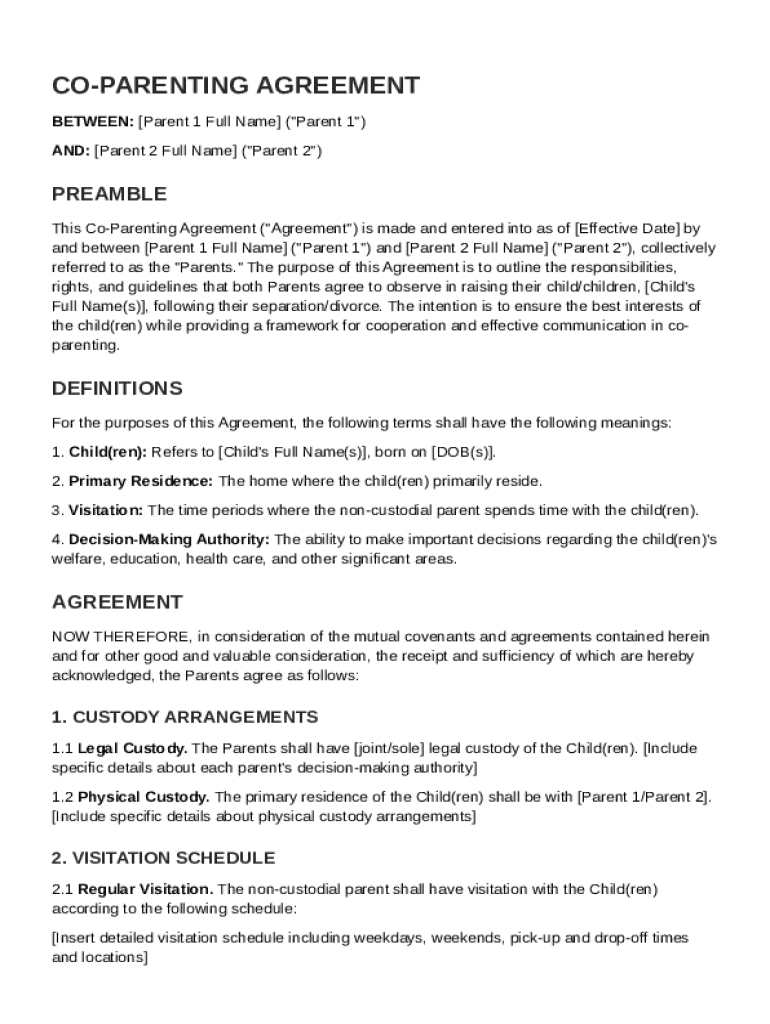







Definition and Purpose of the Co-Parent Agreement Template
The Co-Parent Agreement Template serves as a comprehensive tool for outlining the responsibilities and expectations shared between parents in a post-separation scenario. This document is crucial for clearly defining each parent's roles concerning the upbringing of their child or children. It encompasses a wide range of topics, such as custody arrangements, visitation schedules, educational and healthcare decision-making authority, financial responsibilities, and communication methods. The main objective of this template is to ensure the child's best interests are prioritized while promoting effective cooperation between parents. By providing a detailed and structured framework, the template helps minimize misunderstanding and disputes, allowing for a more harmonious co-parenting experience.
Key Elements of the Co-Parent Agreement Template
A well-crafted Co-Parent Agreement Template generally includes several critical components, each designed to address fundamental aspects of co-parenting arrangements:
-
Custody Arrangements: Details whether custody is joint or sole and the specific terms relating to physical and legal custody.
-
Visitation Schedules: Outlines the schedule for when each parent will spend time with the child, including holidays, vacations, and special events.
-
Decision-Making Authority: Clarifies which parent is responsible for major decisions concerning the child's education, healthcare, and extra-curricular activities.
-
Financial Responsibilities: Includes specifics on child support payments, and how shared expenses like medical costs are to be divided.
-
Dispute Resolution: Establishes agreed-upon methods for resolving disagreements that may arise, such as through mediation or arbitration.
-
Amendment Terms: Provides guidelines for how changes to the agreement can be proposed and implemented.
Steps to Complete the Co-Parent Agreement Template
Completing the Co-Parent Agreement Template requires both parents to work collaboratively. Here is a step-by-step guide to assist:
-
Gather Information: Collect essential details, including personal and contact information for both parents and the child or children involved.
-
Review Legal Requirements: Familiarize yourselves with any state-specific laws pertaining to child custody and co-parenting agreements.
-
Fill Out Basic Information: Begin by entering names, contact details, and any other identifying information in the template.
-
Define Custody and Visitation Terms: Clearly specify the type of custody and articulate the visitation schedule.
-
Outline Decision-Making Authority: Detail who will be responsible for each area of the child's life.
-
Detail Financial Arrangements: Provide specific terms for child support and how additional costs will be managed.
-
Include Dispute Resolution: Identify preferred methods for resolving potential conflicts.
-
Review and Amend if Necessary: Examine the completed form for accuracy, and amend any discrepancies before finalizing.
-
Sign the Document: Both parents should sign the document, ideally with witness or notary verification as required by local laws.
Legal Use of the Co-Parent Agreement Template
In the United States, the Co-Parent Agreement Template can be legally binding and enforceable if it meets specific criteria. Both parents must voluntarily agree to the terms, which should be clearly documented and free from coercion. Often, it is recommended to have the agreement notarized to strengthen its legal standing. In some states, the completion and submission of the document to a family court for approval may be required to ensure enforceability. The legal context underscores the importance of consulting with a family law attorney to ensure the agreement is comprehensive, equitable, and conforms with relevant state laws.
Important Terms Related to Co-Parent Agreement Templates
Understanding key legal and technical terms related to the Co-Parent Agreement Template is vital for creating a clear and effective document:
- Joint Custody: Both parents share custody and decision-making responsibilities.
- Sole Custody: One parent has exclusive legal and/or physical custody rights.
- Mediation: A process where a neutral third party assists in resolving disputes.
- Primary Physical Custody: The child resides primarily with one parent.
- Non-Custodial Parent: The parent who does not have physical custody but may have visitation rights.
- Child Support: Financial payments made by the non-custodial parent for the child's expenses.
State-Specific Rules for Co-Parent Agreement Templates
The Co-Parent Agreement Template's effectiveness and enforceability can vary based on state-specific laws in the U.S. Some states have particular requirements for documenting custody and visitation agreements, while others may have established standard forms or guidelines. States may also differ in terms of mandatory parenting classes or mediation requirements before court acceptance. Therefore, it's crucial for parents to be informed about local legal frameworks, which can often be explored with assistance from legal professionals specializing in family law within the relevant state.
Examples of How the Co-Parent Agreement Template is Used
The Co-Parent Agreement Template is applied in various real-world scenarios, showcasing its flexibility and utility:
-
Example 1: Following their divorce, two parents use the template to establish a co-parenting plan that allows them to alternate weeks during the school year, with holidays evenly split.
-
Example 2: A mother relocating for job opportunities collaborates with the child's father to arrange a summer visitation schedule, allowing the child to maintain relationships with both parents.
-
Example 3: Two parents negotiate financial responsibilities, incorporating shared contributions to a college savings fund within the template.
Each example highlights the template's adaptability to unique family dynamics and needs, demonstrating its role in fostering cooperative co-parenting relationships.




