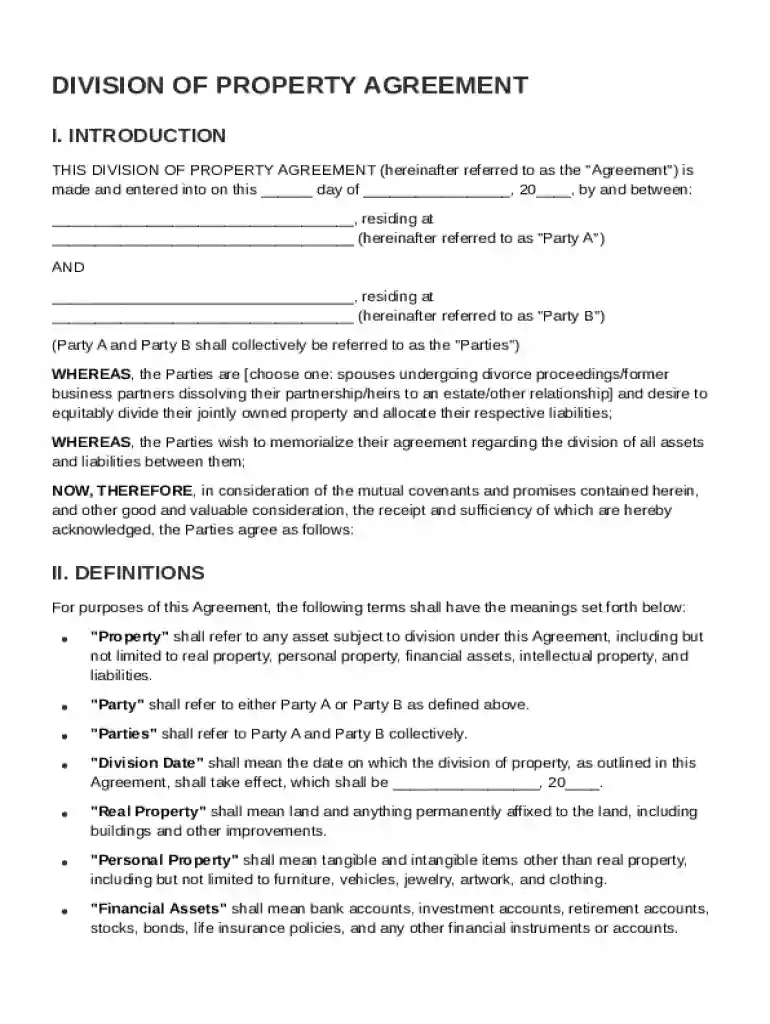
Definition & Meaning
The Division of Property Agreement Template is a legal document used by two parties, typically individuals involved in a partnership or marriage, to delineate the division of jointly owned properties and liabilities upon separation. This agreement helps ensure a mutual understanding and equitable distribution of assets, aligning with legal standards. By clearly defining terms, assets, liabilities, and methods of distribution, it minimizes conflicts and facilitates a smooth transition.
How to Use the Division of Property Agreement Template
Utilizing the Division of Property Agreement Template involves several steps to accurately document the division of property:
- Identify Parties: Begin by clearly specifying the names and details of both parties involved, referred to as Party A and Party B.
- List Assets and Liabilities: Document all joint assets, such as real estate, vehicles, and financial holdings, alongside liabilities like loans or debts.
- Define Distribution: Clearly outline how each asset and liability will be divided between the parties.
- Terms of Transfer: Specify the conditions under which the properties will be transferred and any indemnifications to be provided.
- Dispute Resolution: Agree on a method for resolving potential disputes that may arise after signing.
- Finalize and Sign: Review the document thoroughly before both parties sign to validate the agreement.
Key Elements of the Division of Property Agreement Template
Several critical components should be included in the Division of Property Agreement Template to ensure its effectiveness:
- Identification of Parties: Essential details about Party A and Party B, establishing legal accountability.
- Assets and Liabilities List: Comprehensive enumeration of properties and financial obligations involved.
- Proposed Division: Precise description of the asset allocation and responsibility for liabilities.
- Transfer Terms: Clear terms and conditions regarding how and when assets will be transferred.
- Indemnification: Clauses detailing how each party will protect the other against future claims related to their share.
Steps to Complete the Division of Property Agreement Template
Completing the Division of Property Agreement Template involves a structured approach:
- Information Gathering: Collect detailed information on all jointly owned assets and liabilities.
- Draft the Agreement: Use the template to begin drafting, filling out each section with relevant details.
- Negotiate Terms: Discuss and negotiate terms with the other party to reach a fair division.
- Legal Review: Have the agreement reviewed by a legal professional to ensure compliance with state laws.
- Finalization: Once reviewed and agreed upon, both parties should sign the document in the presence of witnesses if required.
State-Specific Rules for the Division of Property Agreement Template
State laws can significantly influence the provisions within a Division of Property Agreement:
- Community Property States: In states like California and Texas, assets acquired during marriage are generally divided equally unless stated otherwise in a prenuptial agreement.
- Equitable Distribution States: Other states, such as New York and Florida, divide property based on what is deemed fair by the court, which may not always be a 50/50 split.
- Specific Requirements: Each state may have unique requirements regarding notarization or witnesses that must be adhered to for the agreement to be valid.
Legal Use of the Division of Property Agreement Template
For the agreement to hold up legally:
- Consistency with State Laws: The agreement must reflect the property division laws of the state where it is executed.
- Informed Consent: Both parties should understand the terms and implications fully before signing.
- Voluntariness: The document should be entered into voluntarily by both parties, free from any duress or coercion.
Important Terms Related to Division of Property Agreement Template
Understanding key terminologies within the agreement is vital:
- Joint Tenancy: Property owned by both parties jointly with rights to survivorship.
- Tenancy in Common: A shared ownership agreement without survivorship rights.
- Indemnification: A provision where one party agrees to cover potential losses or damages incurred by the other.
- Severability: Ensures that if part of the agreement is invalidated by law, the remainder still stands.
Examples of Using the Division of Property Agreement Template
Real-world scenarios demonstrate the utility of this template:
- Divorce Settlement: A couple uses the template to amicably split properties such as their home, cars, and savings accounts, ensuring no future disputes over ownership or debt responsibilities.
- End of Business Partnership: Two partners utilize the agreement to divide office equipment, financial assets, and outstanding debts when dissolving their business operations.
- Domestic Partnership Dissolution: A couple in a long-term relationship utilizes the arrangement to equitably divide household items and joint financial accounts without involving court proceedings.