01. Edit your form online
Type text, add images, blackout confidential details, add comments, highlights and more.

Type text, add images, blackout confidential details, add comments, highlights and more.

Draw your signature, type it, upload its image, or use your mobile device as a signature pad.

Send it via email, link, or fax. You can also download it, export it or print it out.
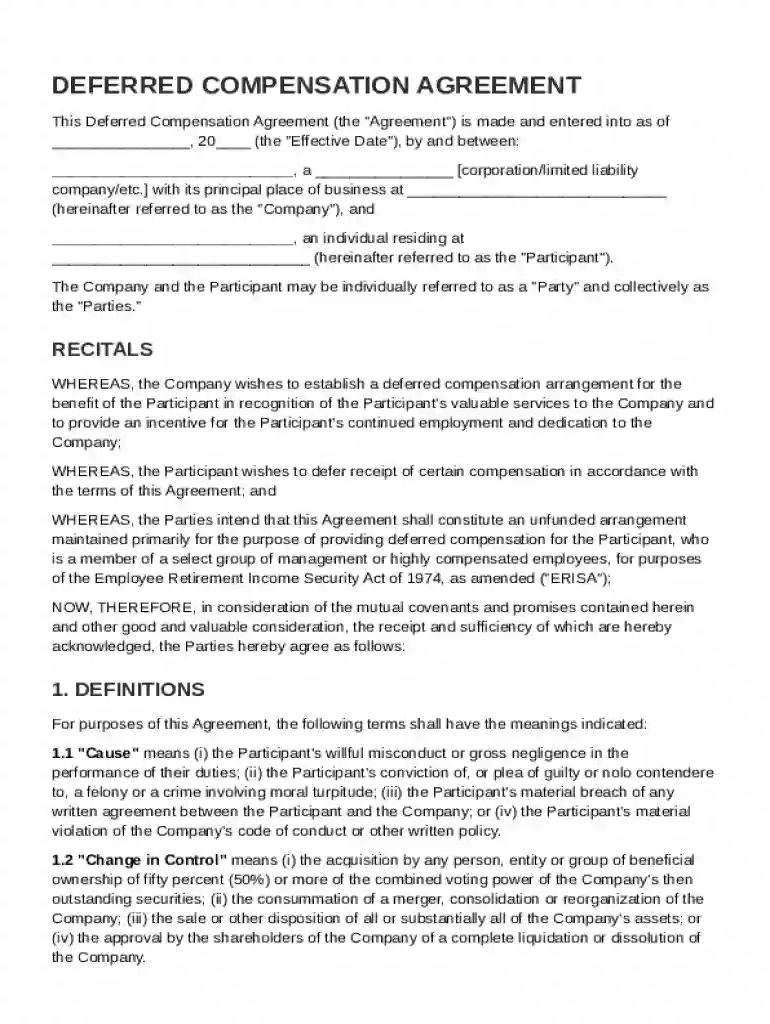
A Deferred Compensation Agreement Template is a contractual document that outlines the terms under which an employee elects to defer a portion of their earned income to be received at a later date, typically during retirement. This agreement is an essential tool for offering supplemental retirement benefits and incentivizing continued employment. It includes detailed parameters such as eligibility criteria, contribution structures, and vesting schedules to ensure clarity and compliance with legal standards like Section 409A of the Internal Revenue Code. Deferred compensation arrangements are generally designed for select management or highly compensated employees, enhancing their financial planning by providing a structured method to plan for future financial needs.
A comprehensive Deferred Compensation Agreement Template contains several critical sections to ensure both the employer’s and the employee’s interests are clearly defined and protected. Key elements generally include:
Completing a Deferred Compensation Agreement Template involves several sequential steps to ensure accuracy and compliance:
The legal application of a Deferred Compensation Agreement Template is centered around its compliance with federal regulations, specifically Section 409A of the Internal Revenue Code. This section governs how deferred compensation plans must operate, detailing guidelines for timing of elections, distributions, and reporting. Violating these rules can lead to penalties, making legal compliance crucial. Companies must ensure that every aspect of the agreement, from definitions to distribution, adheres to these standards, maintaining the agreement's legal enforceability while protecting against potential liabilities.
Several key terms are critical in understanding and using a Deferred Compensation Agreement Template effectively:
State-specific regulations govern certain aspects of deferred compensation plans, particularly around tax treatment and benefits. States such as California may have unique requirements regarding income recognition and tax deductions related to deferred compensation plans. Companies must consider these state-specific rules when drafting agreements to ensure compliance with local laws and avoid any potential legal challenges. Legal counsel familiar with state-specific nuances can provide guidance, ensuring that agreements meet both federal and state legal standards.
The Deferred Compensation Agreement Template can be handled in both digital and paper formats, each with its advantages. Digital versions allow for efficient editing, sharing, and signing via platforms like DocHub, which supports seamless collaboration and secure digital signatures. This electronic handling is especially useful for organizations integrated with the Google ecosystem, as documents can be easily managed and accessed from Google Workspace. Conversely, paper versions remain an option for traditional settings where physical signatures are preferred. However, digital formats tend to offer superior efficiency and traceability compared to their paper counterparts.
The Internal Revenue Service (IRS) provides specific guidelines governing deferred compensation plans, mainly focusing on the compliance requirements under Section 409A. This provision includes rules about how and when employees can elect to defer compensation and the conditions under which these funds can be distributed. It also outlines penalties for non-compliance, such as additional taxes and interest charges on deferred amounts. Organizations must ensure that all deferred compensation arrangements strictly adhere to these IRS guidelines to avoid significant legal repercussions and financial penalties. Legal and tax advisors often play a vital role in interpreting these guidelines and ensuring compliance.
At DocHub, your data security is our priority. We follow HIPAA, SOC2, GDPR, and other standards, so you can work on your documents with confidence.