Book Consignment Agreement Template 2026

Get Form
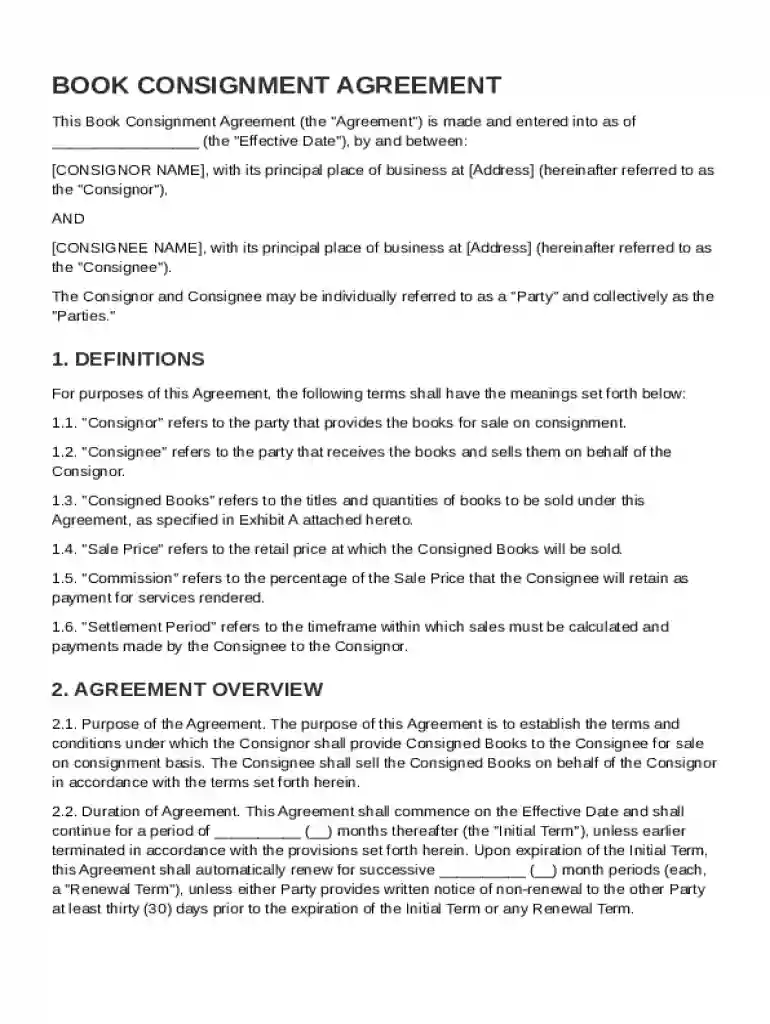
Book Consignment Agreement Template Preview on Page 1

Here's how it works

01. Edit your form online
Type text, add images, blackout confidential details, add comments, highlights and more.

02. Sign it in a few clicks
Draw your signature, type it, upload its image, or use your mobile device as a signature pad.

03. Share your form with others
Send it via email, link, or fax. You can also download it, export it or print it out.

Definition & Meaning

The Book Consignment Agreement Template is a legal document that outlines the relationship between two parties: the consignor, who provides books for sale, and the consignee, who agrees to sell the books on consignment. This arrangement allows the consignor to retain ownership of the books until they are sold, at which point the consignee earns a commission as compensation for their sales services. The agreement clearly delineates responsibilities such as inventory management, sales reporting, and payment schedules, thus providing security and clarity to both parties involved.

Essential Components of the Agreement

  • Consigned Books: Defines the books provided and their condition.
  • Sale Price: The price at which books will be sold, often set by the consignor.
  • Commission: Specifies the percentage of sales retained by the consignee.
  • Payment Terms: Details when and how the consignor will be paid.
  • Inventory Management: Outlines how books are tracked and accounted for.
  • Returns Policy: Procedures in place if books are not sold.

How to Use the Book Consignment Agreement Template

Using the Book Consignment Agreement Template involves a few straightforward steps aimed at protecting both parties. First, both the consignor and consignee must accurately fill out their details, including name, contact information, and business credentials. The template typically provides space for this data at the top of the document.

Step-by-Step Usage

  1. Identify Parties: Clearly indicate the consignor and consignee.
  2. List Books: Provide detailed descriptions of the consigned books.
  3. Agree on Terms: Negotiate the sale price and commission rate.
  4. Sign Agreement: Both parties must sign and date the document.
  5. File the Document: Keep copies for both businesses' records.

Key Elements of the Book Consignment Agreement Template

The Book Consignment Agreement Template includes specific key elements essential for setting a clear understanding between the consignor and consignee. Each element carries its significance in ensuring the transaction is transparent and all terms are enforceable.

Detailed Key Elements

  • Termination Clause: Defines how and under what conditions the agreement can be terminated by either party.
  • Governing Law: Specifies the legal jurisdiction that governs the agreement in case of disputes.
  • Liability Limitations: Limits the liability of each party under various potential issues.
  • Indemnity: Provides protection from losses due to a third party's actions or failures.
  • Miscellaneous Clauses: Covers aspects like force majeure and amendments to the contract.

Legal Use of the Book Consignment Agreement Template

The legal enforceability of the Book Consignment Agreement relies on the proper use of the template, which must be completed in compliance with applicable laws. The agreement supports consignment operations by clearly delineating legal responsibilities and rights.

Points of Legal Importance

  • Adherence to ESIGN Act: Ensure electronic signatures are compliant.
  • Confidentiality: Protect business information shared during the agreement.
  • Compliance with State Laws: Adjust standard terms to fit state-specific legal requirements.

State-Specific Rules for the Book Consignment Agreement Template

While many aspects of a Book Consignment Agreement Template are standard, some elements may vary based on the state where the agreement is executed. Understanding these differences is imperative to ensure compliance.

Considerations for State-Specific Adaptations

  • Sales Tax Obligations: Understand the consignee's responsibility for state sales tax.
  • Regulatory Compliance: Check if state laws impose specific requirements for bookkeeping and reporting.
  • Consumer Protection Laws: Adhere to any state-specific consumer protection regulations impacting the sale or return of books.

Examples of Using the Book Consignment Agreement Template

Real-world scenarios help illustrate how the Book Consignment Agreement Template can be beneficial. By examining various situations, one can gain better insights into its practical applications.

Real-World Scenarios

  • Independent Authors: Use consignment agreements to distribute books in local stores without upfront costs.
  • Schools and Libraries: Partner with local bookstores for book sales during events, using agreements to manage inventory and sales tracking.
  • Online Retailers: Consignees handle listing and selling of books, with consignment agreements defining digital sales terms and conditions.

Important Terms Related to Book Consignment Agreement Template

To fully utilize the Book Consignment Agreement Template, it's essential to understand the terminology used within the document. Knowing these terms ensures all parties are on the same page.

Glossary of Key Terms

  • Consignor: The person or entity providing the books for sale.
  • Consignee: The person or entity responsible for selling the books.
  • Consignment Period: The time frame during which the consignee will attempt to sell the books.
  • Sales Report: A documented summary of sales activities provided to the consignor.
  • Inventory Returns: Procedures for returning unsold books to the consignor.

Digital vs. Paper Version

Understanding the differences between digital and paper versions of the Book Consignment Agreement can help in making a decision on which to use. Each version has its advantages, particularly in how agreements are signed and stored.

Comparison of Formats

  • Digital Version:

    • Enables easy edits and updates.
    • Supports electronic signatures, enhancing efficiency.
    • Facilitates storage and retrieval via cloud systems.
  • Paper Version:

    • Beneficial for face-to-face negotiations.
    • Provides a tactile review experience.
    • Requires manual signatures, possibly slower finalization.
be ready to get more

Complete this form in 5 minutes or less

Get form

Got questions?

We have answers to the most popular questions from our customers. If you can't find an answer to your question, please contact us.
Contact us
Depending on the consignment shop and the item being sold, the seller may concede 25% to 60% of the sales price in consignment fees. Consignment arrangements typically are in effect for a set period of time. After this time, if a sale is not made, the goods are returned to their owner.
How to make a Consignment Agreement Item information. Provide a physical description of the item for sale, including its condition. Party information. Contract and cancellation terms. Fee information. Payment information. Security interest. Storage and delivery information. Dispute resolution.
A consignment sales proposal should include several essential elements: an introduction that outlines the purpose and scope of the proposal, a detailed description of the products being offered, the terms and conditions of the consignment agreement, pricing and payment terms, responsibilities of both the consignor and
What is consignment? When you consign your books to a bookstore, you give the bookseller the right to sell those books on your behalf. If one of your books is sold, the bookseller takes care of the taxes associated with the sale and then splits the revenue according to a predetermined agreement.
An example consignment agreement is one where you are selling something for someone else. You can purchase items from a wholesaler, sell them at your store or online shop and then send the money back to the product owner after taking out your commission fee.

Security and compliance

At DocHub, your data security is our priority. We follow HIPAA, SOC2, GDPR, and other standards, so you can work on your documents with confidence.

Learn more
ccpa2
pci-dss
gdpr-compliance
hipaa
soc-compliance
be ready to get more

Complete this form in 5 minutes or less

Get form

People also ask

In consignment selling, the owner or maker of the items essentially lends them out to a consignment shop, which contracts to sell them at an agreed price, then splits the proceeds in accordance with an agreed formula. As we have seen, a typical consignment percentage is split 60:40 in favour of the seller.
Components of a Consignment Agreement Template Description of goods and terms for selling them. The consignees responsibilities when it comes to the sale, including where they will be sold and when. The consignees commission rate on each sale, along with the payment plan for receiving their money from sales.

Related links