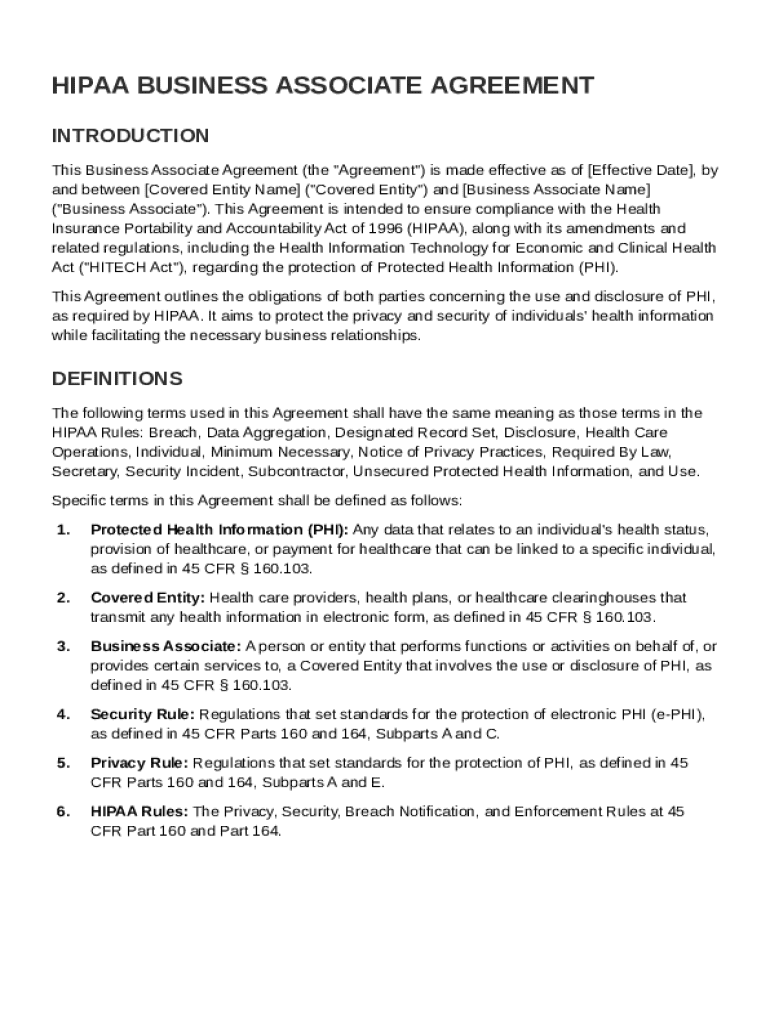







Definition & Meaning
A HIPAA Business Associate Agreement (BAA) is a legally binding document mandated by the Health Insurance Portability and Accountability Act (HIPAA) that outlines the responsibilities and obligations of a Business Associate (BA) when handling Protected Health Information (PHI) on behalf of a Covered Entity. This agreement is essential for ensuring that a BA understands the legal requirements and agrees to safeguard PHI as stipulated under HIPAA and the Health Information Technology for Economic and Clinical Health (HITECH) Act. It establishes clear guidelines on the permissible uses and disclosures of PHI, mandates the implementation of appropriate safeguards, and details the reporting procedures for any breaches of PHI.
Examples of Business Associates that may need to sign a BAA include cloud service providers that store health data, law firms offering legal consultation services involving PHI, and accounting firms handling PHI for billing purposes. Each type of BA must comprehend and comply with the terms set forth in the BAA to avoid significant legal and financial penalties.
Key Elements of the HIPAA Business Associate Agreement Template
A comprehensive BAA template includes several critical elements that ensure compliance with HIPAA regulations:
-
Definitions: Clearly defines key terms such as "Covered Entity," "Business Associate," and "Protected Health Information."
-
Permitted Uses and Disclosures: Specifies how a BA may use or disclose PHI and any restrictions on such actions, aligning with the minimum necessary standard required by HIPAA.
-
Safeguards: Mandates the implementation of technical, physical, and administrative safeguards to protect the integrity, confidentiality, and availability of PHI.
-
Breach Notification: Outlines the procedures for notifying the Covered Entity in the event of a PHI breach, including timelines and the information required in the notification.
-
Subcontractor Compliance: Ensures that any subcontractors or agents of the BA also adhere to HIPAA requirements, safeguarding PHI in their possession.
-
Term and Termination: Details the duration of the agreement and the conditions under which it may be terminated, including the handling of PHI post-termination.
-
Governing Law: Identifies the legal jurisdiction governing the agreement, often aligning with the state in which the Covered Entity is located.
Steps to Complete the HIPAA Business Associate Agreement Template
-
Gather Information: Collect necessary details about both the Covered Entity and the Business Associate, including contact information and the nature of the relationship.
-
Review and Customize: Examine the BAA template thoroughly, ensuring it aligns with the specific needs and legal requirements of both parties. Customize sections as needed to reflect the terms of the agreement accurately.
-
Define Terms and Conditions: Clearly define all relevant terms, ensuring that both parties understand their roles, responsibilities, and the scope of PHI usage and protection.
-
Specify Safeguards: Detail the specific safeguards that the BA will implement to protect PHI, including any encryption, access controls, and policies for handling data breaches.
-
Signatures and Authorization: Obtain signatures from authorized representatives of both the Covered Entity and the Business Associate, formally executing the agreement.
-
Record Keeping: Maintain a copy of the signed agreement for compliance audits and reference in case of disputes or breaches.
Important Terms Related to HIPAA Business Associate Agreement Template
Understanding specific terminology is crucial for effectively using and complying with a BAA:
-
Covered Entity: A healthcare provider, health plan, or healthcare clearinghouse that requires a BAA with any entity performing services on its behalf involving PHI.
-
Business Associate: Any individual or entity that performs functions or activities on behalf of a Covered Entity that involve the use or disclosure of PHI.
-
Protected Health Information: Individually identifiable health information transmitted or maintained in any form or medium.
-
Minimum Necessary Standard: A key principle requiring that only the minimum necessary PHI be accessed or disclosed to accomplish the intended purpose.
-
Safeguards: Measures taken to protect PHI, including administrative, technical, and physical safeguards.
Legal Use of the HIPAA Business Associate Agreement Template
BAAs are legal instruments that must adhere to the stringent requirements set forth by HIPAA. They serve as a critical component in ensuring that PHI is handled responsibly and that the privacy rights of individuals are preserved.
-
Compliance: BAAs enable compliance with HIPAA, providing a legal framework for PHI handling.
-
Liability Protection: Protects both Covered Entities and BAs by delineating specific responsibilities and liability for PHI protection.
-
Breach Mitigation: Establishes procedures for breach notification, helping to mitigate potential damages and ensure timely responses.
Regular legal review of BAAs is advisable to ensure continued compliance with any updates in HIPAA or HITECH regulations, reflecting the current legal environment.
Who Typically Uses the HIPAA Business Associate Agreement Template
BAAs are primarily used by entities that qualify as Covered Entities or Business Associates under HIPAA:
-
Hospitals and Clinics: Healthcare providers that engage BAs to perform services involving PHI.
-
Insurance Companies: Health plans that outsource functions such as claims processing or analytics.
-
Third-Party Service Providers: IT companies, consultants, and other service providers dealing with PHI on behalf of healthcare organizations.


Examples of Using the HIPAA Business Associate Agreement Template
Consider several scenarios where a BAA is essential:
-
Cloud Hosting Services: A healthcare provider contracts with a cloud service to store patient records. A BAA is necessary to ensure compliance with HIPAA and secure the data stored in the cloud.
-
Legal Consultation: A law firm advises a healthcare clinic on compliance issues involving patient data. They must sign a BAA to access and use PHI legally.
-
Billing and Payment Processing: A company provides billing services for a hospital and needs access to PHI to perform its duties. A BAA defines how they can handle this information.
In each example, the BAA ensures that the PHI is used appropriately and that the responsibilities of each party are explicitly defined.
Software Compatibility
DocHub provides a platform that simplifies the creation, editing, and management of BAAs, offering tools for efficient document workflows. It supports various file formats, enabling users to customize and collaborate on agreements seamlessly. The platform's integration with storage services like Google Drive and Dropbox ensures easy access and sharing of documents, facilitating the timely completion and execution of BAAs. Additionally, DocHub's electronic signature capabilities ensure these agreements are legally binding and easily manageable.
Penalties for Non-Compliance
Failure to comply with HIPAA, including the lack of a valid BAA where required, can result in severe penalties:
-
Monetary Fines: Non-compliance can lead to fines ranging from $100 to $50,000 per violation, with an annual maximum of $1.5 million per violation category.
-
Reputational Damage: Breaches and non-compliance can harm an organization's reputation, especially in healthcare, where trust is paramount.
-
Legal Consequences: Potential legal action from affected parties can arise if PHI is mishandled or improperly secured.
Ensuring that a comprehensive BAA is in place helps mitigate these risks and demonstrates a commitment to lawful PHI management.