






Definition & Meaning
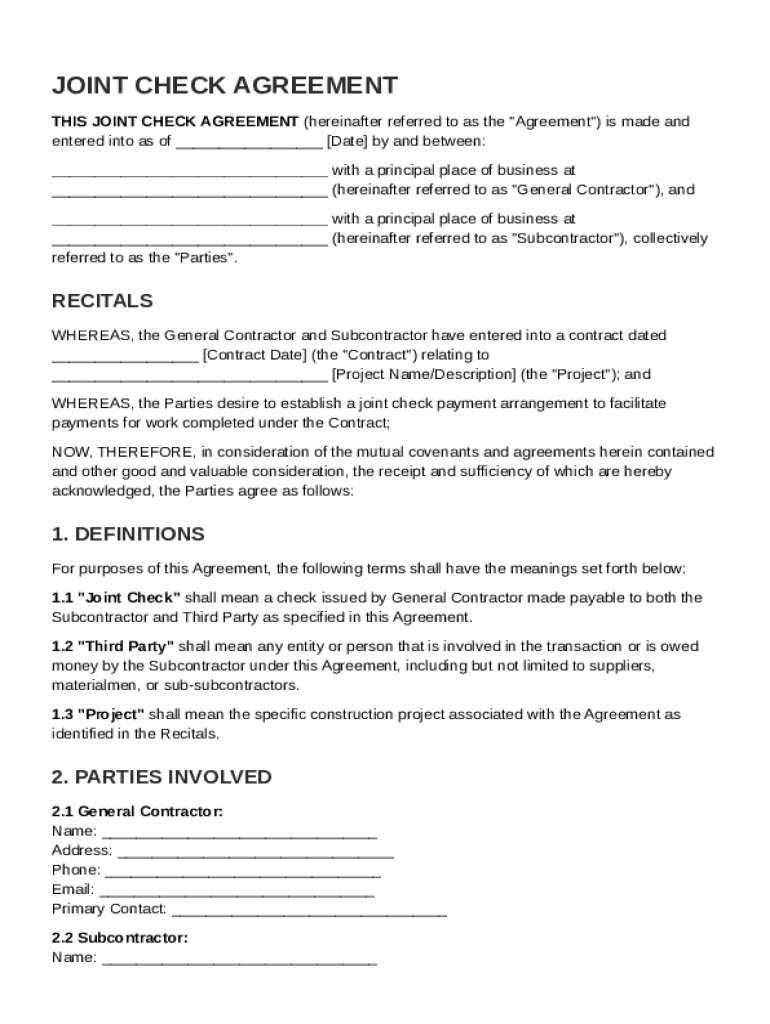
A Joint Check Agreement Template is a legal document used primarily in the construction industry to establish a joint payment arrangement between a general contractor and a subcontractor, typically involving a third-party supplier. This agreement ensures that all parties receive their due payments and outlines responsibilities, payment conditions, and dispute resolution procedures. The template serves as a formal record for all involved parties, clarifying terms to prevent misunderstandings and to provide legal backing in case of discrepancies.
Key Elements of the Joint Check Agreement Template
The Joint Check Agreement Template should include several essential components to ensure legal compliance and effectiveness:
- Identification of Parties: Clearly list the names and contact information of the general contractor, subcontractor, and any third-party suppliers.
- Project Details: Provide a detailed description of the construction project, including location, scope, and timeline.
- Payment Terms: Outline how payments will be distributed among parties, including the schedule, amounts, and conditions for joint checks issuance.
- Responsibilities and Obligations: Define the specific roles and responsibilities of each party involved in the project.
- Dispute Resolution: Specify procedures for resolving any conflicts or disputes, including mediation or arbitration clauses if applicable.
Legal Use of the Joint Check Agreement Template
The Joint Check Agreement Template must be used in a manner consistent with legal standards to ensure enforceability:
- Compliance with State Laws: Adapt the template to align with state-specific construction and contract laws, ensuring all legal requirements are met.
- Binding Terms: Ensure that all parties agree to the terms within the agreement, including signatures from authorized representatives.
- Record Keeping: Maintain a copy of the signed agreement for reference in case of disputes or audits.
How to Use the Joint Check Agreement Template
To effectively use the Joint Check Agreement Template, follow these steps:
- Gather Information: Compile details about the parties involved, the project scope, and payment terms.
- Customize the Template: Fill in the sections of the template with the collected information, ensuring completeness and accuracy.
- Review and Revise: Carefully review the template for any errors or omissions and make necessary adjustments.
- Seek Legal Counsel: Consider having a legal professional review the completed template to ensure compliance and adequacy.
- Execute the Agreement: Obtain signatures from all involved parties, and distribute copies for their records.
State-Specific Rules for the Joint Check Agreement Template
State-specific regulations can influence the preparation and application of a Joint Check Agreement Template:
- Lien Laws: Different states have varying laws regarding mechanics liens, which can affect how joint check agreements are utilized.
- Specific Requirements: Some states may require particular clauses or disclosures to be included in joint check agreements to remain compliant.
- Legal Precedents: Be aware of any state-specific legal precedents that could impact the enforceability of the agreement.
Who Typically Uses the Joint Check Agreement Template
Various professionals in the construction industry commonly utilize the Joint Check Agreement Template:
- General Contractors: Use the template to ensure direct payment to subcontractors and suppliers.
- Subcontractors: Engage in joint check agreements to secure payments and establish clear financial arrangements with contractors.
- Suppliers: Use this agreement as a guarantee of payment for materials supplied on credit.


Steps to Complete the Joint Check Agreement Template
Completing the Joint Check Agreement Template involves several key steps:
- Information Collection: Gather all necessary project-related details and party information.
- Template Customization: Fill in the agreement sections with specifics pertaining to the project and payment terms.
- Verification: Ensure the accuracy of all entered details and make necessary corrections.
- Review by Legal Advisor: Optionally, have the agreement reviewed by a legal expert to confirm compliance.
- Finalization and Signing: Obtain signatures from all parties and distribute copies for their records.
Examples of Using the Joint Check Agreement Template
Real-world scenarios provide insight into the application of the Joint Check Agreement Template:
- Settlement of Payment Disputes: In cases where subcontractors and suppliers have payment conflicts, a joint check agreement can streamline resolution by ensuring direct payment distribution.
- Credit Extension to Subcontractors: Suppliers may use joint check agreements to extend credit to subcontractors, knowing that payment will be secured through joint checks.
- Project-Specific Payment Arrangements: Tailored joint check agreements for unique or large-scale construction projects to manage financial flow and responsibilities efficiently.
Penalties for Non-Compliance
Failing to adhere to the terms outlined in a Joint Check Agreement can lead to significant penalties:
- Legal Consequences: Non-compliance may result in legal disputes, lawsuits, or judgements against the offending party.
- Financial Liabilities: Parties may incur financial penalties, be required to pay damages, or face additional costs from delayed payments.
- Reputation Damage: Breaching agreement terms can harm a party's credibility and future business opportunities within the construction industry.