




01. Edit your form online
Type text, add images, blackout confidential details, add comments, highlights and more.

Type text, add images, blackout confidential details, add comments, highlights and more.

Draw your signature, type it, upload its image, or use your mobile device as a signature pad.

Send it via email, link, or fax. You can also download it, export it or print it out.
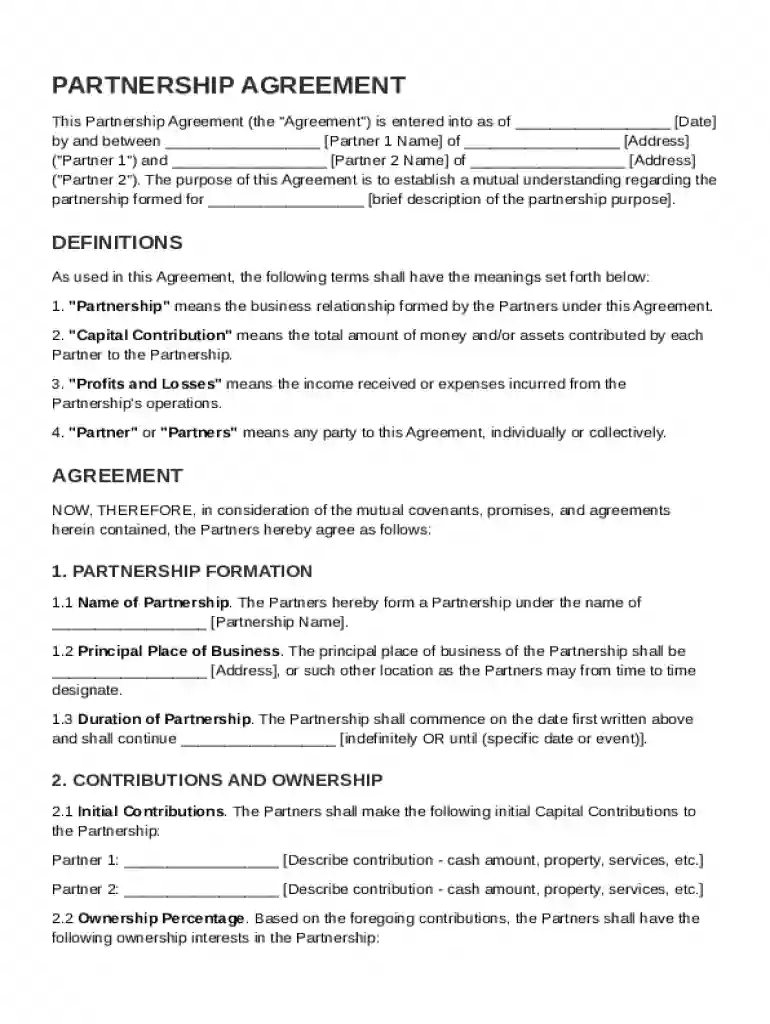
A Written Partnership Agreement Template serves as a foundational document outlining the terms and conditions governing a business partnership between two or more entities. It defines key concepts such as partnership formation, capital contributions, management roles, and profit distribution. By establishing clear guidelines, this template provides a framework for the partners to operate collaboratively while protecting individual interests.
To utilize the template effectively, partners need to personalize the document to reflect their specific business relationship. This involves filling in sections with relevant information such as partner names, contribution amounts, and management structures.
The template includes several essential sections that must be tailored to the partnership's unique needs. Each element serves a critical role in ensuring legal and operational clarity.
The template is designed to be legally binding and should comply with relevant laws within the United States. It ensures that all aspects of the partnership are documented and agreed upon in writing.
This template is most commonly used by small business owners, start-ups, and corporations seeking to establish a formal partnership structure. It is essential for any business venture that involves shared ownership and responsibilities.


While the template provides a general framework, partners must consider state-specific laws and regulations that may affect their agreement. Each state in the U.S. may have unique requirements for partnerships.
Though a Written Partnership Agreement Template itself is not typically issued by a governmental agency, it can be crafted with assistance from legal professionals to ensure compliance with applicable laws.
Failure to establish a proper partnership agreement can lead to disputes, financial losses, and legal penalties. Non-compliance with applicable laws can expose partners to unnecessary risks.
At DocHub, your data security is our priority. We follow HIPAA, SOC2, GDPR, and other standards, so you can work on your documents with confidence.


May 8, 2026 NGO-business partnerships ➜ Definition meaning ✔️ Implementation action plan ✔️ Drivers barriers✔️ Examples case studies
1. The Offer shall be made by the Offering Partner first to the Partnership by written notice (hereinafter referred to as the Offering Notice). WithinRead more


