







Definition & Meaning
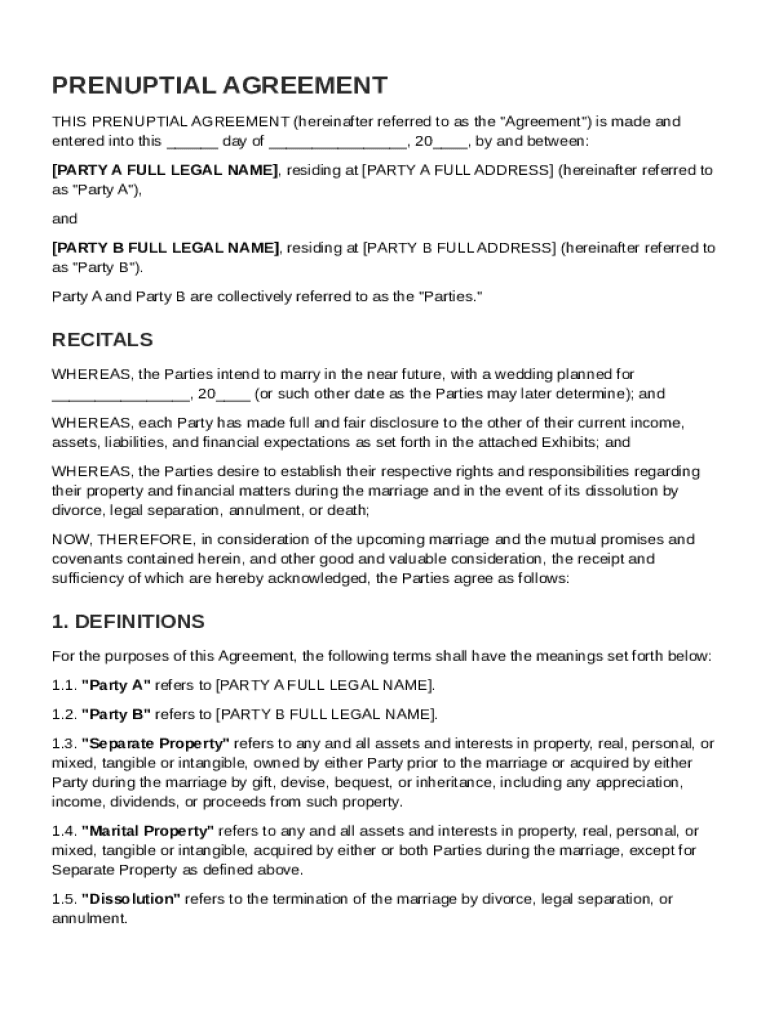
A prenuptial agreement, often referred to as a "prenup," is a legally binding document established between two individuals prior to their marriage. This document defines the distribution of property, assets, and financial responsibilities in case of a divorce or separation. The agreement serves to distinguish between marital and separate property, providing clarity and protection for both parties involved. In the United States, a prenup can cover alimony terms, debt responsibilities, and may include provisions for amendments and dispute resolution. Ensuring full disclosure of assets from both parties is a crucial component, as is the need for each party to seek independent legal advice before signing.
How to Use the Prenup Agreement Template
Using a prenup agreement template involves several key steps to ensure the document is comprehensive and legally binding. Initially, both parties should list all assets, liabilities, income, and expected inheritances. This full disclosure is critical for the agreement's enforceability. Next, the parties should individually and jointly consider their objectives and expectations regarding asset division, alimony, and other financial matters. Once these elements are clarified, they can employ the prenup template to draft the document, customizing sections as needed. Both parties must review the draft with independent legal counsel to ensure the agreement's fairness and adherence to state laws.
Steps to Complete the Prenup Agreement Template
-
Complete Financial Disclosures: Begin by compiling detailed lists of all assets, debts, and income sources for both parties. This includes bank accounts, properties, investments, and liabilities.
-
Define Marital and Separate Property: Clearly outline which assets will be considered separate property and which will be deemed marital property.
-
Establish Alimony and Debt Rules: Detail provisions for spousal support and how debts incurred before and during the marriage will be handled in the event of separation.
-
Consult with Legal Advisors: Before finalizing any terms, each party should engage independent legal counsel to ensure that their rights are protected and the document complies with state laws.
-
Review and Sign: Both parties should thoroughly review the completed document with their attorneys. Once everything is agreed upon, the parties sign the document in front of a notary.
Key Elements of the Prenup Agreement Template
-
Identification of Parties: Include full legal names and addresses of both parties involved in the agreement.
-
Property Lists: Detailed listings of all properties and assets, dividing them into marital and separate categories.
-
Spousal Support Terms: Define terms for potential alimony, including conditions and amounts, if applicable.
-
Debt Obligations: Specify how existing and future debts will be managed during and after the marriage.
-
Modification Clauses: Include conditions under which the agreement can be modified or revoked.
Legal Use of the Prenup Agreement Template
A prenuptial agreement must adhere to state-specific legal requirements to be enforceable. Legal counsel is essential in ensuring the prenup meets all procedural standards. This includes the requirement for full financial disclosure by both parties and that both parties enter into the agreement voluntarily. Additionally, the prenup should be fair and equitable to avoid being declared void by a court. Independent legal advice is recommended to ensure each party fully understands the implications of the agreement, further cementing its viability in a legal setting.
State-Specific Rules for the Prenup Agreement Template
Each state in the United States may have varied requirements regarding prenuptial agreements. For example, some states have specific mandates around spousal support waivers and child custody decisions that cannot be outlined in a prenup. Community property states, like California and Nevada, have different asset division rules compared to equitable distribution states. Parties should consult state-specific laws or a local attorney to ensure their agreement aligns with regional legal standards and remains enforceable within their jurisdiction.
Who Typically Uses the Prenup Agreement Template
Prenup agreements are predominantly used by individuals entering into marriage who wish to define financial boundaries distinctly before tying the knot. This includes professionals with significant assets, such as real estate, stock holdings, or business ownership, who seek to protect their wealth. Couples who have children from previous relationships might also use a prenup to ensure children’s future inheritances are safeguarded. Additionally, individuals entering a second or subsequent marriage often use prenups to establish financial terms distinct from their previous marriage experiences.


Important Terms Related to Prenup Agreement Template
-
Full Disclosure: The requirement for both parties to completely reveal their financial situations, including all assets and liabilities.
-
Marital Property: Assets acquired during the marriage that are subject to division upon divorce.
-
Separate Property: Assets owned by one spouse prior to marriage or acquired through gifts or inheritance, typically exempt from division.
-
Alimony: Financial support that one spouse may be required to provide the other post-divorce.
-
Equitable Distribution: A legal principle where marital property is divided according to fairness, rather than a strict 50/50 split, in non-community property states.
Examples of Using the Prenup Agreement Template
Prenuptial agreements are versatile and can be structured to suit various needs and scenarios. For instance, a high-net-worth individual might stipulate that their business interests remain separate property, ensuring control and ownership do not shift upon divorce. Alternatively, a couple might agree to keep inheritances as individual property while merging all income earned during the marriage as communal. Couples each bringing significant debt into a marriage may outline responsibility for debt repayment to avoid future conflicts. These examples demonstrate how prenup agreements can be tailored to foresee a wide range of financial and personal circumstances.


