




01. Edit your form online
Type text, add images, blackout confidential details, add comments, highlights and more.

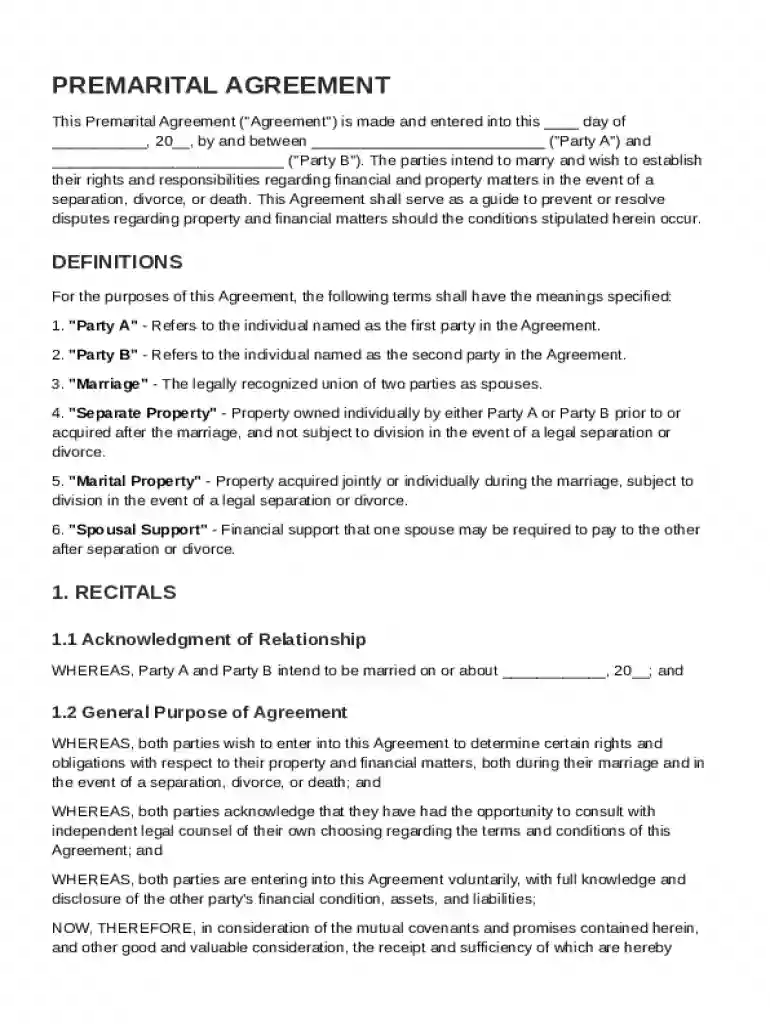
Type text, add images, blackout confidential details, add comments, highlights and more.

Draw your signature, type it, upload its image, or use your mobile device as a signature pad.

Send it via email, link, or fax. You can also download it, export it or print it out.
A premarital agreement, often referred to as a prenuptial agreement or prenup, is a legally binding contract entered into by two individuals prior to marriage. This document outlines the financial and property rights of each party in the event of separation, divorce, or death. It typically covers areas like asset division, debt responsibility, spousal support, and property ownership to prevent future disputes. In the context of a "Premarital Agreement Template," the template serves as a foundational document that couples can personalize to suit their specific circumstances, ensuring both parties have a clear understanding of their rights and obligations.
A crucial component of any premarital agreement is the full and transparent disclosure of assets by both parties. This section requires each individual to list their separate property, including real estate, investments, bank accounts, and any other significant assets. This disclosure helps establish what constitutes separate versus marital property, thereby reducing potential legal challenges should the agreement be contested in court.
The property division section specifies how marital and separate properties will be allocated in the event of a divorce or separation. This includes delineation of real estate ownership, allocation of jointly-held assets, and distribution of personal property. The template may contain provisions for splitting shared assets equitably or according to a predetermined formula agreed upon by both parties.
Another critical element involves clauses related to spousal support, also known as alimony. The premarital agreement can stipulate whether support will be waived or provided upon divorce, including the amount and duration. Waiving spousal support must be done voluntarily and without coercion to be legally enforceable, highlighting the importance of each party fully understanding the implications of such waivers.
Review Template Content
Gather Necessary Information
Consult Legal Counsel
Draft Customizations
Review and Discuss Draft
Finalize and Notarize
Premarital agreements must comply with the specific legal requirements of the state where they are executed. This includes mandatory provisions like being in writing, signed by both parties, and acknowledged before a notary. State laws also dictate the enforceability of certain clauses, such as those waiving spousal support or dictating child custody arrangements, which may be scrutinized for fairness and voluntariness.
For a premarital agreement to be enforceable, neither party should face any form of duress or undue influence during the signing. Courts will assess whether each party had ample time to consider the agreement and obtain independent legal advice, as well as whether there was full and honest disclosure of assets. If these conditions are not met, parts or all of the agreement may be invalidated by a court.
In states like California, Texas, and Washington, which follow community property rules, all property acquired during the marriage is considered equally owned by both spouses. Other states follow equitable distribution, where property is divided fairly but not necessarily equally. Couples can use the premarital agreement to outline how they wish to manage these differences, designating property ownership and division methods that diverge from default state laws.
While premarital agreements can cover many aspects of financial arrangements, they cannot determine child custody or support arrangements, which are always subject to court determination based on the best interests of the child. Couples should be aware of these limitations when drafting agreements to avoid including unenforceable provisions.
Defined as property owned by one party prior to marriage or acquired individually through gifts or inheritance, separate property remains outside the marital estate unless commingled with joint assets. The template provides a framework for identifying and preserving separate property rights.
Typically includes property acquired by either spouse during the marriage, excluding separate property. The agreement should detail how marital property will be divided or treated in the event of divorce.
Including a clause that mandates arbitration for any disputes arising from the agreement can provide a more efficient and private resolution process compared to litigation. This section outlines the method and authority for resolving disagreements, helping to reduce conflict and legal expenses down the line.
Couples with substantial individual assets might use the premarital agreement to delineate clear ownership of valuable assets like real estate portfolios and stock options. This helps in maintaining control over their property and ensures a sense of financial security.
In scenarios where one or both parties have children from previous relationships, a premarital agreement can clarify inheritance expectations and protect the financial interests of children from prior unions, securing a balanced and predetermined distribution of assets.
For couples where one or both parties are business owners, the agreement clarifies the ownership of business interests, ensuring that the enterprise’s operation is unaffected by potential marital dissolution and safeguarding business continuity.
Digital versions of the premarital agreement template provide ease of access and flexibility, allowing parties to make real-time edits and updates. Platforms like DocHub, with robust security features, ensure that sensitive information remains protected throughout the drafting and signing process.
While digital convenience is undeniable, maintaining a paper copy of the signed agreement remains crucial. Paper versions provide a tangible record that can be securely stored and easily accessed for reference or in legal matters.
At DocHub, your data security is our priority. We follow HIPAA, SOC2, GDPR, and other standards, so you can work on your documents with confidence.




Find family law agreement forms, including premarital, separation, and marital settlement agreements, cohabitation and postnuptial agreements.Read more
6 days ago It contains form templates and drafting guides for many common family law actions. Prenuptial agreements : how to write a fair and lastingRead more


