






Definition and Meaning
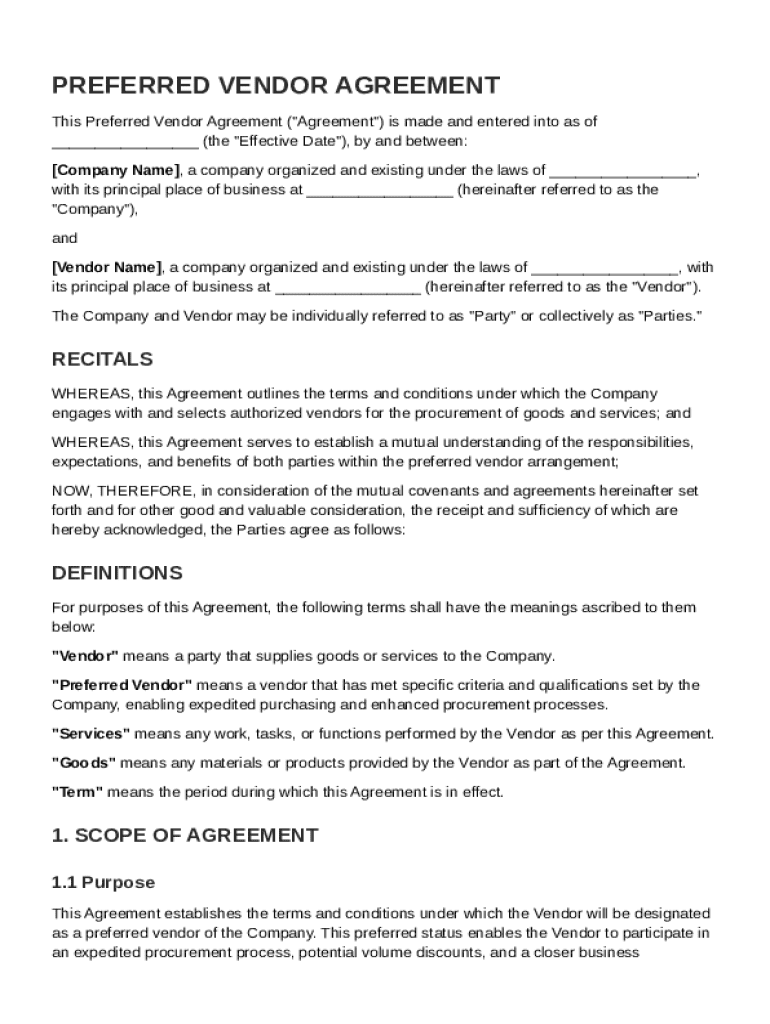
A Preferred Vendor Agreement Template is a structured document used to formalize the relationship between a company and its preferred vendor. It outlines the framework for the partnership, ensuring both parties understand their roles, responsibilities, and expectations. This agreement typically includes various clauses related to pricing, performance standards, delivery schedules, and quality assurances. For businesses, this template serves as a crucial tool for managing vendor relationships, streamlining procurement processes, and ensuring compliance with corporate policies and legal requirements. It helps prevent misunderstandings by providing a clear reference for both parties.
Key Components
- Eligibility Criteria: Defines what qualifies a vendor to become a preferred partner.
- Payment Terms: Specifies timing, method, and conditions under which payments are made.
- Responsibilities: Outlines the duties each party must fulfill.
- Confidentiality Obligations: Describes the measures to protect sensitive information.
- Dispute Resolution: Details mechanisms for resolving conflicts that may arise.
Uses of the Preferred Vendor Agreement Template
This template is instrumental in establishing consistent operational procedures between companies and vendors. By setting predefined standards, the companies can ensure quality while benefiting from potential cost reductions due to preferred vendor statuses. Typically used by procurement departments, it allows for simplified vendor management and enhances relationship-building efforts. Additionally, it delivers a concrete legal framework which protects both parties from potential legal disputes, demonstrating its critical role in operational effectiveness.
Practical Applications
- Common in Industries: Highly utilized within industries such as manufacturing, retail, and technology where consistent supply chain practices are vital.
- Vendor Evaluation: Aids in assessing and onboarding new vendors by outlining clear criteria and evaluation metrics.
- Performance Tracking: Useful for monitoring vendor performance against established benchmarks.
Steps to Complete the Preferred Vendor Agreement Template
Filling out the Preferred Vendor Agreement Template accurately is crucial to its effectiveness. The process involves several key steps:
- Identify Vendor Details: Start by entering the vendor's legal name, contact information, and relevant business details.
- Outline Scope of Work: Clearly specify the products or services to be supplied.
- Set Terms and Conditions: Agree on payment terms, delivery timelines, and quality standards.
- Incorporate Confidentiality Clauses: Ensure the document includes provisions to safeguard proprietary information.
- Determine Dispute Resolution Procedures: Decide on methods for resolving potential conflicts, such as mediation or arbitration.
- Finalize and Sign: Both parties review the document, make necessary amendments, and sign to formalize the agreement.
Detailed Consideration
- Customization: Tailor each section to reflect the specifics of the vendor's products or services.
- Legal Consultation: Involve a legal professional to ensure compliance with relevant regulations and industry norms.
Key Elements of the Preferred Vendor Agreement Template
The effectiveness of the preferred vendor agreement heavily depends on its core elements, which should be comprehensive and tailored to the business needs.
Crucial Sections
- Terms of Engagement: Detailed descriptions of scope, timelines, and expectations.
- Termination Clauses: Clear conditions under which the agreement can be concluded.
- Intellectual Property Rights: Clarifications on ownership of developed or shared intellectual property.
Additional Provisions
- Audit Rights: Allows for performance evaluations through audits, ensuring accountability.
- Insurance Requirements: Ensures vendors maintain necessary insurance coverage for their activities.
Who Typically Uses the Preferred Vendor Agreement Template
Organizations of various sizes and types rely on this template to efficiently manage vendor partnerships, ranging from small businesses to multinational corporations. Procurement departments, legal teams, and operations managers are among the primary users, leveraging the template to maintain consistent and reliable supplier relationships.


Diverse User Base
- Corporations: Utilize this template to secure favorable terms with key suppliers.
- Government Agencies: Apply standardization in procurement processes, facilitating vendor compliance.
- Nonprofits: Use agreements to streamline material acquisition while maintaining ethical considerations.
Legal Use of the Preferred Vendor Agreement Template
The template serves as a legal instrument, clarifying mutual obligations and protecting both parties legally. It should adhere to regional and federal laws in the U.S. to ensure enforceability. The document must adhere to general contract law principles, ensuring all terms are clear and both parties agree to them voluntarily.
Key Legal Aspects
- Compliance with U.S. Laws: Must reflect applicable commercial codes and business practices specific to the United States.
- Binding Commitment: The agreement once signed, constitutes a legal bond between the company and vendor.
Examples of Using the Preferred Vendor Agreement Template
Real-world applications showcase the versatility and importance of the preferred vendor agreement in facilitating negotiated terms and maintaining supplier relationships.
Case Studies
- Tech Companies: Use the template to negotiate hardware supply terms essential for production lines.
- Retailers: Establish agreements with apparel manufacturers to secure continuous inventory at optimized prices.
Outcomes
- Efficiency in Operations: Ensures clarity and predictability in supply chains, leading to cost savings and improved service quality.
- Risk Mitigation: Proactively addresses potential legal disputes by providing a detailed contingency framework.
Important Terms Related to Preferred Vendor Agreement Template
Understanding specific terms within the agreement is vital to ensuring all stakeholders are on the same page. Precise terminology helps prevent misunderstandings and ensures the agreement is applied correctly.
Notable Terms
- Net Payment Terms: Indicates the period vendors have to invoice payments post-delivery.
- Service Level Agreements (SLAs): Detailed metrics to measure service performance.
- Force Majeure: Situations outside a party's control that may impact fulfillment of obligations.
Clarifications
- Indemnity Clauses: Protect parties from certain risks by specifying responsibility for damages.
- Confidentiality Agreements: Obligations to protect shared proprietary or sensitive information.