




01. Edit your form online
Type text, add images, blackout confidential details, add comments, highlights and more.

Type text, add images, blackout confidential details, add comments, highlights and more.

Draw your signature, type it, upload its image, or use your mobile device as a signature pad.

Send it via email, link, or fax. You can also download it, export it or print it out.
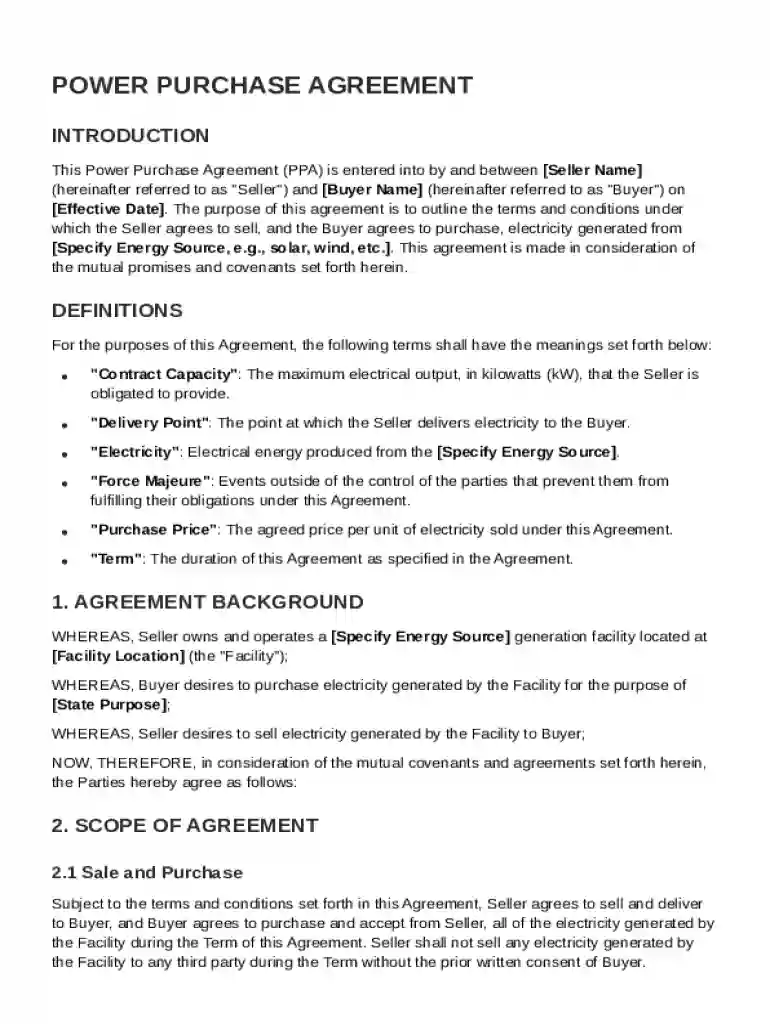
A Power Purchase Agreement (PPA) is a legal contract between a seller and a buyer for the sale and purchase of electricity generated from a specified energy source. This form outlines the obligations of both parties concerning the electricity’s quantity, delivery schedule, and price. By establishing clear terms and conditions, the agreement ensures a structured transaction process. Typically, the seller is a power generator, and the buyer is a utility company or a large power consumer. The PPA serves to facilitate large-scale energy projects by providing a reliable financial framework and is crucial in renewable energy markets.
The Power Purchase Agreement Template contains numerous essential elements, such as:
Definitions and Interpretations: This section clarifies specific terms used throughout the agreement to prevent ambiguity, ensuring all parties have a mutual understanding.
Scope and Nature of Agreement: It outlines the nature and extent of the services provided, including start dates, duration, and conditions for renewal.
Financial Provisions: Discusses pricing mechanisms, payment terms, and any adjustments based on market conditions or regulatory changes.
Obligations of Parties: Details the responsibilities of the seller and buyer to fulfill the contractual terms, including electricity production estimates and consumption forecasts.
Force Majeure: Provisions for unforeseen circumstances that may affect the contractual obligations, such as natural disasters or regulatory changes.
Termination Conditions: Specifies the conditions under which the agreement can be terminated by either party, along with any financial penalties or obligations.
Completing a Power Purchase Agreement Template involves several methodical steps:
Initial Preparation: Gather all necessary information regarding the electricity project, including parties involved, project timelines, and expected output.
Template Customization: Tailor the template to fit unique contractual needs by filling out sections on terms, delivery schedules, and pricing.
Review Key Provisions: Ensure each provision reflects the mutual understanding of both parties and aligns with current legal standards.
Seek Legal Advice: Have a legal professional review the agreement to ensure compliance with state, federal regulations, and contractual obligations.
Finalize and Sign: Once both parties agree to the terms, execute the document with signatures from the authorized representatives.
Distribution and Recording: Distribute the signed copies to all relevant stakeholders and maintain records for future reference.
The Power Purchase Agreement Template is utilized within the legal framework that governs commercial contracts and energy transactions. It complies with federal regulations such as the Federal Energy Regulatory Commission (FERC) guidelines and the Public Utility Regulatory Policies Act (PURPA). Ensuring legal compliance requires collaboration with experience in energy law, familiarity with regional regulatory requirements, and adherence to environmental standards. Legal teams should review provisions related to regulatory approval, terms of service, and dispute resolution to minimize the risk of legal disputes.
State-specific rules can significantly affect the execution and obligations under a Power Purchase Agreement:
Renewable Portfolio Standards (RPS): Certain states have mandates requiring a specific percentage of electricity to come from renewable sources, influencing contract terms in PPAs.
Interconnection Standards: States may have unique interconnection regulations that dictate how energy producers connect to the grid, affecting the operational logistics of the PPA.
Regulatory Approvals: State public utility commissions may require additional approvals or notifications for PPAs, particularly for large-scale energy projects.
Understanding key terms is crucial for anyone working with a Power Purchase Agreement Template:
Capacity Payment: A fixed payment meant to cover the costs of maintaining the energy production capacity.
Energy Charge: Variable payments based on the actual energy produced and delivered.
Curtailment Clause: Provisions allowing the buyer to reduce electricity purchases under specific conditions without penalty.
Dispatchability: The ability of the power producer to adjust output levels as requested by the power grid operator.
Levelized Cost of Energy (LCOE): A measure of the total cost of building and operating a power plant, divided by the total energy output over its lifetime.
Various entities are users of the Power Purchase Agreement Template:
Utility Companies: These buyers often lock in long-term energy supplies through PPAs to ensure stable electricity prices and secure energy supply.
Renewable Energy Developers: Sellers that develop wind, solar, or other renewable projects use PPAs to secure funding and make projects financially viable by guaranteeing a revenue stream.
Large Corporations: Firms with significant energy demands use PPAs to secure renewable energy to meet sustainability goals and achieve predictable energy pricing.
Government Entities: Local or federal agencies may use PPAs to promote renewable projects and stabilize energy procurement costs.


Using the Power Purchase Agreement Template encompasses diverse scenarios:
Renewable Energy Projects: Developers use PPAs to secure financing for solar farms by ensuring a committed buyer for the produced electricity.
Corporate Sustainable Energy Goals: A tech company enters into a PPA to purchase solar power, thus reducing its carbon footprint in compliance with environmental goals.
Community Energy Initiatives: Local governments may engage in PPAs to power municipal facilities with renewable sources, aligning with civic sustainability efforts and reducing overall energy expenditures.
Industrial Energy Procurement: Manufacturing firms engage in PPAs to hedge against energy price fluctuations, ensuring consistent operational costs irrespective of market volatility.
At DocHub, your data security is our priority. We follow HIPAA, SOC2, GDPR, and other standards, so you can work on your documents with confidence.


FITs typically offer a guaranteed purchase agreement for electricity generated from renewable energy sources. These agreements are generally framed withinRead more
Agreement means this Power Purchase Agreement, including the General Conditions and the. Exhibits and Schedules attached hereto. Applicable Law means, withRead more
3 days ago See these sample documents for examples of requests for proposals (RFPs), land use agreements, and more.


