






Definition & Meaning
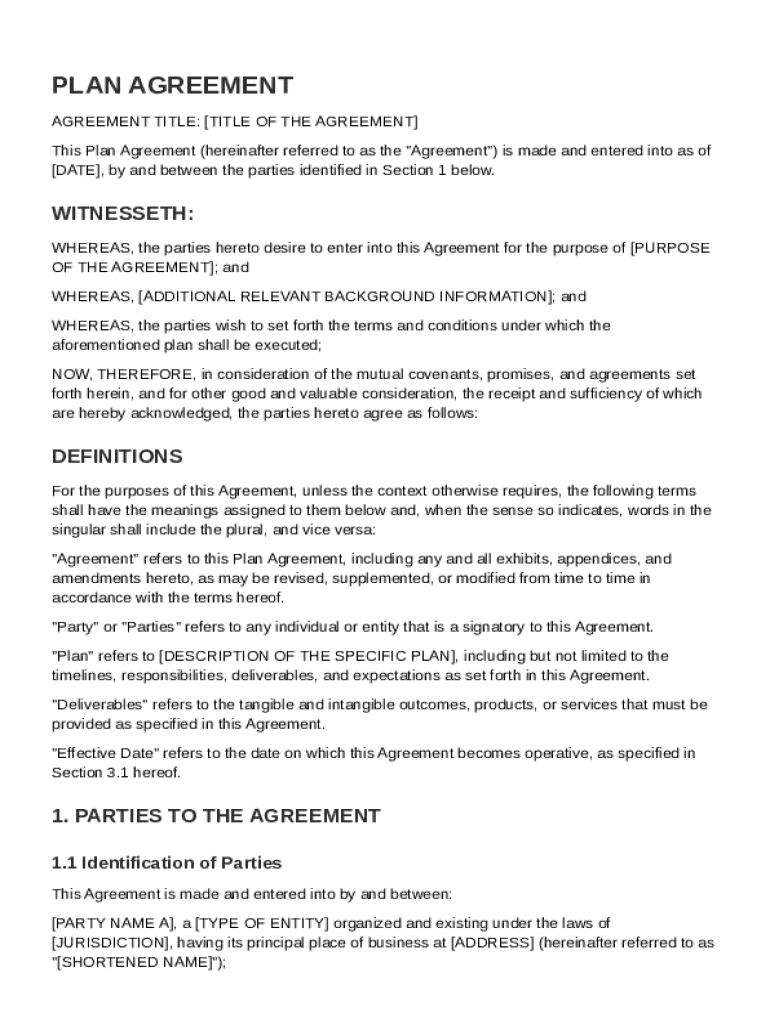
A Plan Agreement Template serves as a structured document that outlines the specific terms and conditions agreed upon by two parties involved in a plan. This template establishes a clear understanding of roles, responsibilities, payment obligations, confidentiality measures, and mechanisms for dispute resolution. By providing an official framework, the template ensures all parties are aligned with common goals and understand what is required for compliance and successful execution of the plan. The template's comprehensive nature also aids in risk management and provides guidance for handling potential termination scenarios.
How to Use the Plan Agreement Template
Using a Plan Agreement Template involves several critical steps to ensure that the document accurately reflects the intentions and agreements of the involved parties. First, it's essential to review the template thoroughly to ensure it encompasses all necessary components such as legal compliance, financial details, and specific obligations. Next, personalize the template by adding details relevant to your specific plan, such as names, dates, and defined objectives. Finally, review the completed document with all parties to confirm mutual understanding and agreement before obtaining necessary signatures, ensuring the document is legally binding.
Steps to Customize the Template:
- Identify parties involved and include full legal names.
- Clearly define roles, expectations, and responsibilities.
- Specify payment terms, including amounts, due dates, and methods.
- Outline confidentiality clauses and any exceptions.
- Detail procedures for dispute resolution, such as mediation or arbitration.
- Include termination conditions and their implications.
Key Elements of the Plan Agreement Template
The Plan Agreement Template comprises several critical elements that contribute to its effectiveness in outlining agreements. Key components typically include:
- Parties Involved: Clearly lists the names and contact information of all parties engaged in the agreement.
- Objective Statement: Provides a concise summary of the plan's purpose and the intended outcomes.
- Terms and Conditions: Details the specific requirements, deliverables, and deadlines.
- Payment Terms: Clarifies payment structures, timelines, and conditions for release.
- Confidentiality: Explains how proprietary information will be protected.
- Termination Clause: Describes conditions under which the agreement can be ended.
- Legal Compliance: Ensures the agreement adheres to relevant laws and regulations.
Each component serves an essential purpose in fostering clarity and reducing ambiguity, ensuring a smooth collaboration between parties involved.
Important Terms Related to Plan Agreement Template
Several crucial terms are commonly associated with Plan Agreement Templates. Understanding these terms is essential for effective use and compliance:
- Counterparty: The entity or individual on the opposite side of an agreement, typically engaged in corresponding roles and responsibilities.
- Deliverables: Specific outputs or services that must be provided as part of the agreement.
- Consideration: In contractual terms, this refers to something of value exchanged between parties, such as payment or services.
- Indemnity: A contractual obligation to compensate for any loss or damage incurred by another party.
- Force Majeure: A clause that frees parties from liability or obligation under extraordinary events or circumstances beyond their control.
These terms play critical roles in the legal and practical framework established by the template.
Legal Use of the Plan Agreement Template
To ensure the Plan Agreement Template's legally binding nature, it must be used in accordance with specific legal principles and requirements. Adherence to these legal standards guarantees that the agreement is enforceable and protectively structured:
- Consent: All parties involved must willingly agree to the contract terms, indicating their acceptance through signatures.
- Capacity: Parties signing the agreement must have the legal authority and capability to enter into contracts.
- Consideration: The exchange of value between parties must be clearly defined and lawful.
- Legality: The agreement must not include provisions that are illegal or against public policy.
The inclusion of a legal compliance review as part of the process of customizing the template helps ensure these conditions are met.
State-Specific Rules for the Plan Agreement Template
While the Plan Agreement Template provides a universal structure, specific state laws may influence its content and enforceability. Key state-by-state differences could include:
- Contract Enforceability: Some states have unique regulations regarding what is considered a legally binding contract.
- Usury Laws: Limits on the amount of interest that can be charged on loans, impacting payment terms.
- Dispute Resolution: State laws may dictate the use of alternative dispute resolution methods, such as arbitration or mediation.
- Public Policy Exceptions: Variations in what constitutes violations of public policy that could nullify contract terms.
Ensuring your Plan Agreement Template complies with relevant state laws requires consulting with legal counsel familiar with specific regional requirements.
Examples of Using the Plan Agreement Template
The Plan Agreement Template can be applied in various situations where formal agreements are required:
- Business Partnerships: Defining roles and profit-sharing in a new venture.
- Consulting Agreements: Outlining services provided, deliverables, and payment expectations between a consultant and a client.
- Joint Ventures: Establishing collaborative efforts between companies for a specific project or initiative.
- Employee Agreements: Detail terms for a temporary project doled out to an employee, including tasks, deadlines, and compensation.
These examples demonstrate how versatile and applicable the template is in diverse contexts, facilitating effective planning and execution across different sectors.
Software Compatibility
DocHub's Plan Agreement Template is designed to be compatible with a variety of software applications beyond standard document formats such as PDF. This versatility ensures users can easily edit and manage their documents irrespective of the software they employ:
- Google Workspace: Direct integration allows seamless importing and exporting of documents.
- Microsoft Office: Compatible with DOC, PPT, and XLS file types for those using Word, PowerPoint, and Excel.
- Cloud Storage Services: Works with services like Dropbox and OneDrive, enhancing accessibility and collaboration.
The wide-ranging compatibility with various applications allows users to efficiently manage their planning documents within their existing software ecosystems.