




01. Edit your form online
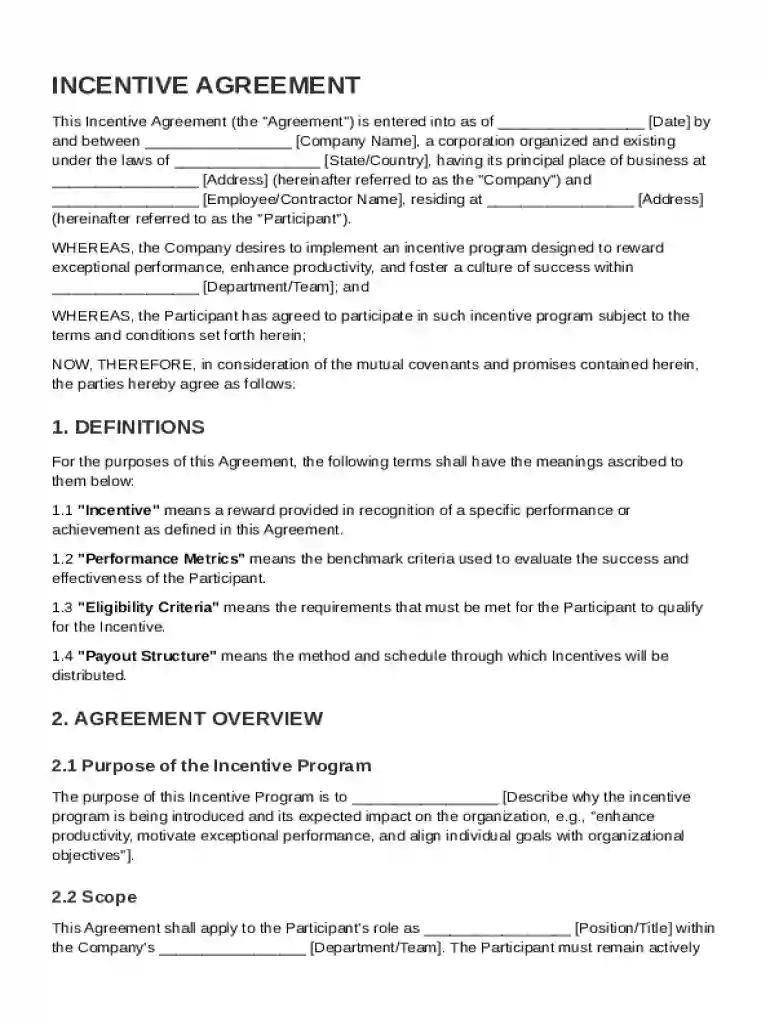
Type text, add images, blackout confidential details, add comments, highlights and more.

Type text, add images, blackout confidential details, add comments, highlights and more.

Draw your signature, type it, upload its image, or use your mobile device as a signature pad.

Send it via email, link, or fax. You can also download it, export it or print it out.
The Incentive Agreement Template is a formal document designed to outline the terms and conditions of an incentive program between a company and a participant, often an employee or a contractor. Its primary purpose is to motivate individuals by providing financial or other types of rewards for exceptional performance. By clearly defining the key terms, such as 'Incentive', 'Performance Metrics', and 'Eligibility Criteria', the agreement establishes a mutual understanding of expectations and obligations.
In practice, such a template serves as a crucial tool for businesses aiming to enhance productivity and retain talent. It facilitates transparency and accountability by detailing the performance metrics required to achieve the incentive, thus aligning individual objectives with the organization’s goals. Additionally, the incentive agreement helps mitigate disputes by preemptively addressing possible areas of contention.
The Incentive Agreement Template comprises several essential components that ensure its effectiveness and legal validity. These elements include:
Navigating the completion of an Incentive Agreement Template involves several key steps to ensure all details are captured accurately:
Incentive agreements can be utilized in various scenarios across different industries. Some practical examples include:
For instance, a technology company might implement an incentive program rewarding developers with equity shares upon the successful launch of a new software feature, thus fostering innovation and ownership among employees.
Eligibility criteria are integral to ensuring the fairness and effectiveness of an incentive program. Key considerations might include:
By setting clear eligibility criteria, a company can effectively target the right candidates for its incentive programs, thereby motivating and retaining top talent.


Incentive agreements are widely used across various sectors, primarily in settings where performance can be quantitatively measured or is crucial to organizational success. Typical users include:
Such diversity in application illustrates the flexibility and importance of the Incentive Agreement Template in aligning individual performance with strategic business objectives.

While incentive agreements are broadly applicable, there may be state-specific regulations affecting their implementation:
Employers must consult legal advisors to ensure compliance with all applicable state laws, thereby safeguarding against potential legal challenges.
In today's digital landscape, using electronically signed incentive agreements is increasingly common. DocHub provides a platform where users can apply legally binding electronic signatures, compliant with the ESIGN Act. Features include:
These features streamline the execution and management of incentive agreements, reflecting a commitment to efficiency and environmental responsibility.
At DocHub, your data security is our priority. We follow HIPAA, SOC2, GDPR, and other standards, so you can work on your documents with confidence.




Departure Incentive Option Agreement Template Form. For questions on individual policies, see the contacts section in specific policy or use the feedback form.
Jun 18, 2026 Incentive Type Definition Financial Rewards Monetary benefits that are designed to encourage PEB or sustainable decisions and achieve green


