




01. Edit your form online
Type text, add images, blackout confidential details, add comments, highlights and more.

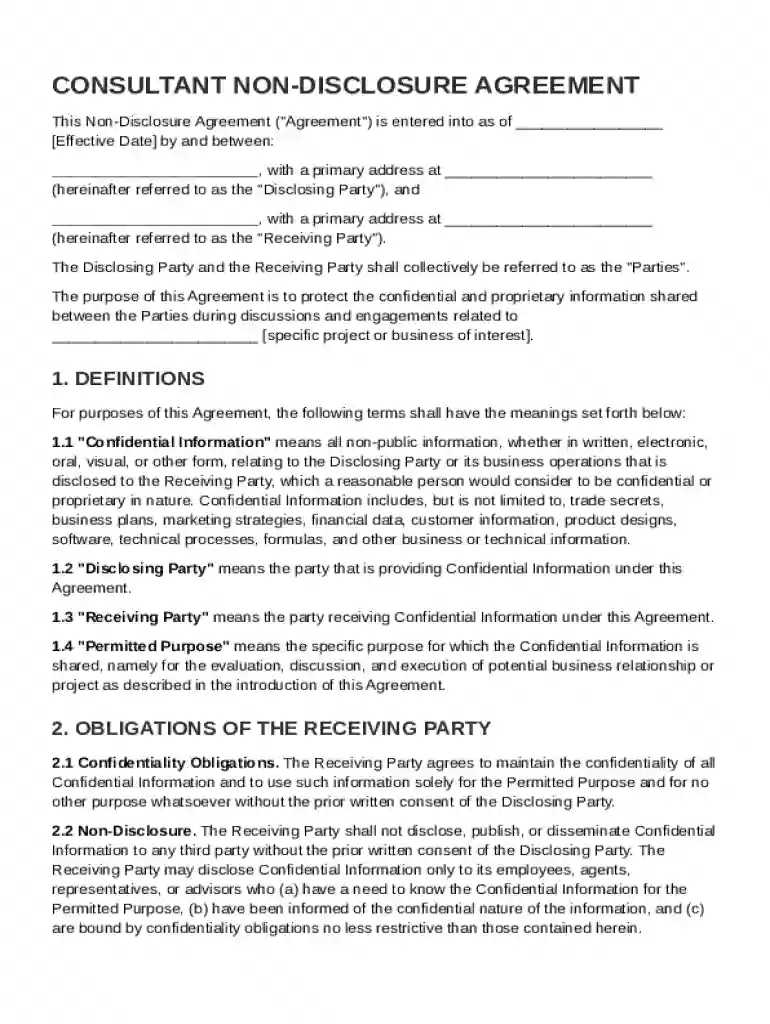
Type text, add images, blackout confidential details, add comments, highlights and more.

Draw your signature, type it, upload its image, or use your mobile device as a signature pad.

Send it via email, link, or fax. You can also download it, export it or print it out.
A Consultant Non-Disclosure Agreement (NDA) is a legal document designed to protect confidential and proprietary information shared between a Disclosing Party and a Receiving Party during business consultations. The primary purpose is to ensure that sensitive data, such as trade secrets, are not disclosed to unauthorized parties. This agreement outlines obligations regarding confidentiality and specifies any exceptions. Businesses in industries such as technology, finance, and healthcare often use these agreements to safeguard their innovations and strategies.
Using a Consultant NDA template involves selecting or customizing a template that aligns with your business needs and legal requirements. Here's a step-by-step guide:
A technology firm engaging a freelance consultant to develop software might use the NDA to ensure the consultant cannot disclose the software's proprietary algorithms to competitors.
Completing a Consultant NDA Template requires attention to detail to ensure all elements are correctly filled out. Follow these steps:
Several core components are crucial in a Consultant NDA Template:
Failing to clearly outline key elements could render the NDA ineffective, leading to potential losses in proprietary information and legal battles.
Consultant NDAs must comply with local and federal laws, including those stemming from intellectual property and confidentiality statutes.
Understanding these legal facets is critical to ensuring enforceability.
Consultant NDAs are widely used across numerous sectors:


A healthcare company might use an NDA when employing a consultant to evaluate and optimize patient data systems, ensuring unauthorized exposure of patient information does not occur.
Consultant NDAs can vary by state due to differing laws on trade secrets and enforceability of non-compete clauses.
Ensuring state-specific compliance can prevent potential legal challenges, making it essential to consult a legal expert familiar with local regulations.
With technological advancements, many NDAs are now executed digitally, providing advantages such as ease of editing and secure sharing.
Digital NDAs provide a secure, efficient method for companies to enforce agreements while reducing the environmental impact associated with paper documents.
At DocHub, your data security is our priority. We follow HIPAA, SOC2, GDPR, and other standards, so you can work on your documents with confidence.


An NDA is a legal agreement which defines information that the parties wish to protect from dissemination and outlines restrictions on use. NDAs are alsoRead more
A Non-Disclosure Agreement (NDA) is a legal contract that restricts how confidential information may be used, shared, or disclosed. In HR compliance and


