
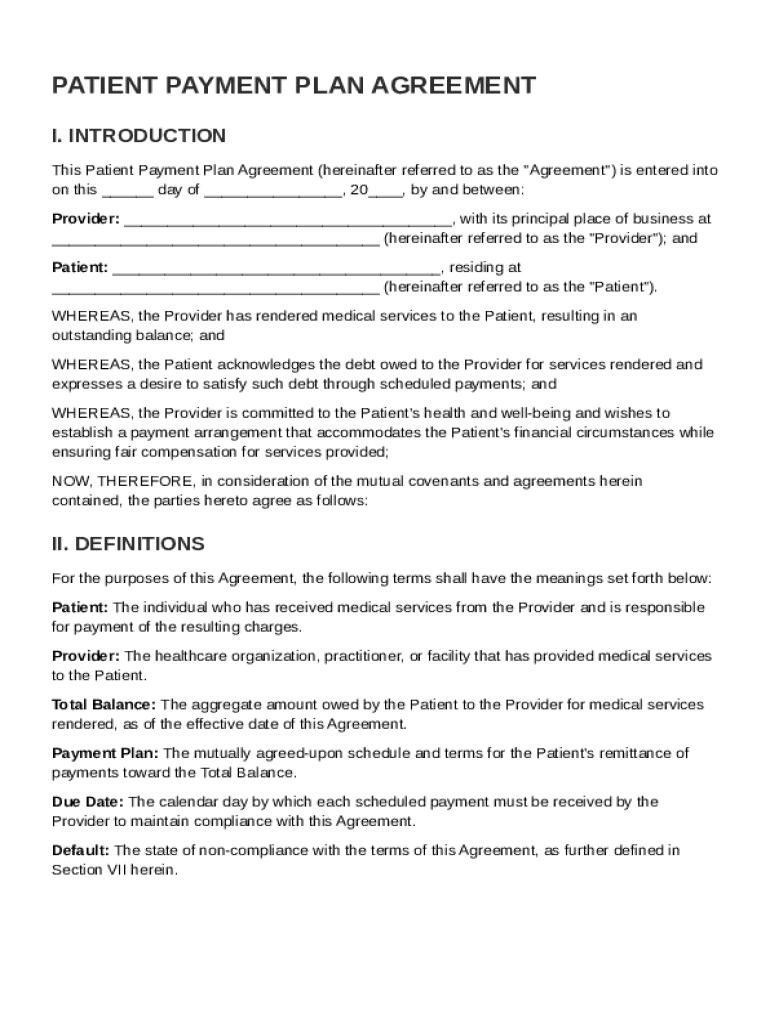







Definition and Purpose of the Patient Payment Plan Agreement Template
The Patient Payment Plan Agreement Template is a structured document that establishes the terms between a healthcare provider and a patient for the repayment of medical services. This form is crucial in ensuring that both parties understand and agree to the conditions under which medical bills will be paid, providing legal protection and clarity. The template typically includes sections on payment schedules, the responsibilities of the patient and provider, conditions for default, confidentiality, and applicable governing law. By using this form, healthcare providers facilitate a manageable payment arrangement for patients while ensuring assured compensation for services rendered, promoting transparency and trust in the healthcare relationship.
How to Use the Patient Payment Plan Agreement Template
Using the Patient Payment Plan Agreement Template involves several steps to ensure both parties understand and adhere to its terms. Initially, healthcare providers should customize the template to reflect specific payment terms relevant to the patient's situation. This customization might include specifying the type of medical services received, the total amount owed, and establishing a clear payment schedule. Patients should then thoroughly review the agreement to ensure they comprehend all obligations, such as payment due dates and any interest or fees associated with late payments. Both parties must sign the document to formalize the agreement, after which a copy should be provided to the patient for their records. This process not only confirms mutual understanding but also legally binds both parties to the stipulated terms.
Steps to Complete the Patient Payment Plan Agreement Template
-
Gather necessary information: Before filling out the agreement, collect all required information such as patient details, service descriptions, and total amounts owed.
-
Customize payment terms: Adjust the payment plan to align with both parties' abilities, detailing the payment amounts, frequency, and duration that the patient will follow.
-
Review terms with the patient: Discuss and explain each section of the agreement with the patient to clarify expectations and obligations.
-
Sign the agreement: Upon reaching a mutual understanding, both parties should sign the document to indicate agreement with the stipulated terms.
-
Provide a copy to the patient: Ensure that the patient receives a signed copy of the agreement for personal records and future reference.
-
Monitor and update: Continuously monitor payments in line with the agreement and update both parties if any changes occur.
Key Elements of the Patient Payment Plan Agreement Template
The Patient Payment Plan Agreement Template typically comprises several key elements essential to its function:
-
Payment Schedule: Clearly outlines the specific dates and amounts due, providing a structured repayment timeline.
-
Default Conditions: Specifies what constitutes a default in payments and the consequences thereof.
-
Confidentiality Clause: Ensures that patient financial information remains private and is handled in compliance with legal standards.
-
Governing Law: Details the legal framework governing the agreement, often differing by state.
-
Responsibilities: Clearly defines the obligations and expectations of both the patient and the healthcare provider.
Each element works cohesively to create an agreement that is enforceable and transparent, reducing the potential for disputes and misunderstandings.
Legal Use of the Patient Payment Plan Agreement Template
For a Patient Payment Plan Agreement to be legally binding, it must comply with applicable state and federal laws. Legal use typically requires that the agreement clearly communicates all terms and conditions, is voluntarily signed by both parties, and is conscionable — meaning it is fair and reasonable. The agreement should include a governing law clause to specify which state's laws apply in case of disputes. Additionally, healthcare providers must adhere to laws that regulate medical billing practices, such as the Fair Debt Collection Practices Act. Ensuring these legal standards are met protects both parties and upholds the agreement's validity in court.
State-Specific Rules for the Patient Payment Plan Agreement Template
While the fundamental purpose of the Patient Payment Plan Agreement Template remains consistent across states, some state-specific rules can influence the document's details. For example, different states have varying statutes of limitations on debt collection and interest rate caps on unpaid medical balances. Additionally, some states may require specific disclosures regarding patient rights and responsibilities or mandate specific language within healthcare financial agreements. It is critical for both parties, particularly the healthcare provider, to consult with legal professionals familiar with state laws to ensure the agreement aligns with local regulations, guaranteeing its enforceability and compliance.
Examples of Using the Patient Payment Plan Agreement Template
Real-world examples highlight the template's use across the healthcare industry:
-
Case 1: A hospital uses the template for a long-term care patient to establish a payment plan over 12 months for significant surgery costs, thus avoiding large upfront payment demands.
-
Case 2: An outpatient clinic allows a patient to repay a diagnostic procedure's cost over several months at a reduced interest rate, demonstrating flexibility and accessibility for low-income patients.
-
Case 3: A dental office implements the template to accommodate uninsured patients, spreading payment across a manageable monthly schedule to encourage timely payments without compromising care.
These cases illustrate the template's adaptability in various healthcare settings, promoting patient satisfaction and financial clarity.
Software Compatibility for Managing the Patient Payment Plan Agreement Template
The Patient Payment Plan Agreement Template can be managed using various digital tools for increased efficiency. It is compatible with document management systems like DocHub, which streamline the process of filling, signing, and storing agreements. DocHub's platform supports secure collaboration and editing, with functionalities for importing agreements directly from cloud services or local storage. Additionally, the template can be integrated into accounting software such as QuickBooks to automate payment tracking and balance updates, or used within CRM systems to track patient agreements. This digital versatility ensures that healthcare providers can maintain organized, secure, and easily accessible records, improving administration efficiency and patient communication.




