






Definition & Purpose of the Collaborative Agreement
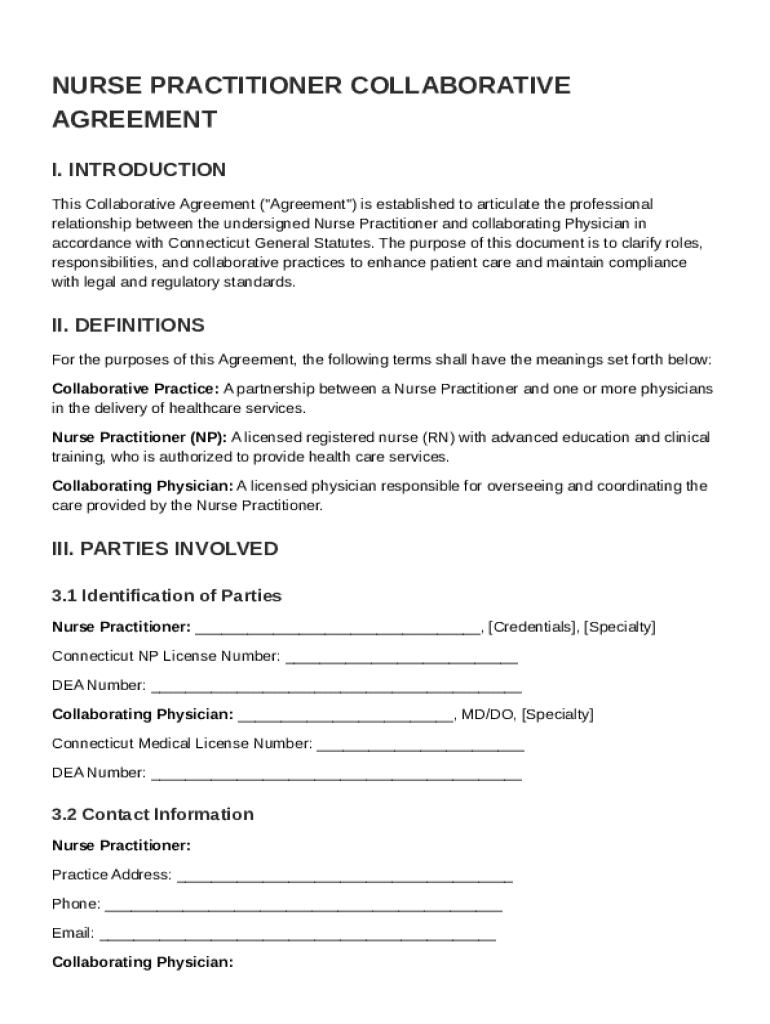
A Nurse Practitioner Collaborative Agreement in Connecticut serves as a formal document defining the professional relationship between a Nurse Practitioner (NP) and a Collaborating Physician. This agreement outlines the collaborative practices, roles, and responsibilities each party holds to enhance patient care while ensuring compliance with Connecticut's legal standards. Key terms are defined to avoid ambiguities, and the agreement lays a foundation for open communication channels between the NP and the physician. This clarity is crucial for a streamlined approach to patient management, quality assurance, and the continuous professional development of both parties.
How to Use the Template
The Nurse Practitioner Collaborative Connecticut Agreement Template is designed to simplify the drafting process of a collaborative agreement. To use this template effectively, both the NP and the physician must review the standard clauses related to roles, responsibilities, and communication protocols. Start by filling in the personal and professional details of both parties, and then proceed to customize the template to address specific collaborative practices. The agreement should reflect mutual understanding and consent on procedures for patient referrals, emergency interventions, and periodic evaluation of care quality. Review and edit clauses to ensure they are aligned with any personal or organizational policies.
Steps to Complete the Template
-
Information Gathering: Collect all necessary personal and professional information about the Nurse Practitioner and Collaborating Physician.
-
Customization: Customize predefined sections to suit your specific partnership dynamics, including roles, responsibilities, and decision-making processes.
-
Review Legal Requirements: Ensure that your agreement complies with Connecticut's state laws and regulations governing NP practices.
-
Quality Assurance Protocol: Define how quality assurance will be maintained, specifying tools or metrics used for evaluations.
-
Communication Framework: Establish clear communication methods and frequency of meetings or evaluations.
-
Signature & Notarization: After careful review, both parties need to sign the document, potentially requiring notarization for authenticity and validity.
Key Elements of the Agreement
-
Roles and Responsibilities: Clearly delineates the functions each party will perform, including patient management and emergency care roles.
-
Quality Assurance: Specifies the measures and evaluations used to maintain high-quality patient care and professional practice.
-
Communication Protocols: Details preferred communication methods for regular updates and urgent consultations.
-
Professional Development: Outlines provisions for continuous education and training opportunities to improve healthcare delivery.
-
Confidentiality Clauses: Ensures all patient data and professional interactions are kept confidential within the boundaries of the law.
State-Specific Rules
In Connecticut, NPs have a level of autonomy; however, a collaborative agreement is required when dealing with certain controlled substances and to ensure compliance with Connecticut General Statutes. Understanding these state-specific regulations is crucial to drafting an agreement that fully adheres to local legalities. This includes acknowledging any specific healthcare standards distinct to Connecticut that the NP and physician must follow.
Legal Use of the Agreement
The Nurse Practitioner Collaborative Connecticut Agreement Template is legally binding, ensuring both parties have a documented mutual understanding of duties and expectations. The document should be kept on file and readily available for review by state medical boards to ensure it aligns with Connecticut’s licensing and regulatory requirements. Using this template helps avoid potential legal disputes by clearly outlining each professional's obligations and areas of collaboration.
Examples of Using the Template
This template is widely used in various healthcare settings ranging from private practices to large hospital networks. For instance, in a hospital, an NP might complete this form with a department head to establish protocols during shifts. On the other hand, a private practice might use it to formalize a partnership with a primary care physician to bolster comprehensive care offerings. Moreover, specialized clinics, such as those focusing on geriatrics or pediatrics, can tailor the template to reflect specific patient needs and collaborative care strategies.
Important Terms Related to the Template
-
Collaborative Practice: A joint approach where both NP and physician contribute to patient care, leveraging each other's expertise for comprehensive management.
-
Scope of Practice: Defines the activities that an NP is permitted to perform under the agreement in accordance with Connecticut laws.
-
Professional Liability: Insurance coverage details that protect both parties from potential legal claims related to medical practice.
-
Quality Metrics: Evaluation indicators to monitor the effectiveness of care provided under the collaboration.
Digital vs. Paper Version
While the Nurse Practitioner Collaborative Agreement can be completed in paper form, the digital version provides ease of access and modification. The digital format facilitates quick updates to the terms as practice dynamics evolve, and easily accommodates electronic signatures via platforms that support secure document signing, such as DocHub. Digital copies also ensure instant sharing and flexible storage, conducive to compliance audits and organizational records.
Eligibility Criteria for Nurse Practitioners
Eligibility to use this template requires the NP in question to hold a valid Connecticut NP license and have identified a healthcare professional willing to enter into a collaborative agreement. The NP should have any necessary additional certifications related to their field of practice and comply with any preliminary collaborative requirements outlined by the Connecticut Department of Public Health.