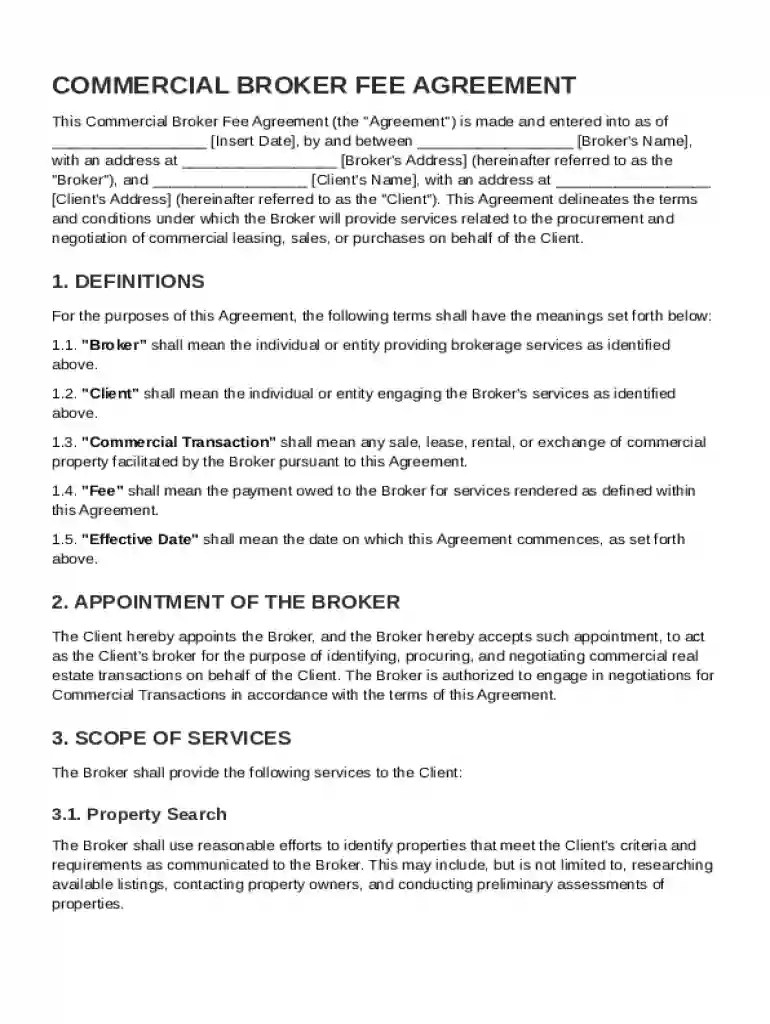
Definition & Meaning
The Commercial Broker Fee Agreement Template is a structured document used to formalize the relationship between brokers and clients within the commercial real estate sector. This agreement sets out the terms under which a broker provides services such as property searches, negotiations, and transaction management on behalf of their client. It clearly defines the rights and responsibilities of both parties, ensuring transparency and reducing the potential for disputes.
- Terms and Conditions: The agreement typically includes detailed descriptions of the services to be provided, the scope of work, and the duration of the agreement.
- Compensation Details: It outlines how and when the broker will be compensated for their services, which could be a percentage of the transaction value or a fixed fee.
- Client Obligations: Specifies what the client is expected to provide or fulfill for the successful completion of the services.
- Confidentiality Agreements: Ensures that sensitive information shared during the business relationship is protected.
- Indemnification and Liability: Protects both parties from certain liabilities and specifies who bears the financial responsibility for potential claims.
How to Use the Commercial Broker Fee Agreement Template
Utilizing the Commercial Broker Fee Agreement Template involves several key steps to ensure an effective and legally binding document.
- Customizing the Template: Tailor the template to fit the specific needs of the transaction by inserting relevant details such as parties' names, specific services rendered, and compensation structure.
- Reviewing Legal Terms: Carefully examine all terms and conditions to ensure they reflect the negotiated agreement. Both parties may benefit from consulting a legal professional to address any complex terms or necessary modifications.
- Signing the Agreement: After confirming that all sections are complete and correct, both parties should sign the document, either electronically or physically.
- Secure Storage: Retain a secure copy of the signed agreement for future reference, which can be digital or hard copy.
Best Practices
- Use Plain Language: Write clearly to avoid confusion or misinterpretation.
- Clear Definitions: Include specific definitions for industry-specific terms to ensure mutual understanding.
- Updates and Amendments: Any amendments to the agreement should be documented and signed by both parties to ensure clarity and enforceability.
Key Elements of the Commercial Broker Fee Agreement Template
The template is designed to cover critical components that ensure the smooth execution of services within a commercial real estate transaction.
- Service Scope: Clear outline of services like property search, market analysis, and contract negotiation.
- Fee Structure: Detailed explanations of how the broker will be compensated, including any retainer fees or contingency agreements.
- Performance Metrics: Any performance indicators or deadlines that the broker agrees to achieve.
- Termination Clause: Details on how the agreement can be terminated by either party and any associated penalties or procedures.
- Governing Law: Specifies the legal jurisdiction under which the agreement operates, essential for dispute resolution.
State-Specific Rules for the Commercial Broker Fee Agreement Template
State-specific variations exist to accommodate local laws and regulations impacting real estate transactions.
- License Requirements: Brokers must comply with state-specific licensing requirements, which may influence the language and enforceability of the agreement.
- Notification Requirements: Some states mandate that certain disclosures or updates be provided to clients at specified stages of the agreement.
- Standard Forms: State real estate boards may provide standard forms which must be adhered to for validity.
Legal Use of the Commercial Broker Fee Agreement Template
This legally binding document is crafted to align with U.S. laws governing broker-client relationships in real estate.
- ESIGN Act Compliance: Electronic signatures within the template are valid and enforceable under the ESIGN Act.
- Enforceability: Courts typically uphold the agreement provided it reflects a fair understanding and all parties executed it knowingly.
- Dispute Resolution: Details mechanisms such as arbitration or mediation to resolve disagreements, minimizing potential legal actions.
Steps to Complete the Commercial Broker Fee Agreement Template
Completing the template involves a series of deliberate steps to ensure all relevant information is appropriately captured.
- Gather Required Information: Collect necessary data, including client and broker details, service descriptions, and negotiated points.
- Fill Out the Template: Enter the gathered data into the corresponding sections of the template.
- Review and Sign: Both parties should review the completed template for accuracy, sign off on each page, and execute the document.
- Distribution: Share copies of the signed agreement with all involved parties and save a properly labeled version for each party's records.
Examples of Using the Commercial Broker Fee Agreement Template
Real-world applications of the Commercial Broker Fee Agreement Template highlight its versatility in different scenarios.
- Commercial Lease Negotiation: Brokers use the agreement to formalize terms with a client seeking commercial leasing opportunities, incorporating performance metrics related to lease terms.
- Property Sales and Acquisitions: Provides a framework for services offered in large-scale property transactions, specifying negotiation boundaries and confidentiality agreements.
- Investment Advisory: When assisting clients with commercial real estate investments, the agreement specifies the advisory scope and any related financial services.
Important Terms Related to Commercial Broker Fee Agreement Template
Understanding critical terms within the agreement is essential for all parties involved.
- Principal: The client or entity engaging services of the broker.
- Broker: The professional party offering real estate transaction services.
- Dual Agency: A situation where the broker represents both the buyer and the seller, subject to specific disclosure and ethical compliance.
- Exclusive Agreement: Limits the client to working with a single broker for specified services during the agreement's duration.