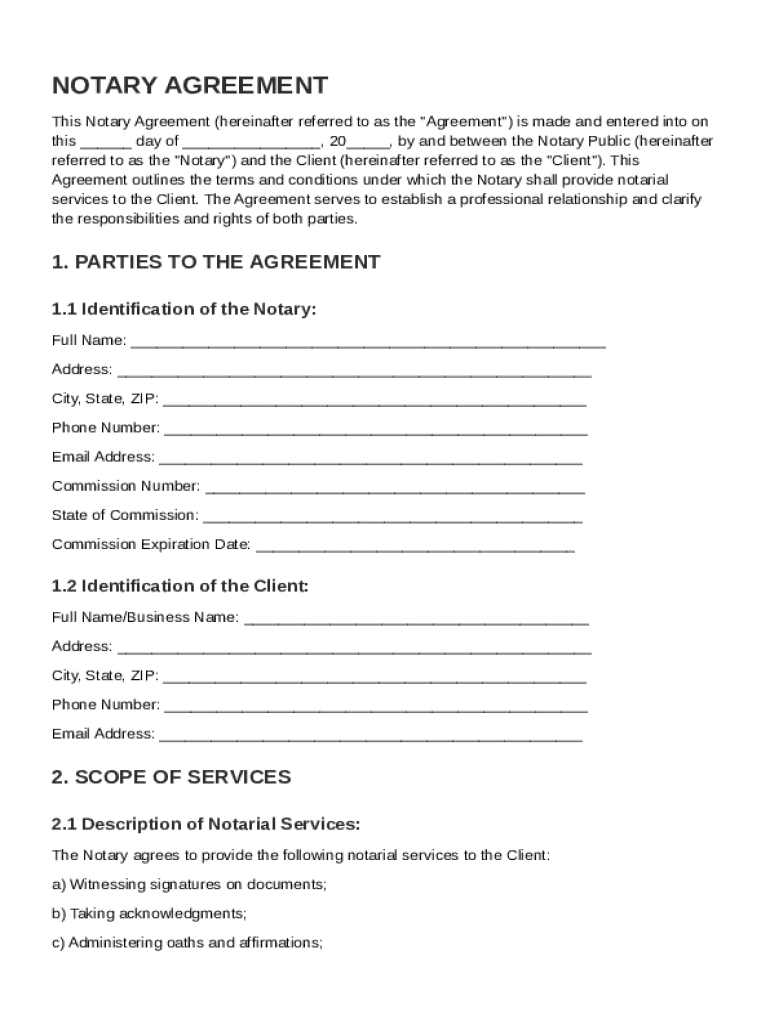







Definition and Meaning of Notary Agreement Template
A Notary Agreement Template is a structured document used to outline the terms and conditions under which a Notary Public provides notarial services to a client. This template serves as an official contract that identifies both parties involved—the Notary and the Client—and details their respective roles and responsibilities. The primary intent of this template is to establish a clear, professional relationship while clarifying rights, obligations, and expectations from each side. Core components of the agreement typically include the identification of the parties, description of services, payment terms, and legal disclaimers.
Components Defined
- Identification: Includes names and contact details of both the Notary Public and the Client to ensure clarity.
- Scope of Services: Clearly states what notarization services will be provided, like witnessing signatures or verifying identities.
- Payment Terms: Outlines how and when the Notary will be compensated, whether it's a flat fee, hourly rate, or per-service cost.
- Termination Terms: Explains how either party can terminate the agreement, which is crucial for maintaining professionalism if services are discontinued.
Steps to Complete the Notary Agreement Template
Completing the Notary Agreement Template requires careful attention to detail and understanding of legal terminology. Here’s a breakdown of steps to finalize it:
-
Gather Necessary Information:
- Collect data on both parties including full names, addresses, and contact numbers.
-
Define the Services:
- Clearly outline the notarial services to be performed, such as document verification or signature witnessing.
-
Establish Payment Details:
- Specify the payment method, frequency, and terms to prevent future disputes.
-
Set the Duration:
- Indicate the start and end date of services, including any renewal options.
-
Include Legal Clauses:
- Ensure clauses for confidentiality, liability, and dispute resolution are clearly stated.
-
Review and Sign:
- Both parties should review the document, make necessary amendments, and sign to make it binding.
Importance of Each Step
- Information Gathering: Prevents misunderstandings about who is involved and responsible.
- Clear Service Definition: Protects both parties by limiting the scope to agreed-upon tasks.
- Payment Clarity: Avoids conflicts over financial expectations.
Key Elements of the Notary Agreement Template
The Notary Agreement Template includes several essential elements that contribute to its effectiveness as a legal contract. Understanding these elements ensures comprehensive coverage of the agreement.
Major Components
- Client Responsibilities: Details what the client is expected to provide or fulfill for the Notary to complete their duties.
- Notary Obligations: Lists the expected professional standards and conduct the Notary needs to adhere to.
- Governing Law: Specifies the legal framework governing the agreement, often based on the state where services are performed.
- Miscellaneous Provisions: Covers additional terms such as amendments, counterparty agreements, and assignment rights.
Essential Clauses to Consider
- Indemnity Clause: Protects the Notary from liability arising from the Client's use of notarized documents.
- Amendment Clause: Allows modifications to the agreement only with mutual consent from both parties.
- Force Majeure: Addresses circumstances that might prevent the fulfillment of obligations due to uncontrollable events.
Legal Use of the Notary Agreement Template
The Notary Agreement Template serves a critical role in ensuring that notarial services are legally binding while safeguarding the interests of both parties involved.
Legal Protections
- ESIGN Act Compliance: Ensures that electronically signed agreements are legally recognized and enforceable.
- Liability Limitation: Minimizes legal risks by explicitly stating responsibilities and limitations.
State-Specific Legal Considerations
- Jurisdictional Variability: Each state might have unique requirements for notarization, and these must be embedded within the template for validity.
- Recognition of Document Types: Different documents may require different notarial acknowledgments according to state law.
How to Use the Notary Agreement Template
Utilizing the Notary Agreement Template efficiently involves understanding how to customize it for specific needs and circumstances.
Practical Usage Tips
- Customization: Adapt the template to suit specific notarial tasks or client requests without deviating from legal requirements.
- Integration with Existing Documents: Incorporate the agreement into a broader legal packet to ensure cohesive documentation.
Common Mistakes to Avoid
- Neglecting Local Laws: Failing to adjust the document to local legal standards can render it invalid.
- Overlooking Signature Requirements: Ensure that all signatures are properly notarized to prevent future disputes.
Examples of Using the Notary Agreement Template
Understanding practical examples of the Notary Agreement in action can offer valuable insights.
Scenario Examples
- Real Estate Transactions: The template is used to notarize deeds and mortgages, ensuring that all parties formally agree.
- Loan Agreements: Involves notarizing loan documents to confirm the borrower and lender's acknowledgment and agreement.
State-Specific Rules for the Notary Agreement Template
Each state has distinct rules regarding the Notary Agreement Template, influencing its structure and execution.
Notable Differences
- California: May require additional disclosures and specific language to meet state-specific requirements.
- Texas: Could have particular mandates concerning out-of-state document notarization.
Importance of Compliance
- Legal Validity: Non-compliance with state regulations can invalidate the agreement.
- Smooth Execution: Aligning the template with state rules ensures hassle-free processing and acceptance.
Who Typically Uses the Notary Agreement Template
Understanding the common user profile for the Notary Agreement Template can guide adjustments and ensure effective deployment.


Typical User Categories
- Legal Professionals: Lawyers often use it for official document executions.
- Business Owners: Utilize it to authenticate contracts and prevent future legal challenges.
Benefits for Specific Groups
- Individuals: Provides peace of mind knowing that significant documents are legally protected.
- Corporates: Guarantees that all contractual documents meet legal requirements without needing extensive legal background knowledge.