






Definition and Meaning of a Non-Solicitation Agreement
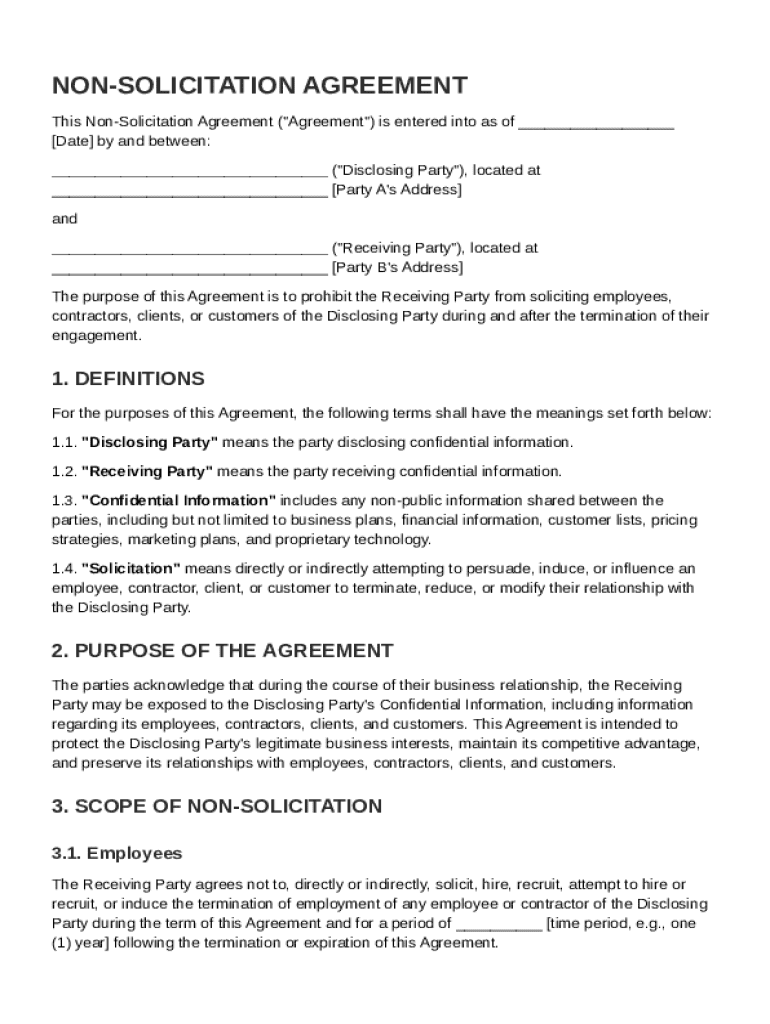
A Non-Solicitation Agreement is a legal contract designed to protect a company's interests by restricting a party from poaching employees, contractors, clients, or customers of the business. This agreement is instrumental in preventing competition and safeguarding proprietary information. Typically, these agreements come into play either during the period of employment or after an employee's departure. The specific terms outline what constitutes solicitation, which may include direct offers of employment or indirect actions like soliciting business from clients. Firms use this document to maintain business continuity and ensure the stability of their workforce and client base.
How to Use the Non-Solicitation Agreement Template
Utilizing the Non-Solicitation Agreement Template effectively requires a clear understanding of its structure and purpose. Start by identifying all parties involved, specifying the Disclosing Party (employer) and the Receiving Party (employee or partner). Customize the template to reflect specific business needs, such as detailing which departments or client relationships are protected. Ensure all terms regarding the duration and geographical scope of non-solicitation are outlined clearly. This customization anticipates potential disputes and strengthens the document's enforceability. Engage with legal professionals to adapt legal terminology, ensuring compliance with applicable laws.
Steps to Complete the Non-Solicitation Agreement Template
- Gather Information: Collect all necessary details about the parties involved, including names, addresses, and roles.
- Draft Specific Terms: Clearly define what constitutes solicitation and specify the restricted entities (e.g., employees, clients).
- Detail Duration: Specify how long the agreement will remain in effect after the termination of the engagement or employment.
- Define Geographical Limits: Outline any geographic limitations, if applicable, to ensure the agreement aligns with business operations.
- Legal Review: Consult with a legal expert to vet the agreement’s compliance with local and federal statutes.
- Sign and Record: Ensure both parties sign the agreement, then store it securely for future reference.
Important Terms Related to Non-Solicitation Agreements
- Solicitation: Any action where one party attempts to attract or recruit another party's employees or clients.
- Disclosing Party: The entity that shares sensitive information or resources that need protection.
- Receiving Party: The individual or organization obligated to adhere to the non-solicitation terms.
- Consideration: The benefit or compensation exchanged between parties that validates the contract.
- Confidentiality: Legal obligation to protect sensitive information shared between parties.
- Restrictive Covenant: A clause in the agreement that imposes restrictions to protect business interests.
Key Elements of the Non-Solicitation Agreement Template
Non-Solicitation Agreement Templates generally include several crucial components to ensure comprehensive protection:
- Purpose and Scope: A clear statement of the agreement’s intent and the activities it covers.
- Duration and Scope: Time frame and geographical limits during which the agreement applies.
- Definitions and Interpretations: Clarifies terms used in the agreement to avoid ambiguity.
- Exceptions: Lists activities or relationships exempt from the agreement restrictions.
- Amendments: Procedures for making changes to the agreement once in force.
- Governing Law: Specifies which jurisdiction’s laws will govern the agreement.
State-Specific Rules for Non-Solicitation Agreements
While the principles of non-solicitation agreements are universally applicable, various U.S. states have different statutes and court rulings affecting their enforceability:
- California: Generally hostile to restrictive covenants unless they fall within specific exceptions.
- Texas: Enforces non-solicitation clauses when they are reasonable and do not unnecessarily restrict free trade.
- New York: Requires consideration for the agreement and mandates that its enforcement is fair and justifiable.
- Florida: Enforces non-solicitation agreements strictly provided they protect legitimate business interests and are reasonable in scope and duration.
Examples of Using the Non-Solicitation Agreement Template
Consider a software development company aiming to protect its client base from former employees who may leave to start competing businesses. By using a Non-Solicitation Agreement, the company can prohibit former employees from reaching out to its current clients. Another scenario might involve a consultancy firm that enters into partnerships with third-party contractors, ensuring they do not solicit their clients directly upon termination of contracts. These examples demonstrate the agreement's utility in various business contexts, emphasizing its role in preserving business relationships and intellectual property.
Who Typically Uses the Non-Solicitation Agreement Template
Non-Solicitation Agreements are commonly employed by a wide array of businesses and professionals, including:
- Technology Companies: To protect intellectual property and client lists.
- Consulting Firms: To safeguard client relationships and proprietary methodologies.
- Recruitment Agencies: To prevent former employees from engaging with their clientele.
- Franchises: To ensure franchisees do not poach from other franchise units.
- Manufacturing Firms: To protect key supplier relationships and specialized knowledge.
Each industry adapts these templates to align with specific operational and competitive challenges.