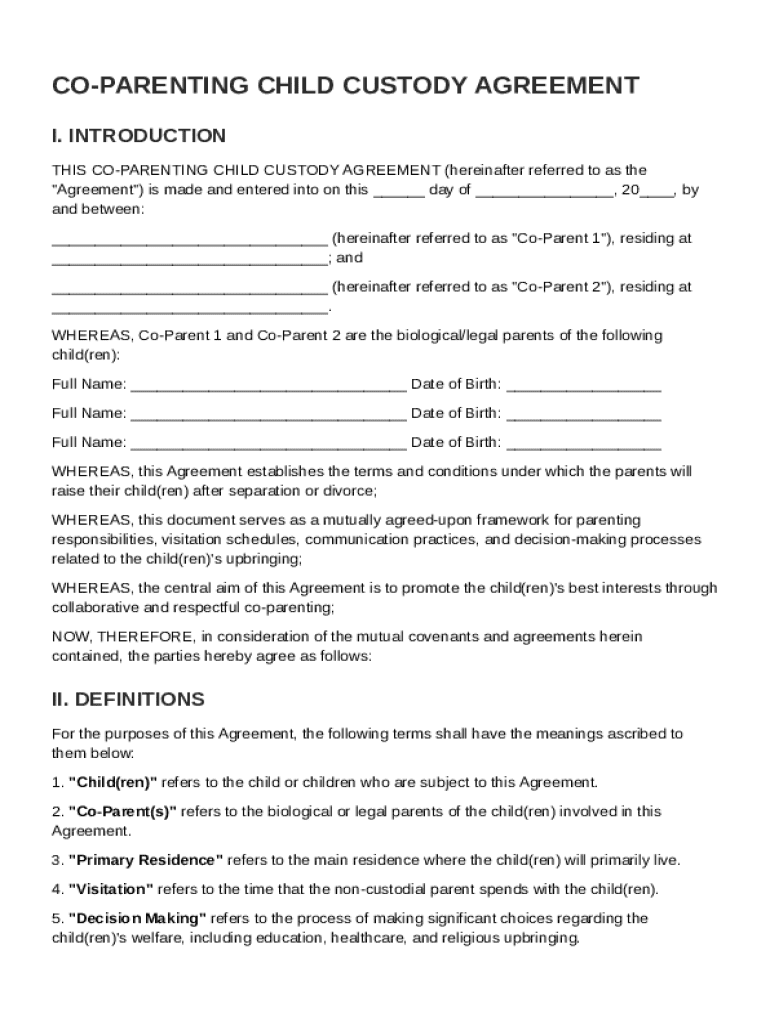







Definition & Meaning
A Co-Parenting Child Custody Agreement Template is a legal document designed to outline the responsibilities and rights of two biological or legal parents regarding the upbringing of their child or children following a separation or divorce. This template serves as a foundational tool to establish clear terms and conditions regarding custody arrangements, visitation schedules, and decision-making processes concerning the child’s welfare. By setting these guidelines, the document aims to minimize misunderstandings and conflicts, ensuring that the interests of the child remain a priority.
Key Concepts
- Custody Arrangements: Specifies which parent will have physical custody, and who will make major decisions affecting the child, such as educational or medical decisions.
- Visitation Schedules: Details the days and times each parent will spend with the child, providing a structured routine.
- Decision-Making Responsibilities: Outlines how parents will handle decisions related to health, education, religion, and extracurricular activities.
- Financial Obligations: Establishes each parent’s responsibilities in terms of child support and financial contributions towards the child’s upbringing.
- Conflict Resolution: Provides steps for resolving disputes without court intervention, promoting cooperative problem-solving.
Key Elements of the Co-Parenting Child Custody Agreement Template
The Co-Parenting Child Custody Agreement Template consists of several crucial elements that collectively ensure a smooth co-parenting experience. These components are designed to cover all aspects of parenting responsibilities and rights.
Custody and Visitation
- Physical Custody: Defines which parent the child will live with.
- Legal Custody: Determines who has the authority to make major decisions regarding the child’s life.
- Visitation Rights: Offers non-custodial parents regular and consistent access to the child.
Financial Aspects
- Child Support: Establishes the financial responsibilities of each parent.
- Shared Expenses: Details additional costs such as education, healthcare, and extracurricular activities.
Communication and Decision Making
- Communication Protocols: Sets guidelines for maintaining open and respectful communication between parents.
- Joint Decisions: Outlines processes for making consensual decisions regarding the child’s education, health, and welfare.
Support Systems
- Conflict Resolution Mechanisms: Includes options such as mediation or arbitration to resolve disputes.
- Adjustment Procedures: Allows for revisions in the agreement in response to significant life changes.
Steps to Complete the Co-Parenting Child Custody Agreement Template
Filling out a Co-Parenting Child Custody Agreement Template requires careful consideration and cooperation between both parties to ensure all details are addressed.
- Gather Essential Information: Collect all necessary details such as the full names, addresses, and contact information of both parents and the child.
- Review Custody Options: Decide on the type of custody arrangements suitable for both parents and the child, considering their work schedules and living situations.
- Outline Visitation Schedule: Clearly document the visitation days, including holidays, birthdays, and vacations, to avoid conflicts.
- Detail Financial Responsibilities: Agree on child support amounts and additional financial obligations for shared expenses.
- Establish Communication Guidelines: Define how parents will communicate about the child, ensuring that both parties remain informed and involved.
- Include Conflict Resolution Processes: Agree on methods to handle potential disputes and modifications to the agreement.
- Finalize and Sign: Once all elements are addressed, both parents should thoroughly review the document, make necessary revisions, and sign it before a notary if legally required.
State-Specific Rules for the Co-Parenting Child Custody Agreement Template
In the United States, child custody laws differ significantly from state to state. Familiarizing yourself with your state’s specific rules is vital when drafting a Co-Parenting Child Custody Agreement.
Examples of State-Specific Considerations
- California: Focuses on the best interests of the child, emphasizing joint custody whenever feasible.
- Texas: Offers detailed guidelines for Standard Possession Orders, which many parents use as a model for visitation schedules.
- New York: Requires that both legal and physical custody be addressed separately in the agreement.
Implications
- Legal Compliance: Ensuring your document aligns with state regulations to avoid legal disputes.
- Flexibility: Adjusting the template as needed to comply with state laws while meeting the child's needs.
Important Terms Related to Co-Parenting Child Custody Agreement Template
Understanding the legal jargon and terminologies related to child custody agreements is crucial for effectively navigating this process.
Common Terms
- Joint Custody: A situation where both parents share legal or physical custody of the child.
- Sole Custody: When one parent has exclusive rights and responsibilities regarding the child.
- Non-Custodial Parent: The parent who does not have physical custody but may have visitation rights.
- Mediation: A process where a neutral third party helps resolve disputes between parents.
- Arbitration: An alternative to court where a designated arbitrator decides on a disputed matter.
Applications
- Legal Settings: Knowing these terms aids in understanding legal documents and proceedings.
- Discussions with Legal Professionals: Ensures accurate communication with attorneys and mediators.
Examples of Using the Co-Parenting Child Custody Agreement Template
Utilizing a Co-Parenting Child Custody Agreement Template can vary based on individual situations, emphasizing the template's flexibility and adaptability.
Scenario Examples
- Uncontested Custody Agreement: This occurs when both parents agree on all terms without involving the court. The template provides a structured format for detailing mutual agreements.
- Court-Mandated Agreement: In some cases, courts may require parents to utilize such templates to facilitate decision-making and document it in legal terms.
- Amendments and Updates: As children grow and circumstances change, parents can revisit the template to update custody arrangements, demonstrating its enduring utility.
Legal Use of the Co-Parenting Child Custody Agreement Template
Creating a legally enforceable Co-parenting Agreement is essential to prevent misunderstandings and ensure compliance with applicable laws.
Key Legal Features
- Notarization: While not required in all states, notarization can provide an additional layer of authenticity.
- Court Approval: Often necessary to make the agreement legally binding, particularly in contested cases.
- Adherence to State Law: Ensuring compliance with specific child custody laws within your jurisdiction.
Legal Guidance
- Consulting an Attorney: Advisable to ensure all legal bases are covered and the document is enforceable.
- Using Template as a Starting Point: It provides a comprehensive framework which can be customized with legal guidance.
Software Compatibility
Managing a Co-Parenting Child Custody Agreement effectively requires compatibility with various software, ensuring accessibility and ease of modification.
Integration with DocHub
- File Import and Export: DocHub allows users to import documents from various cloud storage services and export completed agreements seamlessly.
- Real-Time Collaboration: Facilitates the involvement of both parents and legal professionals through shared document access.
- Security Measures: Enhanced security protocols protect sensitive information, including encryption and password protection.
Broader Compatibility
- Google Workspace Integration: Offers direct access to files stored on Google Drive or received via Gmail, optimizing document management within the Google ecosystem.