
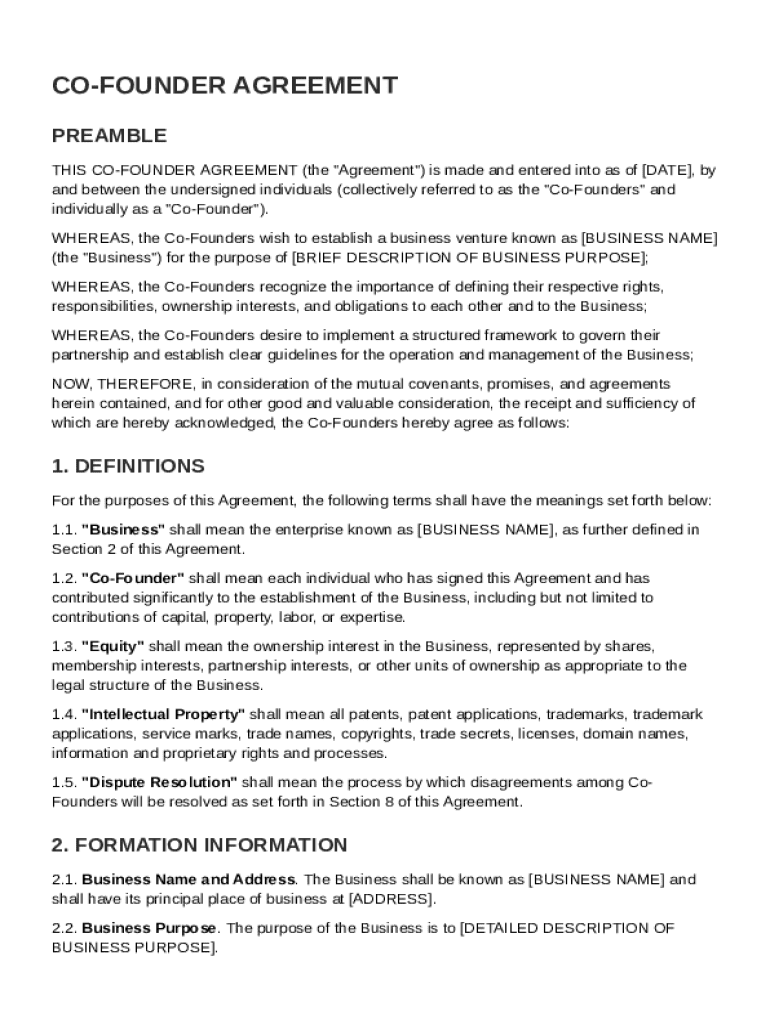







Definition & Meaning
A Co-Founder Agreement Template is a legal document that outlines the foundational terms and conditions between individuals who are establishing a business together. This agreement serves as a formal acknowledgment of the roles, responsibilities, and expectations of each co-founder. It includes critical elements such as equity allocation, profit distribution, intellectual property rights, confidentiality obligations, dispute resolution processes, and procedures for termination or withdrawal of co-founders. By laying out clear guidelines, the Co-Founder Agreement helps prevent misunderstandings and conflicts, thereby facilitating smoother collaboration among partners.
Key Elements of the Co-Founder Agreement Template
The Co-Founder Agreement Template typically includes several essential components that ensure a comprehensive understanding among all parties involved:
- Equity Allocation: Defines how much ownership each co-founder has in the company. This is often determined by contributions in terms of capital, time, and skills.
- Roles and Responsibilities: Clearly outlines the specific duties each co-founder will undertake, reducing ambiguity in business operations.
- Profit Distribution: Details how profits will be shared among co-founders, which is important for aligning expectations and motivations.
- Intellectual Property Rights: Specifies who owns what in terms of IP created within the company, protecting both the business and individual contributions.
- Confidentiality Obligations: Ensures sensitive business information is kept private by all parties.
- Dispute Resolution: Provides a framework for resolving differences efficiently and amicably, which can include mediation or arbitration clauses.
- Termination or Withdrawal Procedures: Sets guidelines for what happens if a co-founder decides to leave the company, addressing the transfer of equity and responsibilities.
Steps to Complete the Co-Founder Agreement Template
Completing a Co-Founder Agreement involves a few critical steps to ensure that all parties are protected and on the same page:
- Identify Co-Founders and Roles: Begin by listing all co-founders and specifying their expected contributions to the business, whether financial, intellectual, or operational.
- Detail Equity and Ownership: Allocate shares based on agreed-upon factors such as initial investment, past contributions, and expected involvement.
- Define Profit Sharing: Establish a formula or approach for distributing profits that reflects each partner's stake and contribution.
- Clarify Intellectual Property Terms: Determine how IP rights are assigned and protect these assets for the business's benefit.
- Set Confidentiality Obligations: Draft clauses to maintain the confidentiality of proprietary information shared among co-founders.
- Outline Dispute Resolution Mechanisms: Choose appropriate methods such as arbitration or mediation to handle conflicts.
- Establish Exit Strategies: Include procedures detailing how to handle a co-founder's exit from the company.
Legal Use of the Co-Founder Agreement Template
This document is legally binding and holds significant importance in formalizing a partnership. It is crucial to tailor the template to comply with applicable laws and regulations. Co-founder agreements are recognized contracts under U.S. law, provided they fulfill contractual requirements such as mutual consent, a legitimate purpose, and consideration. It is advisable to consult with legal advisors to clarify terms, customize the agreement according to specific legal needs, and ensure all federal, state, and local law considerations are addressed.
Who Typically Uses the Co-Founder Agreement Template
The Co-Founder Agreement Template is commonly used by entrepreneurs who are launching a startup or forming a new venture. This includes:
- Startup Founders: Individuals looking to formalize their partnership and establish foundational business operations.
- Business Partners in Joint Ventures: Co-entrepreneurs combining resources and skills to create a new business entity.
- Small Business Owners: Co-founders of small businesses who wish to delineate roles, contributions, and expectations clearly.
- Investors Seeking Clarity: Angel investors or venture capitalists who desire defined agreements among the founding team to mitigate risks.


Software Compatibility
DocHub provides seamless editing, signing, and managing capabilities, making it compatible with a variety of document formats such as DOC, PPT, XLS, and TXT. This flexibility allows users to import co-founder agreements in their preferred format. It integrates well with platforms like Google Drive, Dropbox, and OneDrive, ensuring easy access and management of documents. You can use DocHub’s features to annotate, edit, and collaborate effectively without needing to convert files between different software environments, enhancing workflow efficiency and accuracy.
State-Specific Rules for the Co-Founder Agreement Template
While a Co-Founder Agreement is broadly applicable across the United States, certain state-specific rules and regulations might affect its stipulations:
- State-Specific Partnership Laws: Each state has its statutes concerning business entities and partnerships, which might influence the agreement's components.
- Variations in Confidentiality Expectations: Some states have particular requirements or protections regarding confidentiality agreements.
- Dispute Resolution Preferences: States may have different approaches to arbitration and mediation requirements for business-related conflicts.
- Intellectual Property Laws: These can vary markedly between states, impacting how IP terms should be structured in the agreement.
Examples of Using the Co-Founder Agreement Template
Examples of the practical application of a Co-Founder Agreement include:
- Tech Startups: A tech startup uses the template to allocate shares between co-founders with differing technical and managerial roles, ensuring that each founding member receives equity proportional to their input and reduces potential disputes.
- Retail Partnerships: Two partners starting a retail business delineate responsibilities and profit-sharing structures, minimizing potential conflicts over operational duties and financial returns.
- Creative Enterprises: In a creative enterprise, such as an online media company, co-founders use the agreement to specify IP ownership, thus protecting each founder’s creative content and ensuring clear rights when expanding or selling content.
Such examples demonstrate the versatility and necessity of drafting a comprehensive Co-Founder Agreement to support various business types and objectives effectively.




