






Definition and Meaning
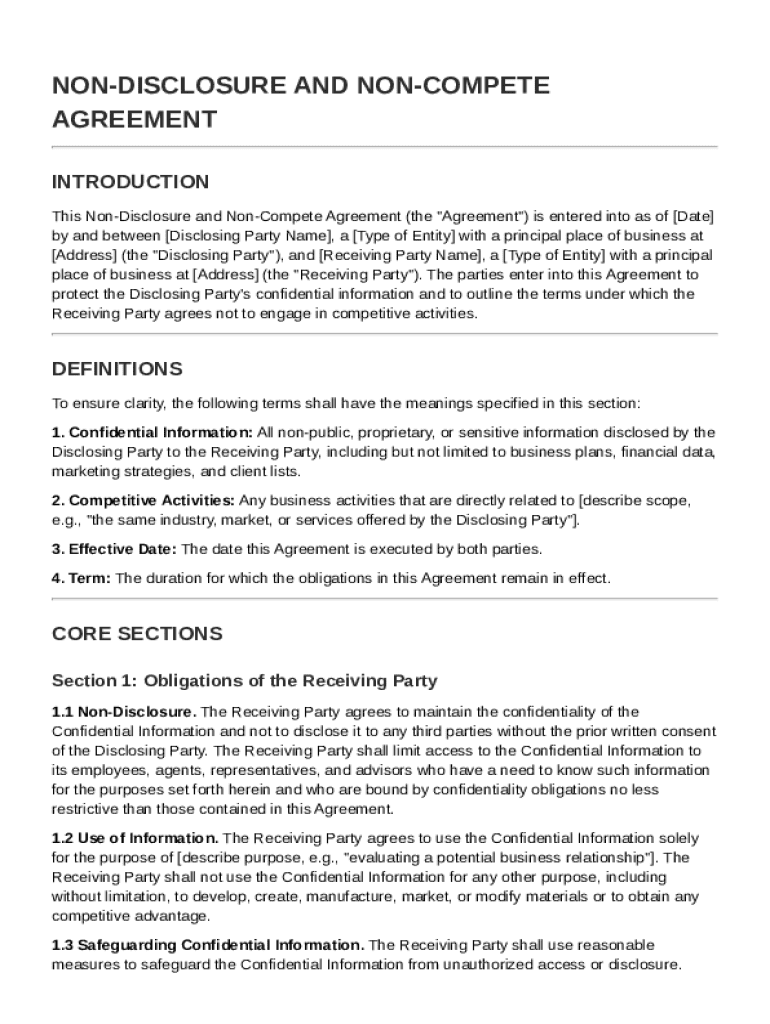
Non-Disclosure Agreements (NDA) and Non-Compete Agreements are legal contracts used to protect sensitive information and limit competitive activities. An NDA ensures that the Receiving Party does not disclose or misuse confidential information shared by the Disclosing Party. A Non-Compete Agreement restricts the Receiving Party from engaging in business activities that directly compete with the Disclosing Party, usually within a specified geographic area and timeframe. Both agreements are essential tools for safeguarding intellectual property, trade secrets, and business interests in competitive industries.
Confidential Information
Confidential Information under an NDA includes a variety of data types and formats, such as business plans, customer lists, and proprietary technologies. The document should clearly define what is considered confidential to prevent any ambiguities. Examples of confidential information might include unpublished financial data, technical drawings, or internal communications. It's essential to specify what is not considered confidential — for instance, information publicly available or already known to the Receiving Party.
Competitive Activities
Competitive Activities in a Non-Compete Agreement are actions that the Receiving Party is restricted from performing, which might harm the competitive position of the Disclosing Party. These could include engaging in similar business offerings, soliciting existing clients, or forming partnerships with competitors. Legal professionals often advise tailoring these clauses to avoid overly restrictive terms that could render the agreement unenforceable.
How to Use the NDA and Non-Compete Agreement Template
The template serves as a foundation for creating a legally sound and tailored agreement that reflects specific business needs. Users should start by carefully inputting the names and details of the Disclosing and Receiving Parties. Each agreement section should be read thoroughly to ensure a complete understanding of the terms and obligations. It may be beneficial to involve legal counsel to customize clauses to meet jurisdiction-specific requirements effectively.
Customizing the Template
When using the template, personalization is crucial to address the unique concerns of each business relationship. This includes specifying the duration of confidentiality or non-compete clauses, identifying the scope and geographical limits, and appointing permissible activities or exceptions. Users should ensure that each customized term reflects the agreed-upon parties' expectations and intentions.
Practical Example
For instance, a technology startup might employ an NDA when sharing prototype designs with a potential investor. Simultaneously, a Non-Compete Agreement might be used within an employment contract to prevent a key engineer from joining a competitor directly after leaving the company. These contractual agreements are vital for sustaining a competitive edge and preserving proprietary advancements.
Key Elements of the NDA and Non-Compete Agreement Template
The template consists of several critical components that dictate the agreement's enforceability and scope. Recognizing these elements aids in crafting comprehensive and balanced contracts.
Identification of Parties
Identifying the involved parties clearly is a fundamental aspect of the agreement. This section should include roles like the Disclosing and Receiving Parties, detailing their legal names and any relevant identification numbers, ensuring there is no ambiguity about who is protected under the contract.
Duration and Termination
The agreement must outline the duration of the confidentiality and non-compete obligations. Typical durations for non-disclosure might last between one to five years, while non-compete terms might be shorter due to enforceability concerns. Termination rights and conditions under which the agreement may expire should be clearly articulated.
Governing Law
This clause specifies which state laws will interpret and enforce the agreement. Choosing appropriate governing law ensures that the agreement is enforceable and adheres to regional legal stipulations. Legal counsel can guide the choice of jurisdiction to align with strategic business locations.
Important Terms Related to NDA and Non-Compete Agreement Template
Understanding the terminology within NDAs and Non-Compete Agreements can prevent misinterpretations and enhance clarity.
Breach and Remedies
A breach occurs when the Receiving Party violates the agreement's terms. The document should delineate possible remedies, such as monetary damages, injunctions, or specific performance sanctions, available to the Disclosing Party. Specifying these remedies deters potential breaches and provides clear recourse in disputes.
Exceptions and Limitations
Both agreements should address any exceptions to confidentiality and non-compete obligations, such as information disclosed under a lawful subpoena. Limits on competitive restraints avoid provisions deemed excessively restrictive by most U.S. jurisdictions, enhancing enforceability.
State-Specific Rules for the NDA and Non-Compete Agreement Template
While federal law provides a framework, state-specific regulations significantly impact these agreements' enforceability.
Variations by State
Certain states, such as California, have stringent restrictions on non-compete clauses, particularly concerning employee agreements. Other states might allow broader restrictions but require justifiable business interests for validity. Familiarity with state-specific rules is necessary when drafting these agreements to ensure they withstand legal scrutiny.
Legally Binding Requirements
To be legally binding, both NDAs and Non-Compete Agreements require specific consideration — a mutual exchange of value. In some states, merely offering continued employment may not suffice as adequate consideration, necessitating additional benefits or compensatory measures.
Legal Use of the NDA and Non-Compete Agreement Template
Complying with legal standards is crucial to protecting business interests effectively.
Compliance with the ESIGN Act
Using electronically signed agreements under the provisions of the ESIGN Act ensures that digital signatures are legally recognized and enforceable across the United States. Platforms like DocHub facilitate collecting and validating legal e-signatures, minimizing administrative burdens while maintaining robust compliance.
Common Legal Disputes
Disputes often arise over the enforceability of non-compete clauses due to perceived overbreadth in geographic or activity restrictions. Courts typically evaluate the reasonableness of such terms, emphasizing the necessity of employing proportional constraints that protect business interests without undue hardship on the individual.
Who Typically Uses the NDA and Non-Compete Agreement Template
Various entities and individuals leverage these agreements across industries to protect sensitive information and secure competitive advantages.


Startups and Entrepreneurs
Innovative startups and entrepreneurs often use NDAs when discussing ideas with investors, partners, or employees. Non-compete agreements might secure proprietary technology or processes from potential competitive exploitation.
Corporations and Employers
Large corporations implement these agreements to protect trade secrets and retain a competitive advantage across global markets. Employers might enforce non-compete clauses with high-ranking executives or employees possessing critical knowledge.
Professionals and Consultants
Consultants and independent contractors may employ NDAs when engaging with companies that require access to confidential data. Non-compete agreements may be explicitly negotiated based on the consultant's role and industry influence.
Who Issues the Form
Typically, the party initiating a business relationship issues the NDA and Non-Compete Agreement template.
Organizational Responsibility
HR departments, legal teams, or administrative units within a corporation are often responsible for issuing and managing these documents. For smaller businesses, owners or designated managers may take on this responsibility themselves, ensuring templates are readily available to streamline contractual processes.
Role of Legal Advisors
Legal advisors play a pivotal role in formulating these agreements, providing essential guidance on creating enforceable terms and aligning documents with current legal trends. Regular consultation with legal professionals ensures conformity with evolving regulations, protecting interests effectively.
Examples of Using the NDA and Non-Compete Agreement Template
Illustrative scenarios demonstrate practical applications of these agreements and inform best practices.
Business Partnerships
In merger discussions or joint ventures, NDAs protect the confidential exchange of strategic plans and financial data. Non-compete clauses might ensure that both parties remain loyal to the joint project without diverting resources to competitors.
Vendor Contracts
Suppliers or distributors who access proprietary product details during business transactions may be bound by an NDA. Non-compete agreements could prevent vendors from simultaneously representing competing brands, thereby guarding market positioning.
Employment Agreements
During employment, non-compete clauses might apply to key personnel receiving unique training or exposure to sensitive information. NDAs protect ongoing projects or client lists to mitigate risks of potential leaks after employment ends.
These examples and explanations offer a detailed exploration of the NDA and Non-Compete Agreement's essential role in diverse professional settings, underscoring their value in maintaining confidential and competitive business operations.