
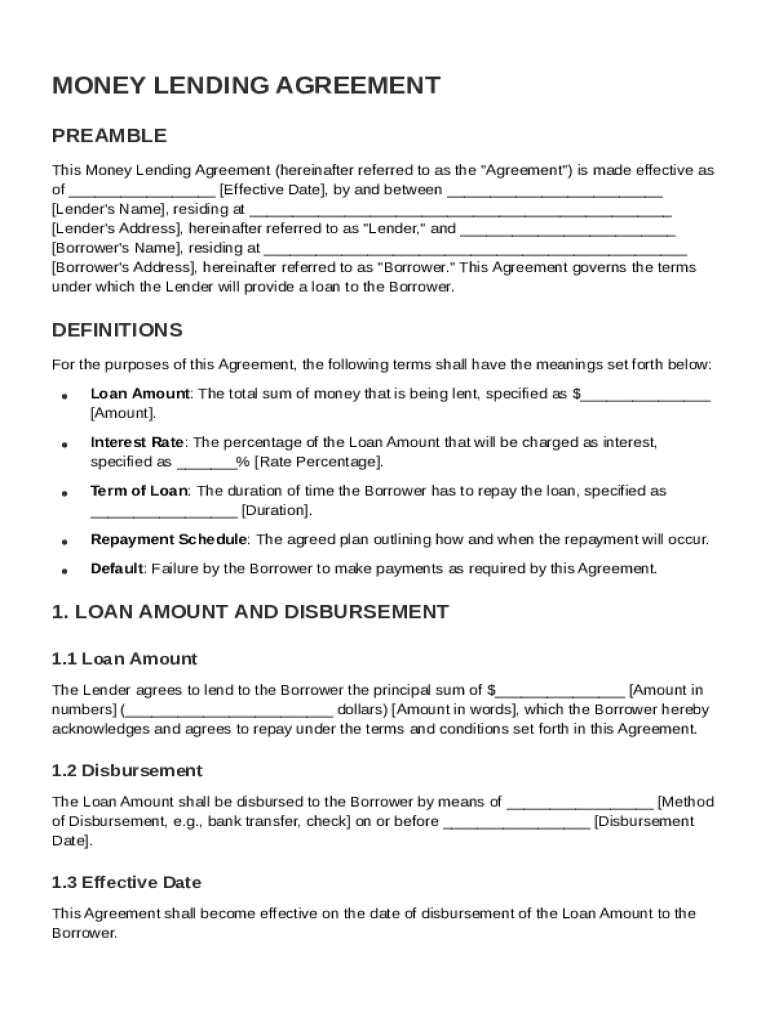







Definition & Meaning
A Money Lending Agreement Template serves as a formal contract between a lender and a borrower, documenting the terms under which a loan is provided. It typically includes crucial information such as the loan amount, interest rate, repayment schedule, and actions taken if the borrower defaults. This template ensures all parties have a clear and mutual understanding of their obligations and rights, thereby minimizing potential disputes.
The Money Lending Agreement Template is particularly important in establishing a legal framework for financial transactions, ensuring that the lending process is transparent and that the lender's funds are protected. It also supports legal enforcement of the terms, should a disagreement arise, making it a fundamental tool in personal and business lending scenarios.
Key Elements of the Money Lending Agreement Template
A comprehensive Money Lending Agreement Template includes several critical sections that outline the responsibilities and expectations of both parties.
-
Loan Amount and Purpose: Specifies the total amount loaned and the intended use of the funds, ensuring they are utilized as agreed.
-
Interest Rate and Calculation: Details the interest applied to the loan, including whether it is fixed or variable, and how it is calculated over time.
-
Repayment Terms: Includes the frequency of payments, due dates, and any grace periods, providing a clear schedule for the borrower.
-
Default Provisions: Outlines consequences for missed payments or other breaches of contract, which may include late fees or accelerated repayment obligations.
-
Governing Law: Identifies the legal jurisdiction that governs the agreement, which is significant for resolving disputes.
Steps to Complete the Money Lending Agreement Template
Finalizing a Money Lending Agreement Template involves several precise steps to ensure its legality and clarity:
-
Gather Required Information: Collect details about the lender and borrower, loan amount, interest rate, and repayment schedule.
-
Fill Out the Template: Input the gathered information into the designated sections of the template, ensuring accuracy and completeness.
-
Review and Edit: Both parties should review the filled template for any errors or unclear terms and make necessary edits.
-
Legal Review: Have a legal professional examine the agreement to ensure it complies with applicable laws and adequately protects both parties.
-
Sign and Date: Once all terms are agreed upon, both the lender and borrower should sign and date the document for it to take effect.
Important Terms Related to Money Lending Agreement Template
Understanding the terminology used in a Money Lending Agreement is essential for effective communication and enforcement. Here are some important terms often included:
-
Collateral: Property or assets pledged as security for the loan, which the lender can seize if the borrower defaults.
-
Principal: The original sum of money borrowed that the borrower agrees to repay, excluding interest.
-
Usury Laws: State-specific laws that cap the maximum interest rate that can be charged on loans.
-
Amortization: The process of gradually repaying a loan through regular payments of principal and interest over time.
-
Acceleration Clause: A provision that allows the lender to demand immediate repayment of the entire loan under certain conditions, such as default.
Legal Use of the Money Lending Agreement Template
Legally utilizing a Money Lending Agreement Template requires compliance with both federal and state laws. This includes adhering to interest rate caps, disclosure requirements, and borrower notification standards. The agreement must be explicit and fair, avoiding any ambiguous language that could be interpreted in multiple ways.
Moreover, both parties must voluntarily enter into the agreement without any coercion, and all terms should be discussed and understood before signing. For enforceability, the agreement should be signed by all parties involved and ideally notarized, especially for large loans or those involving real estate.
State-Specific Rules for the Money Lending Agreement Template
Each U.S. state may have different regulations concerning lending agreements, particularly regarding interest rates, required disclosures, and borrower protections. For instance, states like New York and California have stringent usury laws that limit the interest rates lenders can charge.
When creating a Money Lending Agreement in a specific state, it's crucial to research and incorporate these local laws to prevent the agreement from being deemed illegal or unenforceable. Consulting with legal professionals familiar with the state's regulations can provide further assurance of compliance.
Who Typically Uses the Money Lending Agreement Template
This template is commonly used by individuals and businesses engaged in lending activities. Typical users include:
-
Private Lenders: Individuals who lend money to acquaintances or third parties as part of a personal finance arrangement.
-
Financial Institutions: Banks and credit unions use these templates for loan agreements with their clients.
-
Business Owners: Companies offering lines of credit or financing options to customers or partners.
-
Lawyers and Legal Professionals: Use templates to draft agreements for clients seeking formalized loan contracts.


Examples of Using the Money Lending Agreement Template
Many scenarios exist where a Money Lending Agreement Template plays a vital role:
-
Peer-to-Peer Lending: Individuals lending to peers as an investment strategy utilize agreements to formalize terms and expectations.
-
Family Loans: Families lending large sums for major purchases or debt consolidation use agreements to outline repayment and minimize conflict.
-
Corporate Loans: Businesses receiving loans from investors might use these templates to delineate terms and protect interests.
-
Real Estate Transactions: Financing for property purchases often involves lending agreements to secure terms and mitigate risks.
These examples underscore the template's versatility in various lending situations, highlighting its necessity for ensuring smooth and legally sound financial transactions.




