01. Edit your form online
Type text, add images, blackout confidential details, add comments, highlights and more.

Type text, add images, blackout confidential details, add comments, highlights and more.

Draw your signature, type it, upload its image, or use your mobile device as a signature pad.

Send it via email, link, or fax. You can also download it, export it or print it out.
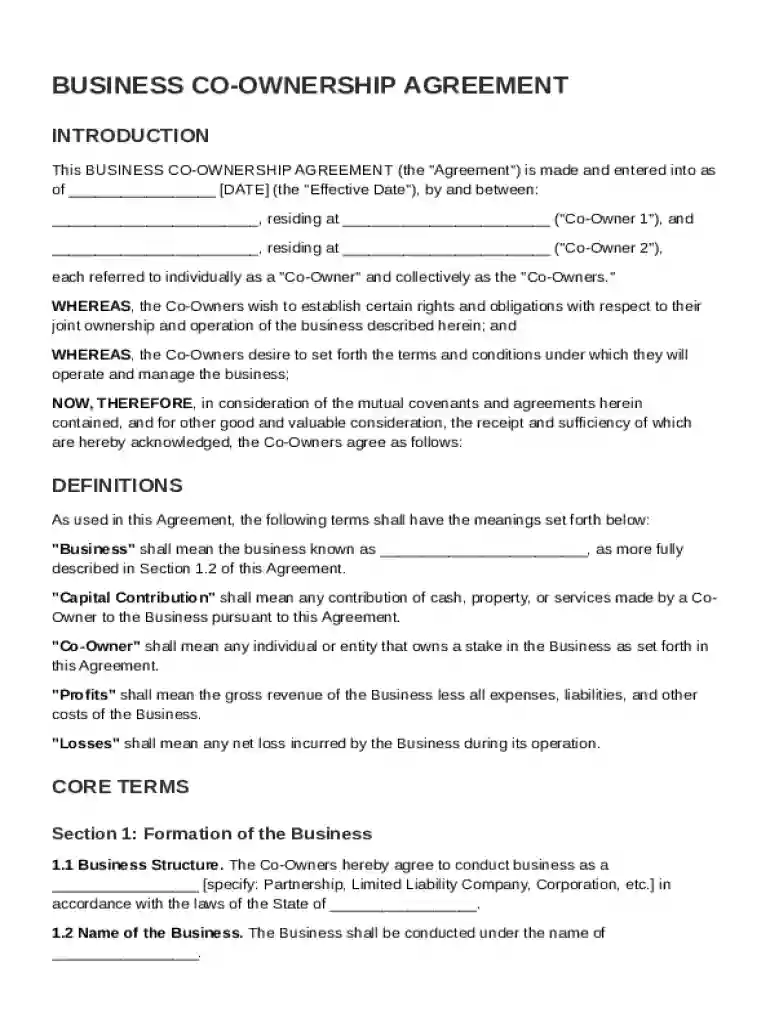
A Business Co-Ownership Agreement is a legal document detailing the terms under which two or more parties will jointly own and manage a business. It serves to establish the foundational rights, obligations, and expectations for each co-owner, minimizing potential disputes and ensuring smooth operations. This agreement encompasses essential components such as definitions, business structure, ownership interests, management roles, profit and loss distribution, dispute resolution, and mechanisms for termination or dissolution. Each term is crafted to provide clarity and understanding, crucial for maintaining healthy business relationships and legal compliance.
Consider two friends who wish to start a bakery. They use a Business Co-Ownership Agreement to define their roles—one managing operations, the other handling finances. This clarity prevents misunderstandings and promotes a cooperative environment. Additionally, should a conflict arise, the agreement provides a clear roadmap for resolution, preventing costly legal battles and ensuring business continuity.
A comprehensive Business Co-Ownership Agreement includes several components vital for protecting the interests of all parties involved.
For example, if three co-owners contribute different amounts of capital, the agreement specifies if profits will be distributed based on investment proportion or another metric, ensuring there's no ambiguity.
Completing a Business Co-Ownership Agreement Template involves several critical steps to ensure all relevant aspects are thoroughly addressed.
Gather Information: Collect details about the business, including name, purpose, and co-owner identities.
Define Terms: Clearly articulate ownership stakes, roles, and responsibilities.
Draft Content: Use a template to input gathered data, ensuring each section (e.g., management duties, profit-sharing) is customized to suit specific needs.
Review Legal Requirements: Confirm that the agreement adheres to state laws and regulations.
Seek Legal Advice: Consider consulting a lawyer to ensure the document protects all parties effectively.
Finalize and Sign: Once reviewed, all parties should sign the document to make it legally binding.
A startup tech company with two founders might begin by specifying a 60/40 ownership split, reflecting respective financial contributions. Each founder’s role, one as CEO and the other as CTO, is defined to streamline operations and enhance accountability.
A Business Co-Ownership Agreement Template, when properly executed, holds significant legal standing and ensures compliance with U.S. laws governing business partnerships. This document serves as an enforceable contract that can be utilized in legal settings to resolve disputes or clarify operational procedures. It is imperative that the agreement is reviewed by legal professionals to meet state-specific requirements, offering robust protection to all parties involved.
If a disagreement arises regarding profit distribution, the agreement acts as a definitive reference, outlining predetermined terms and fostering amicable resolution without requiring court intervention. Ensuring compliance with jurisdiction-specific laws not only solidifies legal protection but also prevents potential fines or penalties.
Understanding the specific language used within a Business Co-Ownership Agreement is essential for clarity and proper execution.
A newcomer to business might initially find terms like "fiduciary duty" confusing. The agreement provides clear definitions, mitigating misunderstandings and ensuring all parties have a shared understanding—a crucial factor in collaborative environments.
Utilizing a Business Co-Ownership Agreement Template offers several advantages, ensuring clarity and efficiency in business partnerships.
A group of artists forming a gallery use a template to swiftly create an agreement that aligns their creative goals with business needs, allowing for immediate focus on the artistic endeavors rather than lengthy negotiations over management roles or profit sharing.
Different versions or alternatives of a Business Co-Ownership Agreement Template may be required based on specific business needs or legal contexts.
A basic agreement might suffice for a small family-run business, while a more intricate version is necessary for a multi-million-dollar software company with diverse stakeholder involvement. Selecting the appropriate model ensures all potential issues are adequately covered, promoting efficient and effective business operations.
Each U.S. state may have specific rules that affect the interpretation and enforcement of a Business Co-Ownership Agreement. Understanding these differences is crucial for compliance and effectiveness.
For instance, while California might prioritize mediation in dispute scenarios, New York may favor arbitration. Recognizing and integrating these state-specific nuances ensures that the agreement stands up to legal scrutiny.
By thoroughly considering these topics, a Business Co-Ownership Agreement can be effectively tailored to any joint venture, equipping co-owners with a reliable tool for successful collaboration.
At DocHub, your data security is our priority. We follow HIPAA, SOC2, GDPR, and other standards, so you can work on your documents with confidence.