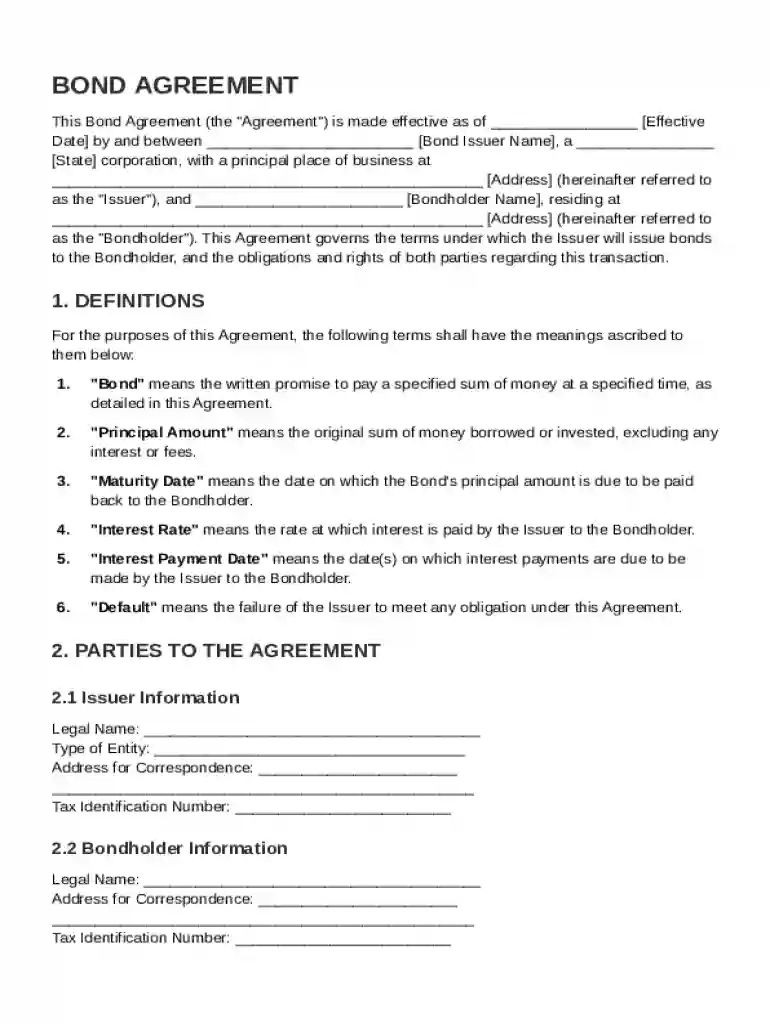
Definition & Meaning
A Bond Agreement is a legally binding document that outlines the terms and conditions of a bond issued by the issuer, typically a corporation or government, to the bondholder. This document serves as a critical contract defining the intricacies of the bond transaction. It details several key aspects, such as the rights and obligations of both parties, interest rates at which the bond will accrue, payment schedules, and legal remedies available should either party default on the agreement. By establishing a clear framework for the financial transaction, the Bond Agreement protects the interests of both parties and mitigates potential disputes.
Key Elements of the Bond Agreement Template
The Bond Agreement Template comprises several crucial elements that ensure clarity and legal enforceability.
- Principal Amount: This is the total amount of money that the issuer is obliged to repay the bondholder by the end of the term.
- Interest Rate: The template will specify the applicable interest rate, whether it is fixed or variable, and how it will be calculated over the bond's term.
- Maturity Date: Clearly identifies the date by which the principal amount must be repaid.
- Payment Schedule: Outlines when interest payments are to be made, and if applicable, how often they will recur, e.g., quarterly, semi-annually.
- Covenants: Lists the specific promises or restrictions placed on the issuer to protect the bondholder, such as maintaining certain financial ratios.
- Default Conditions: Defines what constitutes a default and the legal remedies that can be pursued if a default occurs.
Steps to Complete the Bond Agreement Template
Completing a Bond Agreement Template can be straightforward when approached methodically. Below are the steps typically involved:
- Collect Relevant Information: Obtain all necessary details, including the issuer's and bondholder's particulars, the principal amount, interest rate, and maturity date.
- Review Key Sections: Carefully read through each section of the template to understand essential clauses related to repayment, interest, and covenants.
- Insert Specifics: Fill in the template with specific details gathered, ensuring accuracy and consistency, particularly concerning legal and financial terms.
- Verify Calculations: Double-check interest rate calculations and payment schedules for accuracy.
- Seek Legal Review: Before finalizing, have the document reviewed by a legal professional to ensure all terms comply with relevant laws and regulations.
- Sign and Secure: Once completed, both parties should sign in the designated areas, and appropriate storage or filing measures should be taken to preserve the document.
State-Specific Rules for the Bond Agreement Template
While the fundamental structure of a Bond Agreement remains consistent, specific state laws can influence certain aspects.
- Interest Rate Caps: Some states impose limits on the maximum interest rates permissible on bonds.
- Disclosure Requirements: Varying state regulations may demand additional disclosure of financial information or risk factors.
- Enforcement of Clauses: Legal remedies in case of default may differ according to state jurisdiction, affecting enforceability.
Legal Use of the Bond Agreement Template
The Bond Agreement Template is employed to safeguard the legal interests of both the issuer and the bondholder. It ensures compliance with pertinent legal standards, such as:
- ESIGN Act Compliance: Adheres to electronic signature laws, making digital signing of the agreement legally binding.
- Contract Law: Upholds principles of offer, acceptance, and consideration under contract law to validate enforceability.
- Regulatory Compliance: Ensures the bond issuance complies with both federal and state securities laws.
Business Types That Benefit Most from the Bond Agreement Template
Different business entities leverage bond agreements to facilitate growth and development:
- Corporations and LLCs: Utilize bonds to finance expansions or major capital expenditures without diluting ownership.
- Partnerships: May issue bonds to secure funds for new business ventures or research and development.
- Non-Profit Organizations: Can issue bonds, often referred to as tax-exempt bonds, to fund projects that align with their mission-driven goals.
Examples of Using the Bond Agreement Template
Practically applying a Bond Agreement Template can be seen in various scenarios:
- Expansion Projects: A corporation might issue bonds to finance a new manufacturing plant, using the agreement to outline project costs and repayment plans.
- Public Infrastructure: A city issues a bond for the development of a public park, detailing the bondholder’s right to periodic interest until the project's completion and eventual full payment.
- Debt Refinancing: An existing business may use a bond issue to refinance costly debts, saving on interest payments via the structured terms of the bond agreement.