




01. Edit your form online
Type text, add images, blackout confidential details, add comments, highlights and more.

Type text, add images, blackout confidential details, add comments, highlights and more.

Draw your signature, type it, upload its image, or use your mobile device as a signature pad.

Send it via email, link, or fax. You can also download it, export it or print it out.
The 'Come HOME to Portsmouth' Down Payment and Closing Cost (DPCC) Program is a financial assistance initiative designed to support first-time homebuyers in Portsmouth, Virginia. Funded by the Department of Housing and Urban Development (HUD), the program provides essential funds to assist with down payments and closing costs, easing the process of purchasing a home for low and moderate-income families. This initiative aims to promote affordable housing opportunities and increase homeownership rates within the city.
To qualify for the DPCC Program, potential applicants must meet several criteria. The primary requirement is that individuals must be first-time homebuyers looking to purchase property within Portsmouth, Virginia. Applicants are required to complete a Virginia Housing-approved homebuyer education class, which ensures that participants understand the home buying process. Additionally, they must contribute at least 1% of the sales price towards the purchase. Income limits are also imposed, varying based on household size, to ensure the program benefits those most in need.


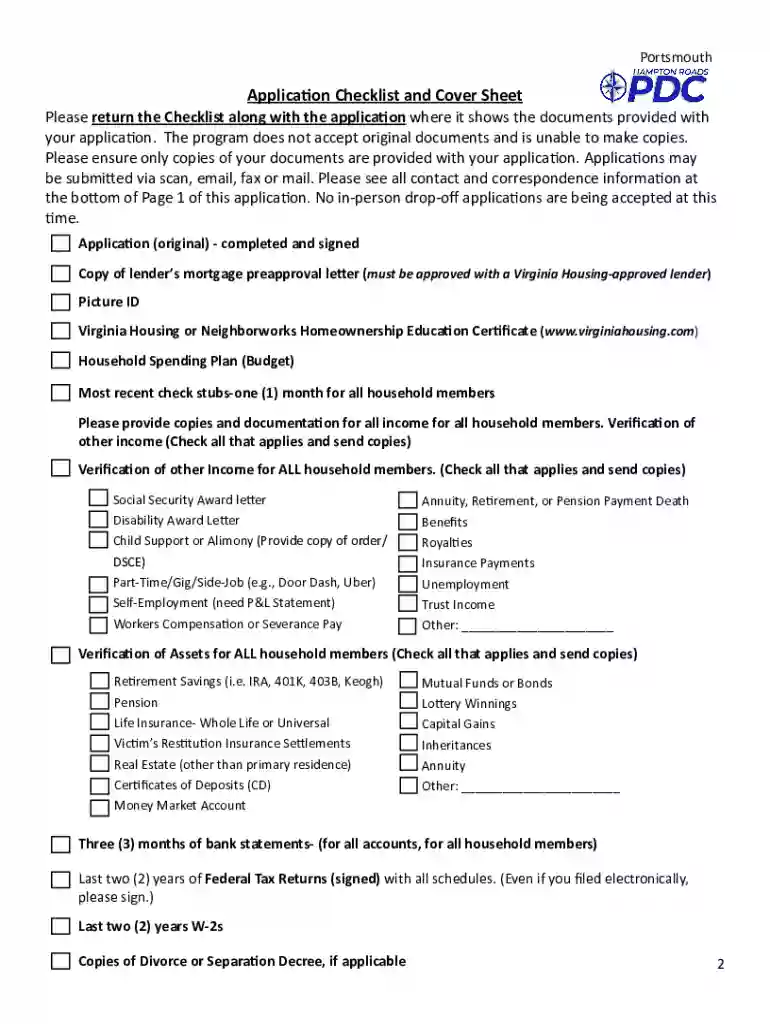
Applying for the DPCC Program involves a structured process. Prospective applicants should first verify their eligibility. Once eligibility is confirmed, applicants need to gather the necessary documentation, which includes income verification, identification, and proof of completion of the homebuyer education course. The application must be thoroughly filled out and submitted to the relevant authority. Following submission, applicants will receive confirmation of receipt and can expect an approval timeframe that varies.
An essential part of the DPCC Program application is the submission of specific documents. These documents verify eligibility and support the application. Key documents include income statements, identification forms, and certificates from the homebuyer education program. Proper documentation ensures the application is processed without unnecessary delays.
The DPCC Program is underpinned by several core elements that make it effective. These include financial assistance covering both down payments and closing costs, guidance through the home buying process, and ongoing support to ensure sustainable homeownership. The program also involves partnerships with local housing authorities and educational bodies to deliver a comprehensive service to applicants.
Although the DPCC Program is primarily an application-based initiative, managing related documents and forms can benefit from digital tools. Software like DocHub offers an efficient way to fill out, sign, and submit government forms digitally. Its compatibility with cloud storage services ensures that applicants can securely store and access their documents, facilitating a smooth application process.
Participation in the DPCC Program is governed by legal requirements that ensure fair access and use of funds. As a federally supported initiative, it adheres to HUD regulations and mandates compliance with local housing laws. Participants are required to use funds solely for down payment and closing costs and must adhere to the terms outlined in their agreement with the program.
The DPCC Program application process is designed to be clear and supportive, though the time from application to approval can vary. Initially, the application is reviewed to ensure all documentation and criteria are met. The approval time largely depends on the completeness of the application and current program demand, which can affect processing speed.
We've got more versions of the The Come HOME to Portsmouth Down Payment and Closing Cost form. Select the right The Come HOME to Portsmouth Down Payment and Closing Cost version from the list and start editing it straight away!
| Versions | Form popularity | Fillable & printable |
|---|---|---|
| 2025 | 4.3 Satisfied (54 Votes) | |
| 2025 | 4.3 Satisfied (49 Votes) | |
| 2024 | 4.6 Satisfied (39 Votes) | |
| 2022 | 4.1 Satisfied (31 Votes) | |
| 2022 | 4.8 Satisfied (116 Votes) | |
| 2022 | 4.1 Satisfied (60 Votes) | |
| 2022 | 4.8 Satisfied (112 Votes) | |
| 2022 | 4.5 Satisfied (52 Votes) | |
| 2021 | 4.5 Satisfied (41 Votes) | |
| 2021 | 4.9 Satisfied (26 Votes) | |
| 2021 | 4.8 Satisfied (66 Votes) | |
| 2021 | 4.9 Satisfied (40 Votes) | |
| 2021 | 4.8 Satisfied (179 Votes) | |
| 2021 | 4.5 Satisfied (55 Votes) | |
| 2021 | 4.8 Satisfied (36 Votes) |
At DocHub, your data security is our priority. We follow HIPAA, SOC2, GDPR, and other standards, so you can work on your documents with confidence.


the Come HOME to Portsmouth Program provides closing cost and/or down payment assistance to qualified first-time homebuyers. Person $37,700 to $60,350. Phone:
Cogentrix Portsmouth Facility is a retired power station in Portsmouth, The plant was deactivated in 2015.


