
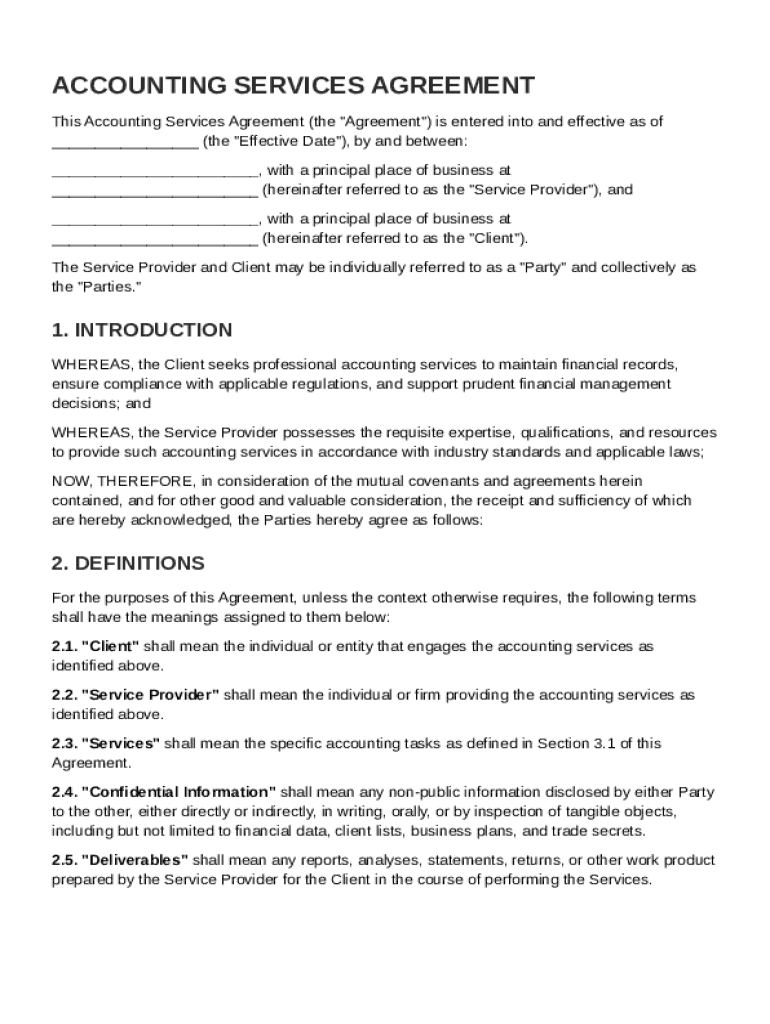







Definition & Meaning
An Accounting Agreement Template is a structured document outlining the terms under which professional accounting services are delivered by a service provider to a client. This template includes crucial aspects such as the scope of services, responsibilities, payment terms, and confidentiality obligations. Its primary goal is to facilitate smooth operations and ensure compliance with relevant regulations, aiding both parties in achieving effective financial management. This template serves as a foundational tool that standardizes agreements, thereby minimizing misunderstandings and legal disputes between parties.
Key Elements of the Accounting Agreement Template
The Accounting Agreement Template encompasses several critical components, ensuring a comprehensive outline of the relationship between a client and a service provider. These elements include:
- Scope of Services: Clearly defined services that the accounting provider will perform, such as bookkeeping, auditing, and tax preparation.
- Payment Terms: Outlines the payment schedule, rates, and terms of payment, whether hourly, monthly, or per project.
- Confidentiality Clauses: Provisions to protect sensitive financial information from unauthorized disclosure.
- Responsibilities: Duties and expectations from both the client and the service provider, ensuring clarity in roles.
- Termination Conditions: Situations under which the agreement can be ended by either party, with or without cause.
These components are essential in fostering a clear and mutually agreeable relationship between the parties involved.
Steps to Complete the Accounting Agreement Template
Completing the Accounting Agreement Template involves several methodical steps to ensure accuracy and completeness:
- Review All Sections: Carefully read through each section of the template to understand the clauses.
- Fill in the Details: Enter the specific details of the parties involved, such as names, addresses, and contact information.
- Define the Scope: Specify the services to be provided and any limitations or exclusions.
- Set Payment Terms: Clearly outline the agreed rates, invoicing schedule, and payment methods.
- Include Confidentiality and Termination Conditions: Detail the clauses that govern confidentiality and the process for termination.
- Review and Adjust: Ensure all conditions meet the legal and situational requirements of both parties, making necessary adjustments.
Ensuring each step is followed meticulously guarantees a comprehensive and enforceable agreement.
Who Typically Uses the Accounting Agreement Template
Various entities and individuals can benefit from using the Accounting Agreement Template, including:
- Accounting Firms: To standardize contracts with clients across different services.
- Independent Accountants: Freelancers who offer specialized accounting services such as tax preparation.
- Business Owners: Companies seeking external accounting expertise to manage financial records.
- Legal Advisors: Professionals who draft or review agreements for compliance and legal soundness.
These templates provide a framework that meets diverse accounting needs while maintaining legal integrity.


Legal Use of the Accounting Agreement Template
The Accounting Agreement Template serves a significant legal purpose by ensuring compliance with applicable laws such as the IRS guidelines and privacy regulations. By doing so, it prevents potential legal disputes over the services rendered and the confidentiality of financial data.
- Compliance Assurance: Conforms to IRS regulations and applicable accounting standards.
- Protection Against Disputes: Clearly outlines responsibilities and expectations, reducing legal conflicts.
- Binding Agreement: Establishes a legally enforceable contract that upholds the interests of all parties.
Utilizing a properly filled Accounting Agreement Template can mitigate risks and uphold lawful business practices.
Important Terms Related to Accounting Agreement Template
Understanding the terminology within the Accounting Agreement Template is vital for effective utilization:
- Indemnity: A provision allowing one party to be compensated for losses incurred due to the actions of another party.
- Force Majeure: A clause excusing non-performance due to extraordinary events beyond control.
- Arbitration Clause: An agreement to resolve disputes outside of court through arbitration.
- Non-compete Clause: A provision restricting the accountant from engaging in competitive activities within a specified period or area.
Familiarity with these terms ensures both parties can navigate the agreement with full comprehension and confidence.
Examples of Using the Accounting Agreement Template
Real-world scenarios highlight the versatility of the Accounting Agreement Template:
- Small Business Partnership: A local bakery hires an accountant to handle monthly bookkeeping, clearly defining services and payment through the template.
- Freelance Accountant: An independent accountant specifies tax services for remote clients, leveraging the template to formalize terms.
- Corporate Engagement: A financial consulting firm standardizes its client agreements, ensuring consistent service delivery and compliance.
These examples illustrate how the template can be adapted to various contexts, ensuring reliable and standardized contractual agreements.
State-Specific Rules for the Accounting Agreement Template
While the Accounting Agreement Template provides a broad framework, state-specific rules may necessitate modifications:
- Licensing Requirements: Some states require accountants to possess specific licenses or certifications.
- Regulatory Compliance: Varies by state, particularly in relation to privacy and data handling.
- State Tax Regulations: Different states impose unique tax codes that may impact agreement terms.
Awareness of state-specific nuances ensures the template is legally compliant and aligned with local regulations, offering a robust foundation for professional accounting services.




