
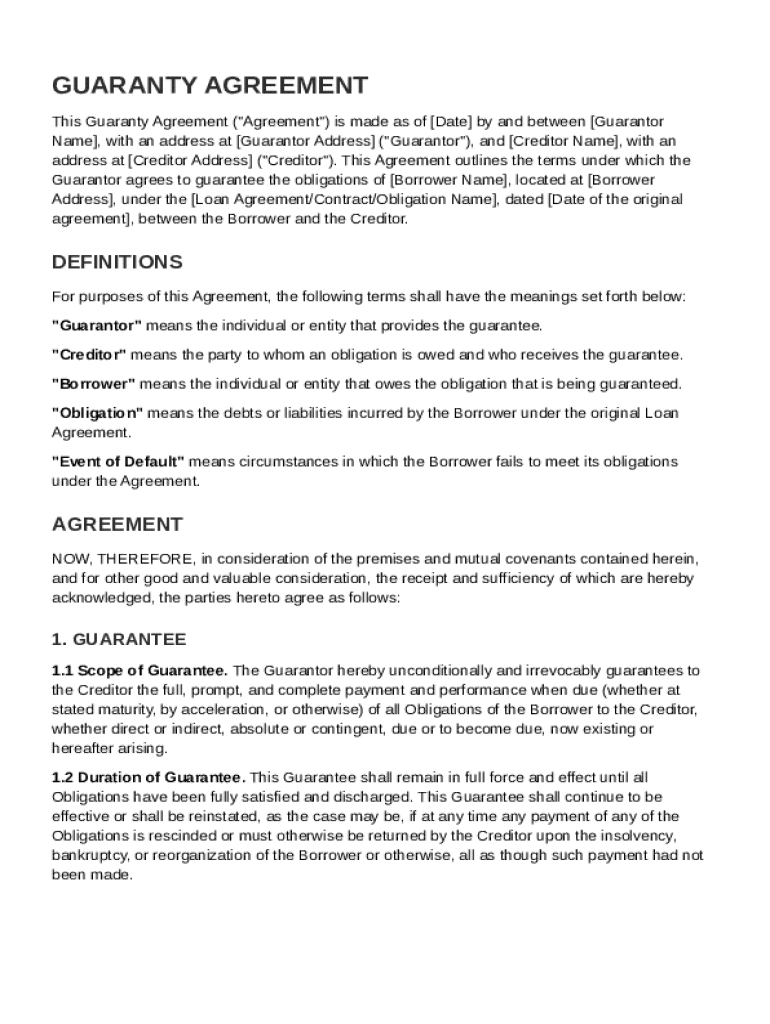







Definition and Meaning of Guaranty Agreement Template
A Guaranty Agreement Template serves as a legal document outlining the responsibilities and commitments of a Guarantor who agrees to fulfill the financial obligations of a Borrower in the event of a default. This template is essential for clearly defining the relationship between a Creditor, Borrower, and Guarantor, setting forth the terms, scope, and limitations of the guarantee.
- Primary Purpose: Ensuring that the Creditor has a secondary source of repayment if the Borrower fails to meet their obligations.
- Key Participants: Borrower (primarily responsible), Guarantor (secondary responsible party), and Creditor (party to whom the obligation is owed).
How to Use the Guaranty Agreement Template
Utilizing a Guaranty Agreement Template involves several steps to ensure all parties understand and agree to the terms.
- Review the Template: Examine each section of the template to understand its terms.
- Personalize the Details: Insert specific details such as the names of parties involved, loan amounts, and conditions.
- Legal Review: Obtain legal advice to ensure conformity with state and federal laws.
- Execution: All parties must sign the document to validate the agreement.
Steps to Complete the Guaranty Agreement Template
Filling out a Guaranty Agreement Template requires careful attention to detail and accurate information entry.
- Identify All Parties: Clearly mention the names, addresses, and roles of the Guarantor, Borrower, and Creditor.
- Specify Guaranteed Obligations: Detail the amount and type of obligations being guaranteed.
- Define Terms: Include definitions for key terms like "Borrower," "Guarantor," and "Creditor."
- Set Scope and Duration: Clearly articulate the duration of the guarantee and any specific limitations.
- Sign and Date: Ensure all parties sign, with the Guarantor signing last to acknowledge their understanding and agreement.
Key Elements of the Guaranty Agreement Template
Crucial components must be present within the template to ensure legality and comprehensiveness.
- Obligation Details: Exact specifications of the obligations guaranteed.
- Triggering Events: Conditions under which the Guarantor’s obligations are activated.
- Representation and Warranties: Statements asserting the capacity and willingness of all parties to enter the agreement.
- Waivers and Amendments: Sections that describe conditions under which modifications are allowed.
Legal Use of the Guaranty Agreement Template
Using the Guaranty Agreement Template legally involves adhering to regulations and understanding the legal implications.
- Validity: Ensure the document complies with state and federal laws.
- Binding Nature: The agreement is enforceable in court, with the Guarantor legally bound to fulfill obligations.
- Jurisdiction: Specify which state’s laws govern the agreement, typically the state where the Creditor is located.
Important Terms Related to Guaranty Agreement Template
Understanding terminology is essential for all parties involved.
- Guarantor: The individual or entity that promises to repay the Borrower’s debt if they default.
- Creditor: The entity to whom the debt is owed.
- Default: The failure to meet the legal obligations or conditions of the loan.
- Liability: The legal responsibility to settle a debt.
Examples of Using the Guaranty Agreement Template
Using a Guaranty Agreement Template can be illustrated through various scenarios.
- Small Business Loan: A business owner personally guarantees a loan taken out by their business.
- Real Estate Transactions: Guarantor backing a rental lease to ensure rental payments.
- Partnerships: Partner guarantees a loan for the business entity.
State-Specific Rules for the Guaranty Agreement Template
Different states may have unique considerations and requirements.
- Governing Law Clauses: Specify the applicable state law that will oversee the agreement.
- State-specific Regulations: Some states may impose special disclosure requirements or restrictions on certain clauses.
- Local Legal Counsel: Recommendation to consult with an attorney familiar with the specific state laws to ensure compliance.


