
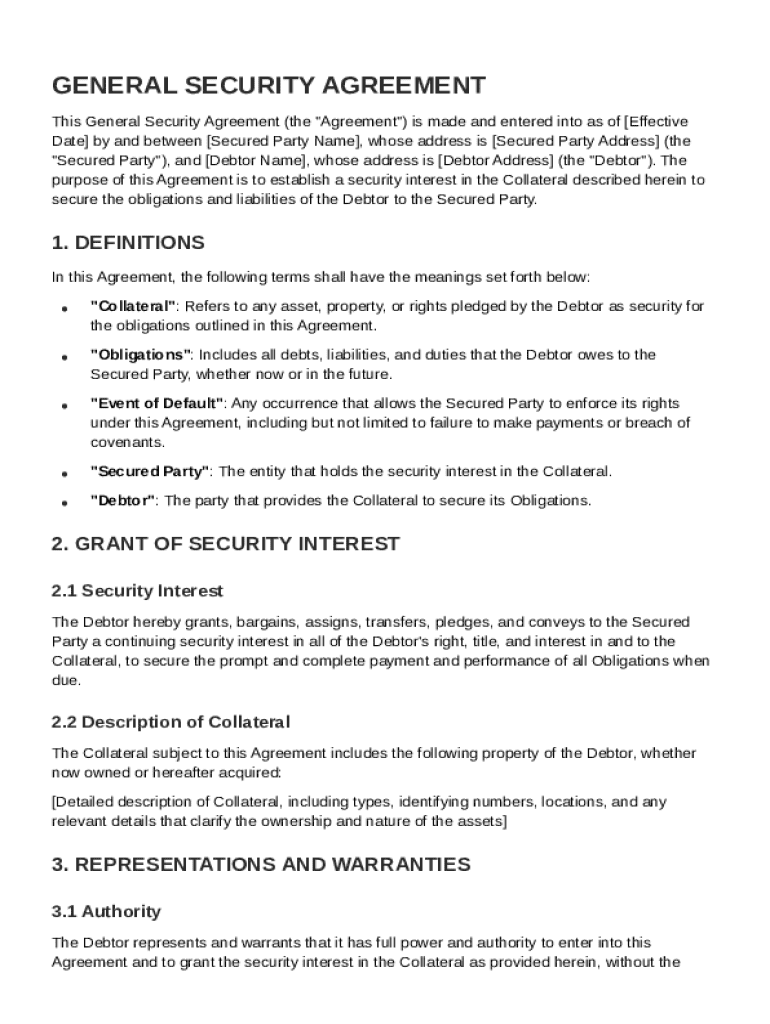







Definition & Meaning
A General Security Agreement (GSA) is a legal document that formalizes a security interest in specific collateral to secure the obligations of the debtor to the secured party. This agreement specifies the terms under which the secured party can claim the debtor's assets if the debtor defaults on their obligations. The GSA is crucial in delineating definitions, the grant of security interest, representations, and warranties, as well as covenants concerning the collateral's maintenance and insurance. Additionally, it outlines events of default and the remedies available to the secured party in such instances. This agreement also includes various miscellaneous provisions like governing law and amendments, ensuring a complete framework for both parties involved.
How to Use the General Security Agreement Template
To efficiently utilize a General Security Agreement Template, follow these procedures:
-
Identify the Parties Involved: Clearly identify the debtor and the secured party, including their legal names and addresses.
-
Define the Collateral: Identify and describe the assets under the security interest, ensuring clarity and precision.
-
Outline Obligations: Clearly enumerate the debtor's obligations under the agreement and the conditions for fulfillment.
-
Grant of Security Interest: Specify how the security interest is granted in relation to the defined collateral.
-
Detail Covenants: Include covenants that the debtor must adhere to, such as maintaining and ensuring the collateral.
-
Specify Events of Default: Define conditions under which a default is considered to have occurred.
-
Include Miscellaneous Provisions: Add clauses regarding jurisdiction, amendment procedures, and other significant terms.
Each field of the template should be completed with accurate information to ensure it effectively secures the interests of the involved parties.
Important Terms Related to General Security Agreement Template
Understanding essential terms related to the General Security Agreement Template is crucial for comprehending its comprehensive application:
- Collateral: Assets pledged by the debtor as security for loan repayment.
- Secured Party: The entity (lender) that holds the security interest in the debtor’s collateral.
- Debtor: The borrower who pledges their assets as collateral.
- Security Interest: A legal claim on collateral that secures the payment or performance of an obligation.
- Default: Failure of the debtor to meet the legal obligations of the agreement.
- Perfection: Legal process of protecting a secured party's rights in the collateral against third parties.
- Priority: The order of rights among various secured parties in the same collateral.
Legal Use of the General Security Agreement Template
The General Security Agreement Template is designed to provide a legally binding framework for securing loans with collateral. Its use is grounded in legal statutes that dictate the allowable terms and enforceability of security interests.
Key components include:
- Compliance with State Laws: Ensure that the agreement aligns with the governing laws of the jurisdiction where it is implemented.
- Enforcement: Detailed terms regarding enforcement rights under state-specific regulations.
- Rights on Default: Clearly outlined secured party rights in case of debtor default, enabling lawful asset recovery processes.
By adhering to these regulations, parties can ensure that the agreement is legally sound and enforceable.
Key Elements of the General Security Agreement Template
Several pivotal elements must be carefully incorporated within a General Security Agreement Template to ensure clarity and enforceability:
- Description of Collateral: Clear and precise identification of assets offered as security.
- Obligations of the Debtor: Specific duties and responsibilities during the loan period.
- Security Interest Clause: Explicit description of how the security interest is applied to the collateral.
- Covenants: Requirements for maintenance, insurance, and preservation of collateral value.
- Default Conditions: Circumstances under which the debtor is considered to be in default.
- Remedies and Rights: Legal remedies available to the secured party if the debtor defaults.
These elements are vital for creating a robust agreement that accurately protects the interests of all parties involved.
Steps to Complete the General Security Agreement Template
- Gather Information: Collect all necessary information on the debtor, secured party, and collateral.
- Fill Template: Complete the template with the collected data following each section’s guidelines.
- Review Terms: Ensure all terms, especially around collateral and default, are accurately captured.
- Consult Legal Counsel: Have a legal professional review the completed agreement for compliance and accuracy.
- Sign the Agreement: Once reviewed, both parties should sign to enforce the agreement.
Completing each step with due diligence ensures the final document is thorough and binding.
Examples of Using the General Security Agreement Template
In practical scenarios, businesses frequently use the GSA for various financial arrangements:
- Commercial Loans: Businesses offering fixed assets as security to obtain loan financing for expansion.
- Inventory Financing: Retail companies securing loans with inventory as collateral.
- Construction Projects: Contractors securing loans using equipment and machine assets.
These applications demonstrate the GSA's flexibility and practical utility in multiple business finance contexts.
State-Specific Rules for the General Security Agreement Template
The rules governing a General Security Agreement can vary significantly by state, influencing its enforceability and the processes involved. Important state-specific considerations include:
- UCC Filings: Requirements for public filing under the Uniform Commercial Code, which may differ across states.
- State Tax Liens: Variations in how state laws address tax liens on collateral.
- Judicial Processes: Differences in state laws governing the judicial foreclosure procedures.
Understanding these nuances ensures that agreements are tailored to comply with local regulations, thereby minimizing legal risks.




