






Definition and Meaning of the Gas Supply Agreement Template
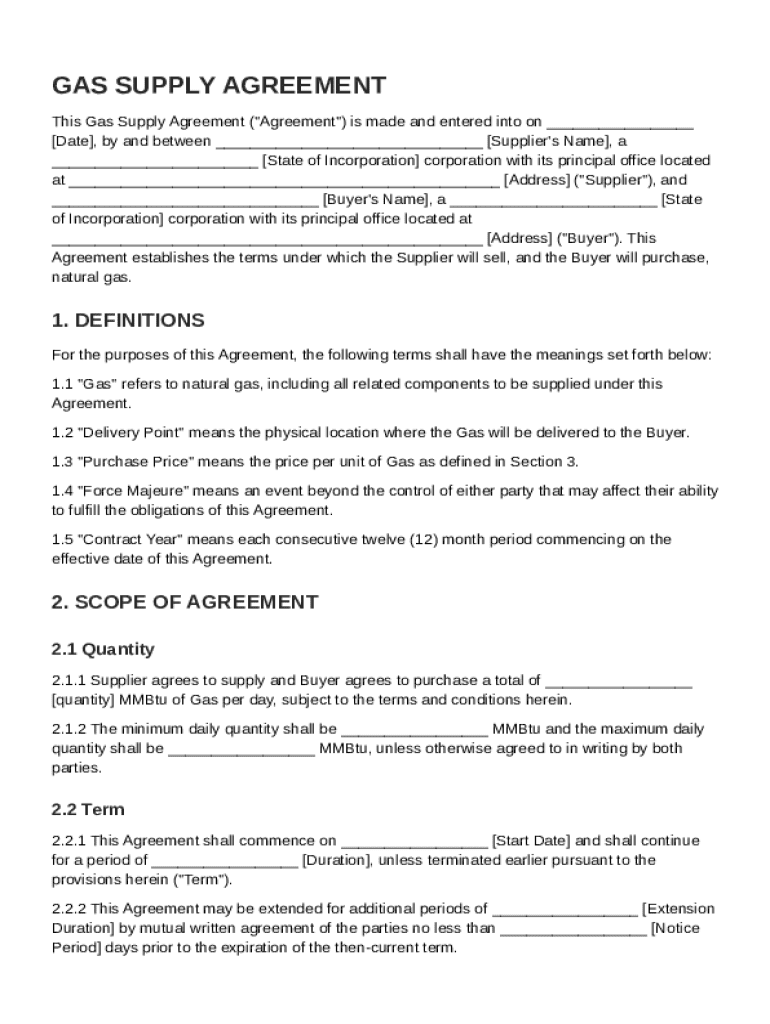
A Gas Supply Agreement Template is a foundational document that outlines the essential terms under which natural gas is supplied from one party, known as the Supplier, to another party, known as the Buyer. This template provides a comprehensive framework detailing responsibilities, rights, and protections for both parties involved in the transaction. The core components include pricing mechanisms, delivery schedules, quality specifications, and risk management clauses such as force majeure. Understanding the nuances within these agreements is critical, as they dictate the operational relationship and resolve disputes that may arise between the parties involved.
Practical Scenarios and Examples
Most commonly, gas supply agreements are used in commercial contexts where businesses need a steady and reliable supply of natural gas for operations or manufacturing processes. For example, a manufacturing plant relying on natural gas for production lines would enter into a long-term agreement outlining delivery expectations and penalties for non-compliance. By utilizing a template, parties can ensure thorough coverage of both standard terms and customizable sections tailored to specific industry needs.
Steps to Complete the Gas Supply Agreement Template
Completing a gas supply agreement efficiently requires a systematic approach. The template ensures all critical areas are covered, mitigating risks of misunderstanding or non-compliance.
- Start by identifying and defining both parties involved, including full legal names and addresses.
- Establish the scope of the agreement detailing what the supply covers, expected volume, and quality standards.
- Outline pricing terms, considering variables such as market rates, fixed pricing, or escalator clauses.
- Specify delivery terms, schedules, and acceptable transportation methods.
- Set responsibilities of both Supplier and Buyer, ensuring adherence to applicable regulations.
- Include contingency plans such as termination clauses and conditions under which they may be invoked.
- Ensure all sections are agreed upon, dated, and signed by authorized representatives from both parties.
Variations and Adaptations
While the core structure remains consistent, templates may be customized to align with specific legal or operational environments. For instance, changing economic conditions or regulatory adjustments may necessitate modifying the delivery or payment terms. Having a flexible template allows both parties to adapt to unforeseen changes without a complete redraft.
Key Elements of the Gas Supply Agreement Template
The gas supply agreement template encompasses several key elements vital for ensuring a robust and enforceable contract.
- Definitions and Interpretations: Clarifies specific terminology used throughout the document.
- Term and Termination: Details the duration of the agreement and grounds for termination by either party.
- Responsibilities and Liabilities: Allocates the duties of each party and outlines indemnity provisions.
- Pricing and Adjustments: Documents how pricing is determined, including any adjustment mechanisms for market fluctuations.
- Quality and Performance Standards: Sets the benchmarks that the supplied gas must meet to fulfill agreement terms.
- Dispute Resolution: Provides mechanisms for resolving disagreements without resorting to litigation.
- Confidentiality: Protects sensitive information shared between parties during the agreement term.
Specific Clauses and Provisions
A detailed template will also include specialized provisions like conditions unique to specific industries or geographical areas. For example, incorporating clauses concerning the environmental impact and compliance with local regulations can be vital depending on the agreement's jurisdiction.
Legal Use of the Gas Supply Agreement Template
The legal enforceability of a gas supply agreement hinges upon its compliance with applicable laws and regulations. In the United States, this means adhering to contract laws specific to each state, alongside federal regulations governing the energy sector.
Ensuring Compliance
Engaging legal counsel when drafting and customizing the template is prudent, ensuring all standard and unique clauses are enforceable. Each signing party must have a clear understanding and the authority to enter into such agreements. Additionally, incorporating electronic signature functionality helps streamline the signing process, enhancing efficiency while maintaining legal standing.
Important Terms Related to Gas Supply Agreement Template
Recognizing critical terms within the agreement fosters understanding and aligns the parties' expectations.
- Force Majeure: A clause that frees parties from liability or obligation when extraordinary events prevent fulfilling the contract.
- Escalator Clause: Allows for price adjustments based on market indices or predefined criteria.
- Indemnity Clause: Outlines compensation responsibilities if one party causes damage or incurs loss.
Contextual Examples
For instance, during a natural disaster, the force majeure clause might be invoked if a supplier cannot deliver gas due to infrastructure damage, relieving them of penalties associated with non-delivery during such events.
Software Compatibility for the Gas Supply Agreement Template
The versatility of a gas supply agreement template can be enhanced when integrated with document management platforms such as DocHub. This compatibility allows for seamless editing, signing, and sharing of agreement documents.
Benefits of Using DocHub
DocHub provides an efficient solution for managing legal documents. With 256-bit SSL encryption and features like real-time collaboration, parties can securely negotiate, revise, and finalize agreements. Furthermore, the ability to use legally binding electronic signatures simplifies the process, particularly for companies leveraging digital workflows.
State-Specific Rules for the Gas Supply Agreement Template
Understanding state-specific regulations is key when drafting a gas supply agreement to ensure legal standing and compliance. Each state in the U.S. may have unique legal requirements and energy market conditions that impact the structuring and enforcement of contracts.
Adapting to State Regulations
For example, states like Texas have explicit regulatory frameworks governing natural gas transactions due to its extensive energy sector. Similarly, California has stringent environmental standards that may necessitate additional clauses within the agreement to ensure compliance. Customizing templates to reflect these state-specific nuances minimizes the risk of legal challenges or compliance issues.