






Definition and Meaning
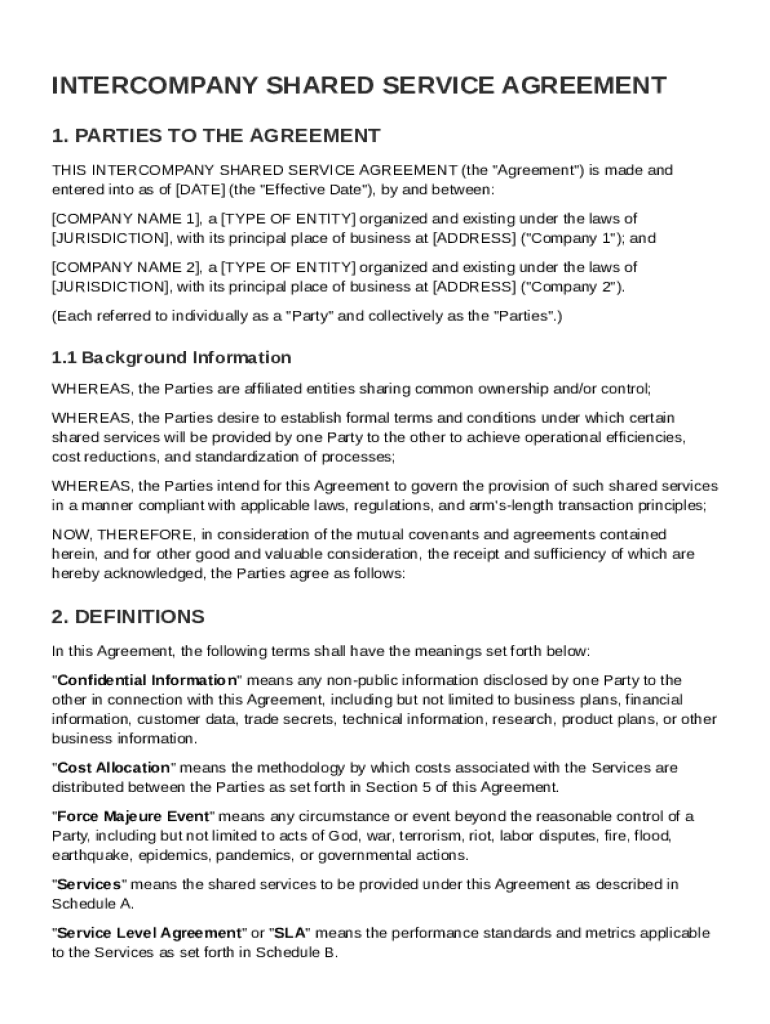
The Intercompany Shared Service Agreement Template is a pivotal legal document that delineates the parameters under which two or more affiliated entities, often operating under a parent company, exchange services. This agreement is crafted to ensure that shared services between related companies are rendered efficiently and cost-effectively. By clearly defining the roles, responsibilities, and terms of service between affiliated entities, the template aims to optimize operational efficiency and reduce ambiguity in intercompany dealings, thus leading to more streamlined business operations.
Key Elements of the Intercompany Shared Service Agreement Template
A thorough understanding of the core components of this agreement is essential for creating a robust shared service agreement. Some critical elements include:
-
Scope of Services: This part outlines the specific services that will be exchanged between the parties—whether they pertain to IT support, financial services, human resources, or other functions.
-
Roles and Responsibilities: Each party's responsibilities are clearly defined to establish accountability and minimize disputes.
-
Cost Allocation Methodologies: Details on how costs will be divided between the parties are crucial, often using methodologies like cost-plus or fixed cost.
-
Service Level Agreements (SLAs): These agreements specify the performance standards that the provided services must meet.
-
Confidentiality Obligations: Protects sensitive business information from unauthorized disclosure, outlining measures to maintain confidentiality.
-
Termination Rights and Conditions: This section specifies the conditions under which the agreement can be terminated, including notice periods and consequences.
-
Liability Provisions: Establishes the limitations and extents of liability for parties if issues arise during the service period.
-
Dispute Resolution Procedures: Effective methods for resolving conflicts, such as mediation or arbitration, are arranged to circumvent lengthy court disputes.
How to Use the Intercompany Shared Service Agreement Template
To effectively utilize this template, follow these steps:
-
Identify Key Stakeholders: Involve representatives from all parties who will be using or affected by the shared services.
-
Customize with Relevant Details: Tailor the template with specific details pertaining to the roles, responsibilities, and expectations of each party.
-
Review and Edit: Ensure the document reflects all legal and operational requirements particular to the related companies and sectors.
-
Consult Legal Advisors: Seek legal advice to verify compliance with relevant laws and regulations.
-
Finalize and Execute: Once all modifications are complete and approved, execute the agreement by obtaining signatures from authorized representatives of each entity.
Who Typically Uses the Intercompany Shared Service Agreement Template
The template is typically employed by large corporations that have multiple subsidiaries or divisions under a parent company. Key users include:
-
Corporations: Large multinationals operating across different jurisdictions.
-
Subsidiaries: Smaller entities under a larger corporate umbrella that share services like IT, human resources, or marketing.
-
Internal Service Providers: Departments within the parent company that offer specialized services to other branches.


Legal Use of the Intercompany Shared Service Agreement Template
This agreement must adhere to specific legal standards to ensure compliance and avoid jurisdictional issues. Critical legal aspects include:
-
Compliance with Local Laws: Since rules can vary by state or region, the agreement must comply with all local regulatory requirements.
-
Legally Binding Clauses: Must include clauses that make the agreement enforceable in a court of law.
-
Transparent Disclosure: All terms and conditions should be transparent to prevent misinterpretation or potential legal disputes.
State-Specific Rules for the Intercompany Shared Service Agreement Template
Different states in the U.S. may have varying regulations regarding intercompany agreements. Some states might have specific rules about:
-
Tax Implications: Understanding any state-specific tax obligations associated with the sharing of services can prevent future fiscal penalties.
-
Industry-Specific Regulations: Certain industries may face bespoke state regulations that influence the execution of intercompany agreements.
Examples of Using the Intercompany Shared Service Agreement Template
Practical examples can provide insight into the utility and adaptability of the template:
-
Scenario 1: A logistics company shares its HR services across regional branches to ensure centralized and standardized employee management.
-
Scenario 2: An international tech company consolidates its financial services across different subsidiaries to optimize cost efficiency and data synchronization.
Business Types That Benefit Most from the Intercompany Shared Service Agreement Template
Businesses across various sectors can leverage this agreement type, but those benefiting most include:
-
Information Technology Firms: Companies that need to standardize solutions and services across different geographical locations.
-
Financial Institutions: Banks and financial service providers that streamline back-office functions for efficiency.
-
Manufacturing Corporations: Large manufacturing entities with numerous production sites requiring centralized service agreements for resource management.
By understanding these elements, users can better align their shared service agreements with business goals, leading to optimal outcomes in intercompany collaborations.