




01. Edit your form online
Type text, add images, blackout confidential details, add comments, highlights and more.

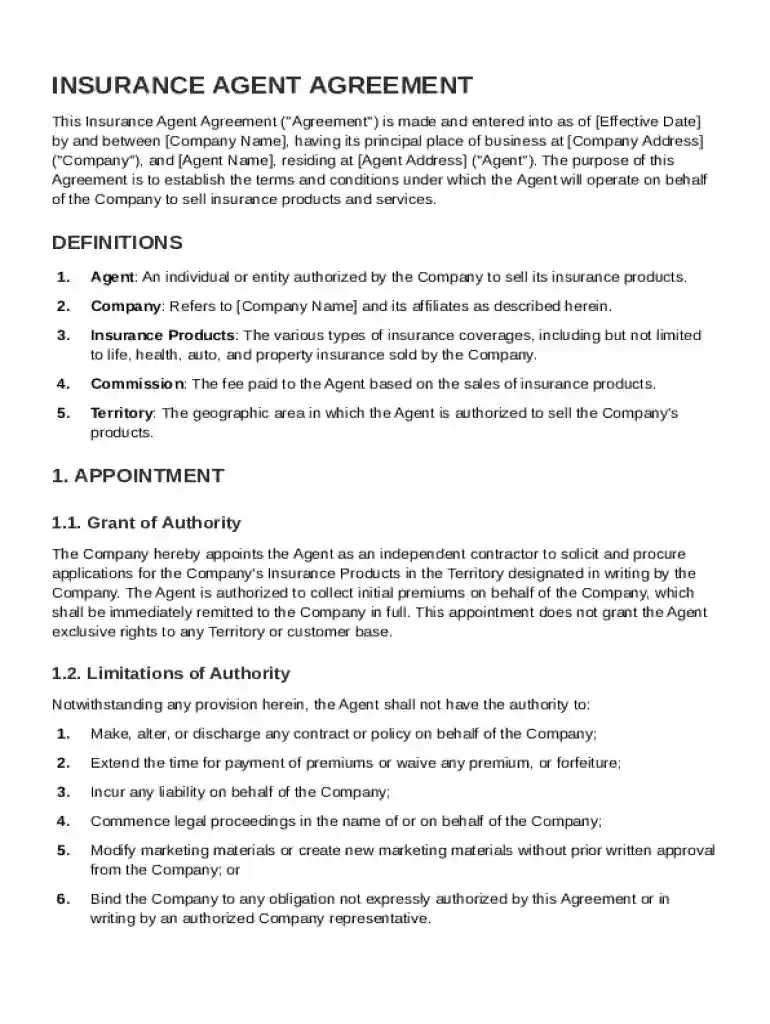
Type text, add images, blackout confidential details, add comments, highlights and more.

Draw your signature, type it, upload its image, or use your mobile device as a signature pad.

Send it via email, link, or fax. You can also download it, export it or print it out.
The Insurance Agent Agreement Template serves as a crucial document outlining the terms under which an insurance agent operates on behalf of an insurance company. Its primary purpose is to detail the roles, obligations, and limitations of the agent while ensuring compliance with legal standards. This agreement not only defines the relationship between the company and the agent, often designating the latter as an independent contractor, but also mitigates risks by setting clear expectations regarding sales, compensation, and confidentiality. In the U.S., understanding these components is essential for maintaining a lawful and productive agent-company relationship.
The template comprises multiple essential sections that help govern the conduct and operations of an insurance agent:
Sales Obligations and Responsibilities: Details the specific insurance products the agent is authorized to sell, along with any targets or quotas.
Compliance and Legal Requirements: Specifies adherence to federal and state laws, regulatory guidelines, and industry standards.
Compensation Structure: Outlines commission rates, potential bonuses, and payment schedules to ensure transparent financial relations.
Termination Provisions: Clearly sets the conditions and procedures for terminating the agreement, protecting both parties from unjust dismissal.
Confidentiality and Indemnification: Ensures sensitive information is safeguarded and outlines responsibilities in instances of breach.
Dispute Resolution: Provides methods for resolving conflicts, including mediation or arbitration options.
Utilizing this template involves several procedural steps to ensure it meets the specific needs of both the insurance company and the agent:
Customization: Adapt the template to fit the unique business context, including inserting company-specific details and agent information.
Review and Amendments: Thoroughly examine the document for any additional clauses or legal stipulations necessary for comprehensive coverage.
Legal Consultation: Engage with legal advisers to confirm adherence to state-specific laws and regulatory requirements, which can vary significantly across regions.
Finalization and Agreement: Upon mutual agreement, the document should be signed electronically via platforms like DocHub to maintain legal validity and enforceability.
Completing this template involves several structured steps to ensure its adequacy and accuracy:
Information Collection: Gather all relevant details related to both the insurance company and the agent, such as contact information, registration numbers, and relevant licenses.
Data Entry: Input the necessary data into the template's fillable fields, ensuring clarity and precision to avoid discrepancies during the term of the contract.
Clause Evaluation: Examine each clause to ensure all contingencies are covered, including scenarios like changes in regulation or market conditions.
Digital Signing: Use e-signature tools to securely execute the agreement, preserving an audit trail for future reference.
This template is a legally binding document that upholds the terms agreed upon between an insurance company and its agent. It is vital that this document adheres to the Electronic Signatures in Global and National Commerce (ESIGN) Act, establishing its enforceability when signed electronically. Users must ensure all conditions comply with applicable state regulations, effectively making the agreement suitable for defending potential disputes relating to agent conduct, compensation, and other obligations.
Understanding critical terms within this template aids in comprehending its full scope:
Independent Contractor: Highlights that the agent has autonomy in their operations, distinct from an employee relationship.
Commission: Represents the primary form of remuneration for agents based on sales performance.
Confidential Information: Refers to proprietary or sensitive data that requires protection during and after the agreement period.
Indemnification: Legal protection against claims or liabilities resulting from the agent’s actions.
This document is primarily utilized by:
Insurance Companies: To formalize and govern relationships with agents who sell their insurance products.
Independent Insurance Agents: Seeking to establish clear terms of operation with companies while protecting their professional interests.
In addition, legal professionals and business consultants often engage with these templates to provide strategic advice on compliance and contract management.


While traditional paper agreements offer a tangible record, the digital version of the Insurance Agent Agreement Template holds several advantages:
Accessibility: Cloud-based platforms like DocHub ensure easy accessibility from any location, enhancing workflow efficiency.
Security: Digital templates benefit from advanced encryption and secure storage solutions, reducing the risk of unauthorized access.
Speed: Electronic signatures expedite the signing process, reducing turnaround times compared to paper-based methods.
At DocHub, your data security is our priority. We follow HIPAA, SOC2, GDPR, and other standards, so you can work on your documents with confidence.


