Property Partnership Agreement Template 2026

Get Form
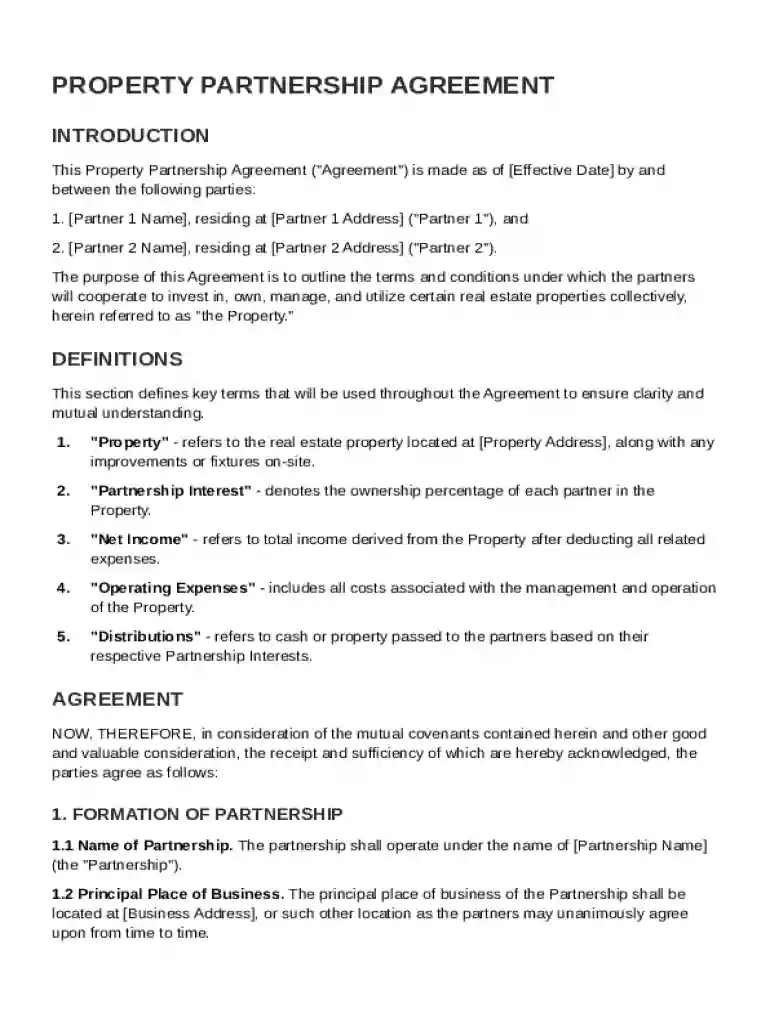
Property Partnership Agreement Template Preview on Page 1

Here's how it works

01. Edit your form online
Type text, add images, blackout confidential details, add comments, highlights and more.

02. Sign it in a few clicks
Draw your signature, type it, upload its image, or use your mobile device as a signature pad.

03. Share your form with others
Send it via email, link, or fax. You can also download it, export it or print it out.

Definition and Meaning

A Property Partnership Agreement Template is a legal document used to formalize the terms and conditions of a real estate partnership. It delineates the roles, responsibilities, and commitments of each partner involved in the investment, management, and use of real estate properties. This template serves as a foundation for defining relationships between partners, addressing the allocation of profits, and stipulating the procedures for handling disputes or withdrawals. For example, it may specify what constitutes 'Partnership Interest' and how 'Net Income' from the property is calculated and divided. Understanding this agreement's intricacies is essential to protect each partner's interests and ensure a transparent and fair partnership dynamic.

Key Elements of a Property Partnership Agreement Template

Several crucial components are typically included in a Property Partnership Agreement. These elements ensure that the partnership is managed effectively and that partners are clear about their roles:

  • Formation: Details the official creation of the partnership, including official start date and initial capital contributions.
  • Profit Sharing: Specifies how profits and losses will be shared among partners, possibly proportional to each party's investment.
  • Management Responsibilities: Allocates duties such as property management, decision-making authority, and routine maintenance tasks.
  • Partner Withdrawal: Sets out the terms under which partners can exit the partnership, including buyout procedures.
  • Dispute Resolution: Defines the methods for resolving conflicts, potentially including mediation or arbitration clauses.

Important Terms Related to the Property Partnership Agreement Template

Understanding the terminology used within the Property Partnership Agreement is critical for clarity and precision in the partnership:

  • 'Partnership Interest' refers to the ownership percentage each partner holds in the property and the partnership.
  • 'Net Income' is calculated by subtracting all relevant expenses from the gross income generated by the property.
  • 'Capital Contribution' details the initial and subsequent financial investments each partner makes to facilitate the partnership's objectives.

Legal interpretations of these terms affect how diverse scenarios are managed within the partnership, ensuring that partners have a mutual understanding from the outset.

Who Typically Uses the Property Partnership Agreement Template

This template is used by a diverse group of individuals and entities interested in investing in real estate collaboratively. This includes:

  • Individual Investors: People looking to diversify their investment portfolio through real estate might join forces to share financial and managerial responsibilities.
  • Family Members: Families may choose to invest collectively in properties that serve as both investment and residential properties for family members.
  • Business Entities: Corporations, LLCs, and partnerships that specialize in real estate development or management frequently use these agreements to structure their joint ventures.

These users benefit from a structured framework that outlines obligations and ensures legal protection, reducing the risk of disputes.


decoration image ratings of Dochub

Why Use a Property Partnership Agreement Template

The template is particularly beneficial because it provides a standardized structure, reducing the complexity of drafting an agreement from scratch. Here are several reasons to utilize this template:

  • Legally-Certain Structure: Ensures the partnership is governed by clear rules that are consistent with legal standards.
  • Conflict Reduction: Minimizes potential disputes by setting out clear regulations and procedures for operation and conflict resolution.
  • Operational Efficiency: Facilitates decision-making by outlining specific management roles and authorities.

By using a template, parties can quickly establish a partnership with clarity and legal backing, allowing them to focus on growth and profitability rather than legal minutiae.

Steps to Complete the Property Partnership Agreement Template

Completing this template requires careful attention to detail to ensure all relevant factors are considered and accurately documented:

  1. Identify Partners: List all individuals or entities entering the partnership, including their personal or business details.
  2. Define Contributions: Specify the financial and operational contributions each partner will make.
  3. Specify Terms and Conditions: Detail terms concerning profit sharing, dispute resolutions, and operational responsibilities.
  4. Review Legal Requirements: Ensure compliance with state-specific partnership regulations.
  5. Consult with Legal Counsel: Obtain a legal professional's review to ensure the agreement's enforceability and protection against legal risks.
  6. Sign and Execute: Officially execute the agreement with signatures from all parties involved.

By following these steps, partners can ensure the agreement is comprehensively drafted to cover all potential contingencies.

Legal Use of the Property Partnership Agreement Template

The template provides a legal framework that partners agree upon to govern their cooperative endeavors. These agreements must adhere to state and federal laws concerning partnerships and real estate. This adherence ensures the agreement is enforceable and offers legal recourse if disputes arise. Property partnership agreements typically incorporate:

  • Adherence to the Uniform Partnership Act (UPA): If applicable, partners should recognize regulations set forth by state adaptations of the UPA.
  • Consideration of Local Real Estate Laws: Comply with specific state or local regulations that may impact operations or profit-sharing methodologies.

Proper legal utilization of this template creates a binding document that partners can rely on for consistent governance.

State-Specific Rules for the Property Partnership Agreement Template

Each U.S. state may have particular rules and regulations regarding partnership agreements:

  • Registration Requirements: Some states require partnerships to register with a state office for legal recognition.
  • Tax Implications: State-specific tax considerations may affect how profits are reported and distributed.
  • Legal Dispute Frameworks: Differences in dispute resolution norms or requirements can impact agreement content and procedures.

Partners should ensure their agreements consider these variations to ensure state compliance and avoid potential legal complications. Consulting with a legal expert familiar with local laws is advisable when drafting a template in a specific jurisdiction.

Software Compatibility for the Property Partnership Agreement Template

DocHub's platform facilitates seamless compatibility with various file formats and integrates effectively with multiple software ecosystems:

  • Document Editing: Users can edit agreement templates within DocHub, utilizing tools identical to those in preferred editing suites like Microsoft Word or Google Docs.
  • Digital Signature Options: Agreement sign-off can be efficiently handled using DocHub's legally binding e-signature capabilities.
  • Cloud Integration: Directly import and export documents from Google Drive, Dropbox, and OneDrive, eliminating redundancy in file management processes.

This compatibility ensures that users can manage their agreement templates within a convenient digital framework, allowing for smooth transitions from drafting to implementation stages.

be ready to get more

Complete this form in 5 minutes or less

Get form

Got questions?

We have answers to the most popular questions from our customers. If you can't find an answer to your question, please contact us.
Contact us
There are three relatively common partnership types: general partnership (GP), limited partnership (LP) and limited liability partnership (LLP). A fourth, the limited liability limited partnership (LLLP), is not recognized in all states.
It is highly recommended that you get professional legal advice when drawing up a partnership agreement. An effective agreement should include the following information but this isnt an exhaustive list and what should be included in a partnership agreement will be dependent on the specific business.
For these reasons, we strongly recommend having your partnership agreement written by a specialist solicitor with specific experience in these matters. It is also a good idea for each partner to have independent legal advice before signing.
The 5Ds: Key Risks to Business Partnerships These unintended consequences can include Divorce, Death, Disagreement, Distress, and Disability, also known as the 5Ds.
A RELP typically has a general partner (who manages the property and makes business decisions) and a limited partner (who provides capital but has few management responsibilities). General partners face unlimited personal liability for all partnership debts, while limited partners can only lose what they invested.

Security and compliance

At DocHub, your data security is our priority. We follow HIPAA, SOC2, GDPR, and other standards, so you can work on your documents with confidence.

Learn more
ccpa2
pci-dss
gdpr-compliance
hipaa
soc-compliance
be ready to get more

Complete this form in 5 minutes or less

Get form

People also ask

Partnership agreements do not have to be docHubd. That said, notarizing your partnership agreement is an added layer of protection.
How to Write a Partnership Agreement Define Partnership Structure. Outline Capital Contributions and Ownership. Detail Profit, Loss, and Distribution Arrangements. Set Decision-Making and Management Protocols. Plan for Changes and Contingencies. Include Legal Provisions and Finalize the Agreement.
Simple partnerships are often formed for a limited time; an example would be a construction collaboration that dissolves after the project is completed.

Related links