






Definition & Meaning
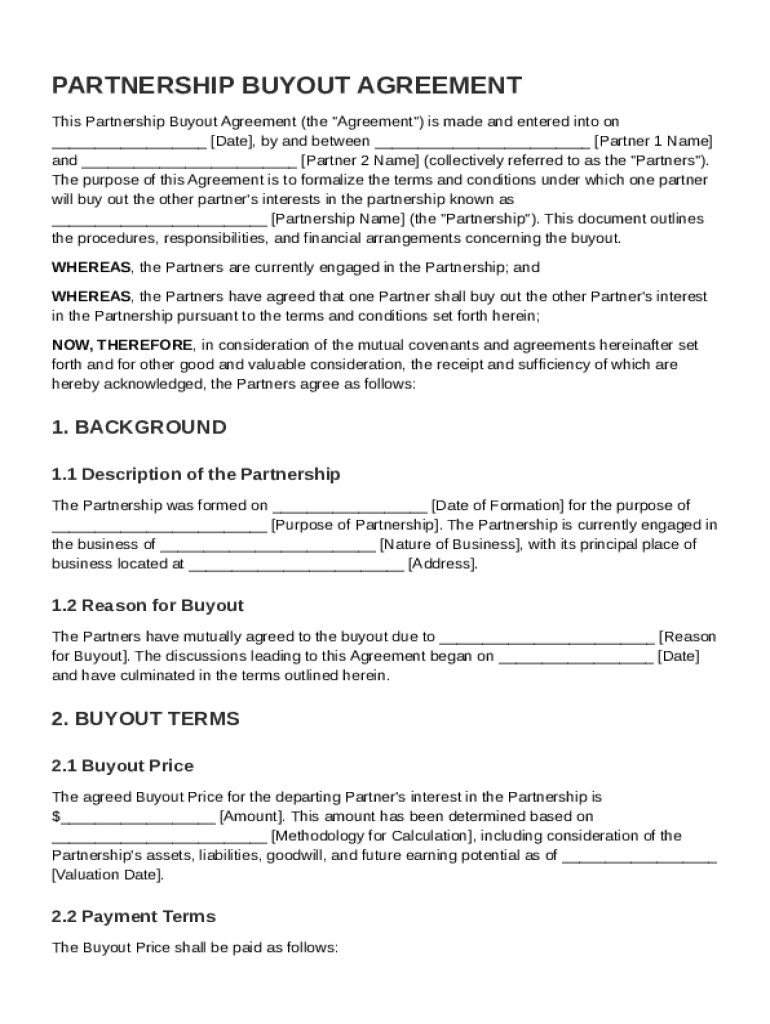
A Partnership Buyout Agreement Template is a legal document that outlines the terms and conditions under which one or more partners purchase the ownership interests of another partner within a business partnership. This agreement serves as an essential tool to facilitate a smooth transition during a partner's exit, ensuring that all parties have a clear understanding of their rights and obligations. The document typically includes the rationale for the buyout, financial arrangements, such as pricing and payment terms, as well as any necessary procedures for completing the transaction. Emphasizing individual responsibilities and outlining specific representations and warranties is crucial to prevent potential misunderstandings or disputes.
Steps to Complete the Partnership Buyout Agreement Template
- Identifying the Parties Involved: Begin by listing the names and addresses of all partners involved, specifying whether they are buying or selling their interests.
- Statement of Purpose: Clearly define the reasons for the buyout, including any business goals or personal reasons prompting the transfer of ownership.
- Valuation and Financial Arrangements: Describe the method used to value the partnership interest, the agreed buyout price, and the payment terms, such as lump-sum or installment payments.
- Representations and Warranties: Include representations and warranties from both parties to ensure transparency and accuracy concerning financial statements and liabilities.
- Indemnification: Define indemnification responsibilities, outlining how the seller will be protected against potential claims arising after the buyout.
- Dispute Resolution: Establish methods for resolving any disputes that may arise, such as mediation, arbitration, or legal proceedings.
- Execution and Closing: Outline the steps for finalizing the agreement, including the signing process, any necessary approvals, and the transfer of ownership documents.
Key Elements of the Partnership Buyout Agreement Template
- Identity of Parties: Clearly identify the buyer(s) and seller(s) in the transaction.
- Valuation of Interest: Define the method of valuation for the departing partner's interest and the agreed valuation figure.
- Payment Terms: Elaborate on how and when payments will be made to the seller.
- Representations and Warranties: Address the assurances provided by each party regarding pertinent business details.
- Indemnification Clauses: Detail protections afforded to each party against potential liabilities.
- Dispute Resolution Mechanisms: Outline preferred methods for handling disagreements.
- Governing Law: State which jurisdiction's laws will govern the agreement.
Important Terms Related to Partnership Buyout Agreement Template
- Buyout Price: The amount agreed upon for the purchase of the departing partner's share.
- Valuation Method: The process used to determine the fair market value of the partnership interest.
- Closing Date: The agreed date when the transaction will be finalized and ownership transferred.
- Indemnity: A contractual obligation of one party to compensate the loss incurred by another due to specified events.
- Escrow: An arrangement where a third party temporarily holds assets until all conditions of the sale are satisfied.
Legal Use of the Partnership Buyout Agreement Template
A Partnership Buyout Agreement Template is legally binding once signed by all parties and witnessed as required. It serves to protect both the buyer and seller by clearly delineating the terms of the transaction and providing a framework for addressing potential disputes. It is important that the document complies with state laws and regulations; legal counsel may be sought to ensure compliance and address any complex legal issues. Legal enforceability is crucial, ensuring that the agreement stands up in a court of law if disputes arise over its interpretation or execution.
State-Specific Rules for the Partnership Buyout Agreement Template
Different states across the U.S. may have varying rules and regulations concerning partnership buyouts, with particular states requiring additional disclosures or specific contractual language. For instance, some states may have distinct tax consequences for buyouts that practitioners should be aware of. It is advisable to research or consult with a lawyer to understand these state-specific nuances and incorporate them appropriately into the agreement.
Who Typically Uses the Partnership Buyout Agreement Template
The template is often utilized by business partners in various types of enterprises, including small businesses, professional partnerships, and family-owned companies. Typically, it is used in scenarios where one partner wishes to exit the business due to retirement, personal circumstances, or strategic business decisions. Law firms and financial advisors frequently prepare these documents to ensure accurate reflection of the terms and compliance with legal requirements.

Examples of Using the Partnership Buyout Agreement Template
- Family-Owned Businesses: A sibling partnership decides to buy out one partner's share to keep the business within the family.
- Professional Partnerships: In a law firm, one partner retires, and the remaining partners agree to divide the exiting partner's share among themselves.
- Startup Ventures: A founding partner decides to exit due to strategic differences, and the other partners elect to purchase their interest to have a unified direction.
Business Types That Benefit Most from Partnership Buyout Agreement Template
- Limited Liability Partnerships (LLPs): Allow for flexible ownership structures and ease of transferring interest with appropriate agreements.
- Professional Corporations: Law firms and medical practices often require structured buyouts when partners retire or leave.
- General Partnerships: Needs clarity during partner transitions to avoid operational disruptions and legal conflicts.
This detailed exploration provides thorough insights into the Partnership Buyout Agreement Template, ensuring understanding of its role, completion, and legal considerations within business partnerships.