01. Edit your form online
Type text, add images, blackout confidential details, add comments, highlights and more.

Type text, add images, blackout confidential details, add comments, highlights and more.

Draw your signature, type it, upload its image, or use your mobile device as a signature pad.

Send it via email, link, or fax. You can also download it, export it or print it out.
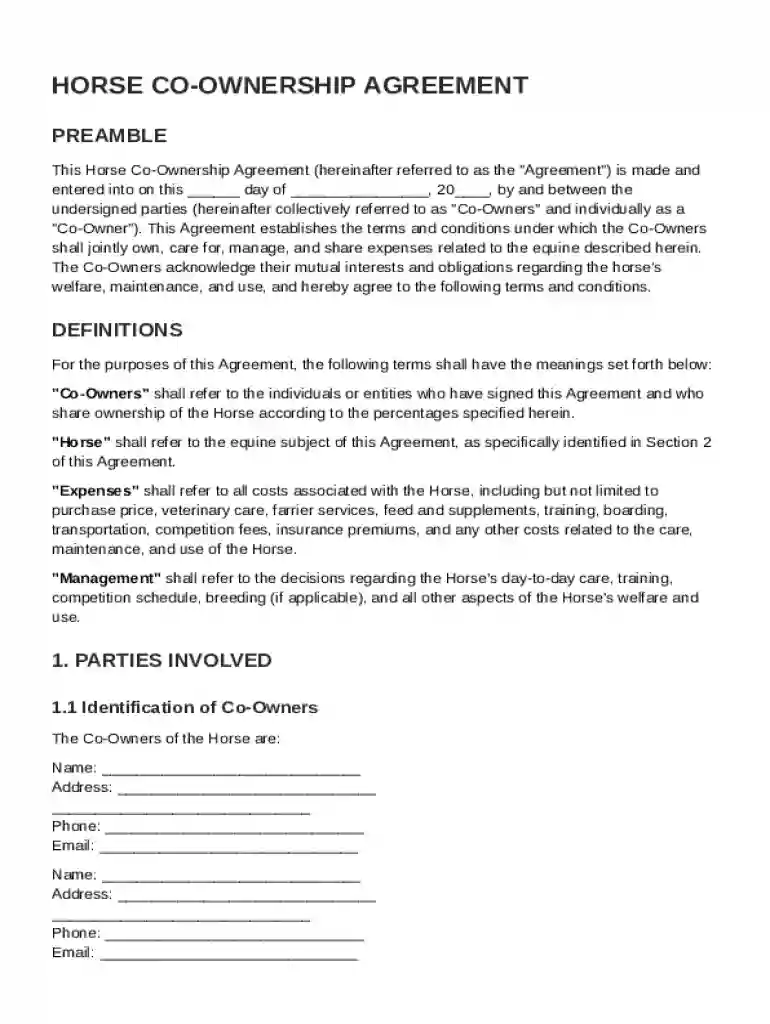
The Horse Co-Ownership Agreement Template is a legal document used to define the terms and conditions for joint ownership of a horse. It outlines key responsibilities, rights, and obligations of each co-owner, covering aspects like care, management, and shared expenses. This agreement helps prevent disputes by clearly setting expectations between co-owners regarding the animal's welfare. It typically includes information about the horse, the identities of the parties involved, and the ownership shares. This template ensures transparent communication and cooperation among co-owners.
The template covers several essential components to structure a comprehensive and clear agreement. Notably, it defines ownership shares, outlining the percentage owned by each party. It also specifies the responsibilities of each individual concerning the animal's daily care and financial contributions, including veterinary costs, feeding, training, and housing. Another critical component addresses dispute resolution procedures, detailing how disagreements will be managed. Lastly, the governing law section defines which jurisdiction's laws will apply, which is particularly important for legal enforceability.
This template is commonly used by individuals and entities engaged in joint horse ownership. This includes equestrian facilities that manage shared horses, private horse owners looking to manage ownership transitions or partnerships, and racing syndicates where multiple parties co-own racehorses. Additionally, breeders may use this agreement when sharing the ownership of a mare or stallion. It serves any group that requires a structured framework to manage their shared interest in a horse legally and efficiently.


Certain terms are fundamental within this agreement to provide clarity and enforceability. They include "co-owners" referring to all individuals holding an interest in the horse, "ownership shares" which denote the percentage of ownership each party holds, and "financial contributions" indicating the expected monetary input from each owner for expenses like boarding and veterinary care. "Governing law" specifies the jurisdiction overseeing the agreement's legal aspects, while "dispute resolution" refers to the agreed-upon method for managing conflicts.
The template ensures that the ownership arrangement is legally binding and enforceable under U.S. law. It provides a formal record, reducing the likelihood of misunderstandings by clearly delineating each party's rights and responsibilities. When executed correctly, it can be used in court to resolve conflicts or enforce compliance with agreed-upon terms. It's important that each co-owner consults legal professionals to ensure the agreement aligns with specific state laws and fully protects all parties’ rights.
Different states may have varying rules affecting the formation and execution of a Horse Co-Ownership Agreement. Some states might have specific requirements for notarization or recording the agreement, especially if it involves a high-value asset like a competitive racehorse. Additionally, states have different laws regarding liability and care responsibilities, which must be accurately reflected in the agreement. It is important for co-owners to research and adhere to these state-specific legal requirements to ensure the agreement's enforceability.
Consider a scenario where three friends decide to purchase a racehorse together. They use the Horse Co-Ownership Agreement Template to outline each person’s financial investment and their respective ownership share. They also define the responsibilities of each co-owner in terms of care and training, while agreeing on how the horse’s winnings will be shared. In another instance, two breeders might co-own a stallion for breeding purposes and utilize the template to clarify breeding rights, stud fees, and maintenance costs.
Several versions of this agreement might be used depending on the specifics of horse ownership, such as templates for different horse breeds or types of ownership arrangements. Alternatives include agreements focusing specifically on syndicate ownership, breeder partnerships, or specific types of equestrian activities, such as racing or show jumping. These variants often include clauses tailored to the unique circumstances and legal considerations relevant to that particular setting or horse type.
Equestrian centers and boarding facilities managing multiple-owned horses are prime users of this template to legally structure shared ownership. Racing syndicates, which often involve multiple stakeholders investing in a horse, also find this agreement essential for delineating financial stakes and responsibilities. Breeding operations where ownership and breeding rights are shared between multiple farmers or investors are other examples where clarity and legal backing via a formal agreement are crucial.
At DocHub, your data security is our priority. We follow HIPAA, SOC2, GDPR, and other standards, so you can work on your documents with confidence.