01. Edit your form online
Type text, add images, blackout confidential details, add comments, highlights and more.

Type text, add images, blackout confidential details, add comments, highlights and more.

Draw your signature, type it, upload its image, or use your mobile device as a signature pad.

Send it via email, link, or fax. You can also download it, export it or print it out.
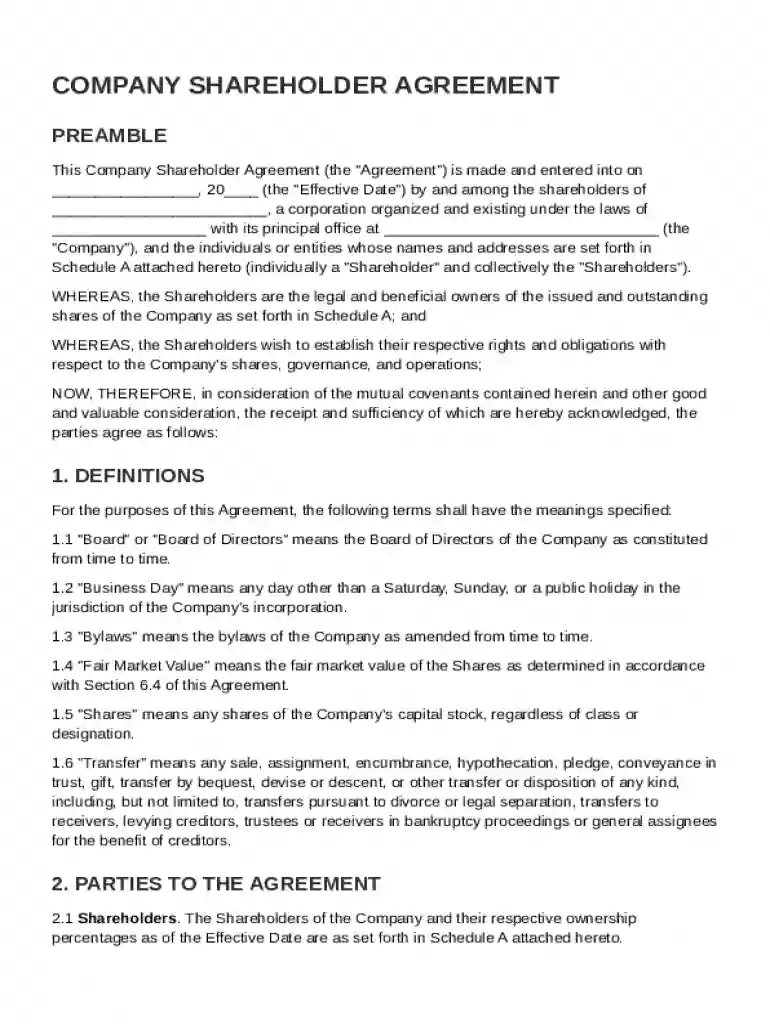
A Company Shareholder Agreement is a pivotal legal document that outlines the rights and duties of shareholders within a corporation. It acts as a comprehensive blueprint for shareholder relations, diving into governance structures, share ownership, and transfer stipulations. By establishing clear guidelines, it serves to protect shareholder interests, sustain stable corporate operations, and define robust protocols for decision-making and conflict resolution. In essence, such an agreement solidifies the foundation upon which the company and its shareholders interact, operating as a vital tool for avoiding potential disputes and misunderstandings.
The Company Shareholder Agreement Template typically encapsulates several crucial components:
Governance Structure: This details how decisions are made within the corporation, specifying the roles and responsibilities of shareholders, board members, and executives.
Share Ownership and Transfer Restrictions: It outlines how shares are distributed among shareholders and sets rules for transferring ownership, including conditions for selling shares.
Dividend Policies: This section explains how and when dividends are distributed to shareholders, ensuring clarity and fairness in profit allocation.
Dispute Resolution Processes: Mechanisms such as mediation or arbitration may be stipulated to handle disagreements amicably and efficiently.
Confidentiality Requirements: Shareholders are often required to maintain the confidentiality of sensitive company information to protect business interests.
To effectively complete a Company Shareholder Agreement Template, follow these steps:
Gather Essential Information: Collect details about all shareholders, including names, addresses, and percentage of share ownership.
Outline Governance Structure: Clearly define roles and responsibilities of the board and how decisions will be made.
Define Share Transfer Conditions: Set rules for buying, selling, or transferring shares, including any restrictions or prior approval requirements.
Specify Dividend Policies: Outline how profits will be distributed among shareholders.
Establish Dispute Resolution Methods: Include preferred mechanisms for resolving conflicts among shareholders.
Ratify the Agreement: Ensure all parties understand the terms and officially sign the document, witnessing compliance for legal validity.
In the United States, the Company Shareholder Agreement is a legally binding document when executed properly. It must comply with state-specific corporate laws to be enforceable. State statutes govern various aspects of the agreement, from corporate governance rules to shareholder rights protections. The document should reflect the general corporate legal framework while accommodating specific provisions relevant to the corporation in question. It is often used in preventing disputes by pre-determining accepted processes and conduct standards.
The template is widely utilized across different spheres by:
Entrepreneurs: Those establishing new businesses engage in shareholder agreements to formalize relationships and create operational stability.
Existing Corporations: Companies may revise shareholder agreements to adapt to changing business dynamics or legal requirements.
Legal Professionals: Lawyers often draft or customize these agreements to meet the specific needs of their clients.
In essence, while these agreements are predominantly used by corporations, they extend to any business entity with shareholders who seek a structured operational backbone.


Understanding a few key terms associated with shareholder agreements can be instrumental:
Quorum: The minimum number of shareholders or directors needed to make any meeting decisions valid.
Preemptive Rights: Rights that allow existing shareholders to buy new shares before outsiders to maintain their ownership percentage.
Drag-Along Rights: Clauses that force minority shareholders to sell their shares if a majority shareholder sells theirs.
Tag-Along Rights: Provisions for minority shareholders to join a sale initiated by majority shareholders under the same conditions.
Veto Powers: Specific rights granted to shareholders or directors to block certain corporate actions.
State-specific regulations significantly influence the formation and enforceability of shareholder agreements. For instance, Delaware’s corporate laws offer more flexibility in governance structures and shareholder rights, making it a popular state for incorporation. In contrast, states like California have stricter requirements regarding minority shareholder protections and corporate transparency. When drafting a shareholder agreement, it is paramount to consult state-specific statutes to ensure compliance and adapt the template accordingly.
Practical application of a shareholder agreement template can be seen in scenarios like:
Startup Brand Launches: Entrepreneurs use the agreement to stipulate roles, investment returns, and how control is distributed among founders and investors.
Corporate Restructuring: Companies undergoing structural changes might use the agreement to redefine shareholder roles and responsibilities in line with the new business strategy.
Family Businesses: To prevent disputes, family-owned businesses delineate ownership shares and roles to ensure harmonious succession planning.
At DocHub, your data security is our priority. We follow HIPAA, SOC2, GDPR, and other standards, so you can work on your documents with confidence.