






Definition & Meaning
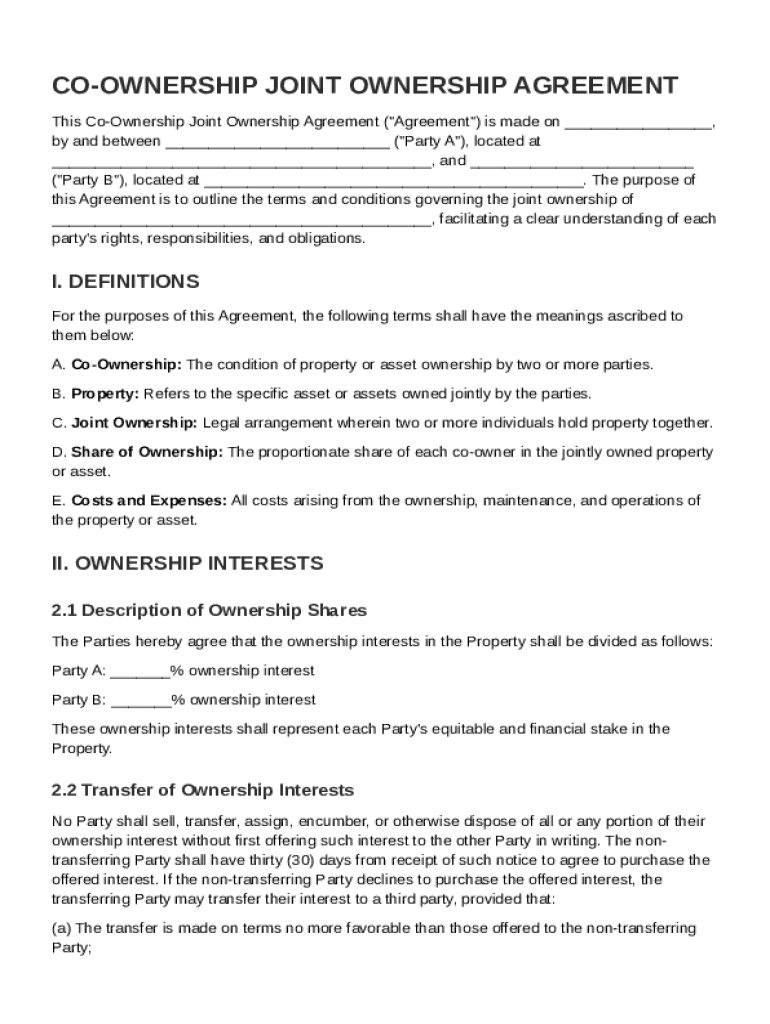
A Co-Ownership Joint Ownership Agreement Template is a formal document that outlines the terms and conditions associated with the joint ownership of a property or asset by multiple parties. This template helps define each party's rights and responsibilities, clarifying ownership interests, financial obligations, and management duties. It serves as a comprehensive guide to prevent misunderstandings and disputes, covering crucial aspects such as usage rights, dispute resolution mechanisms, and termination conditions.
How to Use the Co-Ownership Joint Ownership Agreement Template
To effectively utilize the Co-Ownership Joint Ownership Agreement Template, begin by gathering all necessary information about the co-owners, the property, and any specific terms you wish to include. Next, fill in the template with details such as the names and addresses of all parties involved, the description of the property, and the agreed-upon percentage of ownership for each party.
- Initial Preparation: Gather documents related to the property and identify all parties involved.
- Detailing Responsibilities: Specify the roles, financial obligations, and management duties of each party.
- Usage Rights: Clearly outline how the property can be used by each owner.
- Review and Finalize: Once filled, review the agreement for omissions or errors, ensuring clarity and accuracy.
Important Considerations
- Ensure that all parties are in agreement with the terms before finalizing.
- Consult with a legal professional if complex legal language or specific legal implications arise.
Key Elements of the Co-Ownership Joint Ownership Agreement Template
The template consists of several essential components that must be addressed:
- Ownership Interests: Defines the ownership percentages.
- Management Responsibilities: Details who manages what aspects of the property and how decisions are made.
- Financial Contributions: Outlines how costs are to be divided and any initial or ongoing financial commitments.
- Dispute Resolution: Provides a process for resolving disagreements between co-owners.
- Termination Conditions: Covers events leading to the dissolution of the agreement and subsequent actions.
Steps to Complete the Co-Ownership Joint Ownership Agreement Template
- Document Preparation: Gather all relevant information and documentation.
- Template Customization: Enter specific details such as owner names, property description, and ownership percentages.
- Agreement Drafting: Expand on sections with clear, agreed-upon terms, focusing on management duties and financial contributions.
- Review and Revise: Verify all information for accuracy and completeness, making revisions as necessary.
- Legal Review: Obtain a legal review to ensure enforceability and compliance.
- Sign and Finalize: All parties should sign the document, marking the official agreement.
Who Typically Uses the Co-Ownership Joint Ownership Agreement Template
This template is commonly used by:
- Family Members: Engaging in joint ownership of familial property.
- Business Partners: Sharing ownership in a business asset or property.
- Friends or Colleagues: Jointly purchasing property for investment or shared use.
- Real Estate Investors: Multiple investors sharing ownership in an investment property.


Practical Scenarios
- Investment Properties: To formalize ownership shares and clarify return on investments.
- Shared Vacation Homes: To determine usage schedules and maintenance responsibilities.
Legal Use of the Co-Ownership Joint Ownership Agreement Template
The legal principles governing co-ownership agreements are designed to ensure fair and equitable management of jointly owned properties. By using the template:
- Clarity and Precision: Legally documented agreements reduce the risk of conflicts.
- Enforceability: Should disputes arise, courts have a clear reference of the agreed-upon terms.
- Protection of Rights: Each party's rights are outlined, ensuring fair treatment.
Legal Validity
- Adherence to state and federal laws is crucial. Customizations may be required to comply with regional regulations.
State-Specific Rules for the Co-Ownership Joint Ownership Agreement Template
While the basic structure of the template remains consistent across states, certain state-specific rules may apply:
- Property Laws: Property laws can vary, which may affect management and decision-making protocols.
- Tax Regulations: State tax implications for shared property ownership should be reviewed.
Regional Variations
- Community Property States: Specific rules may affect how ownership interests and profits are divided.
Examples of Using the Co-Ownership Joint Ownership Agreement Template
Practical examples illustrate the application of the template in real-world scenarios:
- Example A: A group of professionals investing in a commercial property, using the agreement to define each member's input and share in profits.
- Example B: Siblings inheriting a family home, employing the template to allocate usage time, maintenance tasks, and financial contributions.
By utilizing the Co-Ownership Joint Ownership Agreement Template effectively, individuals and groups can clearly define their roles, rights, and responsibilities, mitigating the risk of conflict and facilitating smooth and cooperative management of jointly owned properties.