






Definition & Meaning
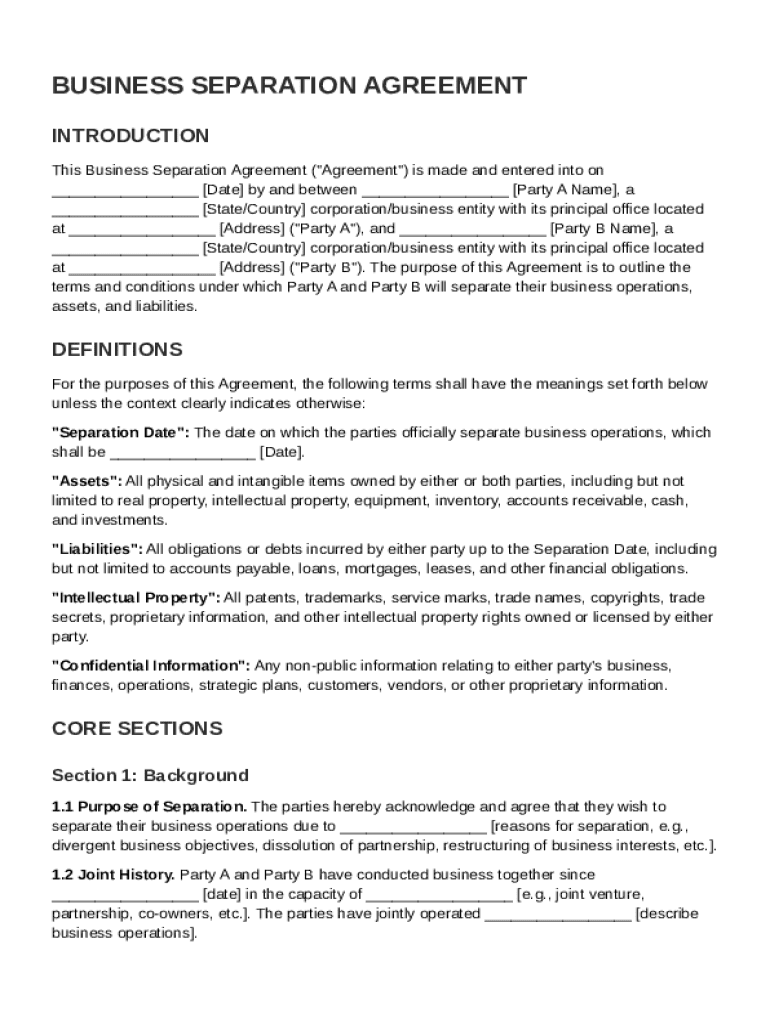
A Business Separation Agreement Template is a structured document used to formalize the division of business operations, assets, and liabilities between two or more parties, typically referred to as Party A and Party B. This agreement is critical for ensuring an orderly transition when business partners decide to dissolve their business relationship. Key terms defined within the agreement include "assets," "liabilities," and "separation." These terms clarify what each party will receive and their obligations post-separation.
Understanding the purpose of this template is crucial because it outlines the legal and operational frameworks necessary for a smooth business separation. By defining responsibilities and expectations, it reduces the likelihood of disputes and provides a clear reference point for all involved parties.
Important Terms Related to Business Separation Agreement Template
Key Concepts and Clauses
- Asset Distribution: Specifies how assets such as real estate, inventory, and intellectual property are allocated between the parties.
- Liability Allocation: Details how existing debts and obligations will be divided.
- Confidentiality: Ensures that sensitive business information remains protected after separation.
- Dispute Resolution: Provides methods for resolving conflicts, such as mediation or arbitration.
These terms are integral to creating a comprehensive and enforceable agreement. Each term must be clearly defined to avoid ambiguity and ensure all parties comprehend their rights and responsibilities.
Key Elements of the Business Separation Agreement Template
Core Components
- Purpose of Separation: Clearly states the reasons behind the decision to separate.
- Asset and Liability Allocation: In-depth details on how financial and physical assets plus liabilities will be divided.
- Post-Separation Obligations: Outlines responsibilities each party must fulfill after the separation is complete.
- Confidentiality Requirements: Ensures protection of proprietary information.
- Miscellaneous Provisions: Offers additional terms that may include non-compete and non-solicitation clauses.
Each element plays a vital role in ensuring that the agreement is comprehensive and enforceable.
Who Typically Uses the Business Separation Agreement Template
Business owners, partners in small to medium enterprises (SMEs), and corporate executives commonly use the Business Separation Agreement Template. These individuals or entities may need to dissolve partnerships due to strategic realignments, personal decisions, or external market forces.
- Examples:
- A tech startup's founders parting ways due to differing visions for the company.
- Family-owned businesses that wish to allocate parts of the business to different family members as part of succession planning.
Understanding the typical users helps tailor the agreement's specific terms and provisions to suit the parties' unique needs.


Steps to Complete the Business Separation Agreement Template
Step-by-Step Guide
- Collect Relevant Information: Gather all necessary details about the business assets, liabilities, and any other pertinent records.
- Define Terms: Clearly define each term within the context of your business.
- Draft Agreement: Populate the template with the collected information, using clear and concise language.
- Review by Legal Counsel: It is advisable to have the document reviewed by a legal professional to ensure accuracy and compliance.
- Signatures: Finalize the document with signatures from all parties involved.
There are nuances in each step – for example, consulting with a legal advisor will help in identifying potential future disputes.
Legal Use of the Business Separation Agreement Template
The legal validity of this agreement is critical because it outlines the enforceable division of a business’s assets and liabilities. It provides a legally binding framework that parties can rely on to ensure compliance.
- Documentation: Ensures all included information is documented and can be proven in court if necessary.
- Compliance: Aligns with state and federal laws to make sure parties' rights are protected throughout the separation.
By meeting these legal standards, the agreement helps protect the interests of all involved parties.
Examples of Using the Business Separation Agreement Template
Real-world Scenarios
- Partnership Dissolution: Two partners in a restaurant chain decide to dissolve their partnership. The template helps allocate branches and liabilities fairly between them.
- Corporate Spin-off: A conglomerate decides to spin off one of its divisions, using the agreement to precisely transfer assets and intellectual property to the new entity.
These scenarios illustrate how the template facilitates orderly transitions and preserves business value.
State-specific Rules for the Business Separation Agreement Template
Business separation agreements can be subject to state-specific regulations, which may affect various components of the agreement, including asset distribution and tax implications. It’s essential to consult state laws where the business operates to ensure compliance.
- Example: In some states, there may be additional filing requirements or tax considerations when transferring business assets.
Understanding these state-specific nuances is crucial for creating a legally sound agreement that takes into account local regulatory obligations.