






Definition & Meaning
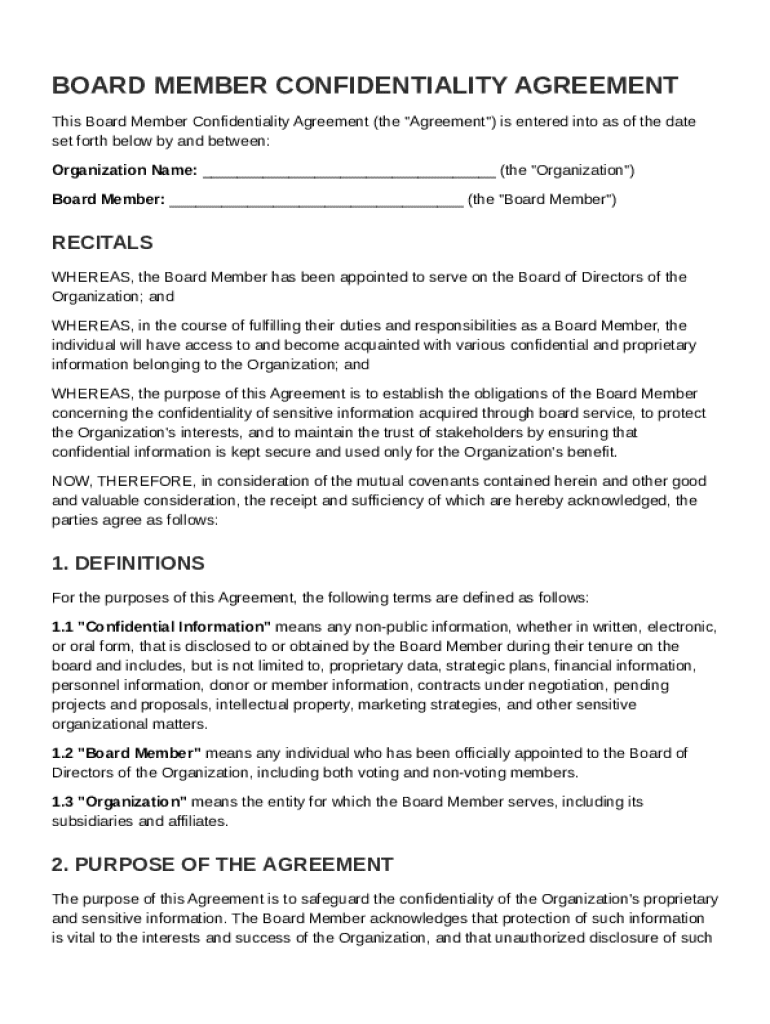
A Board Member Confidentiality Agreement serves as a contract between an organization and its board members to ensure the protection of sensitive information. This agreement clearly outlines what constitutes 'Confidential Information,' such as proprietary data, trade secrets, or any information deemed private by the organization. By signing this agreement, board members commit to maintaining confidentiality, preventing unauthorized disclosure, and limiting the use of this information for anything other than official business purposes. This is crucial for safeguarding the organization's competitive edge and maintaining its trustworthiness.
Key Elements of the Board Member Confidentiality Agreement Template
Identification of Parties
The agreement begins by identifying the parties involved, including the organization and the individual board members. Accurate identification is essential to legally bind the involved parties.
Description of Confidential Information
This section delineates what is considered confidential. It can include business plans, financial data, and client information. By clearly defining these elements, the agreement sets parameters for what needs protection.
Non-Disclosure Obligations
Board members are bound not to disclose confidential information to unauthorized individuals or entities. The agreement specifies the contexts in which information sharing is permissible, usually limited to legal requirements or authorized disclosures within the organization.
Breach Consequences
Consequences for breaching the confidentiality terms are outlined in this section. Penalties might include legal action or removal from the board to enforce adherence to confidentiality obligations seriously.
Who Typically Uses the Board Member Confidentiality Agreement Template
This agreement is typically used by corporations, non-profits, and other organizations that have a formal board of directors. Startups and established companies alike use it to protect sensitive business information from inadvertent or intentional leakage by board members. Non-profit organizations employ similar agreements to safeguard donor information and strategies. Any organization that deals with proprietary data can benefit from utilizing this template to shield its confidential information.


Steps to Complete the Board Member Confidentiality Agreement Template
-
Download the Template: Obtain a compatible version from a trusted source like DocHub to ensure it meets legal standards.
-
Enter Party Details: Fill in names and positions of both the organization and board members to establish clear accountability.
-
Define Confidential Information: Clearly outline what constitutes confidential data in the context of the organizations' operations.
-
Detail Non-Disclosure Terms: Specify the circumstances under which the board member is allowed or forbidden to disclose information.
-
Set Consequences for Breach: Clearly state legal consequences or penalties for the unauthorized disclosure of confidential information.
-
Sign and Date: Ensure both parties sign and date the agreement, keeping copies for both organization records and the board member.
Important Terms Related to Board Member Confidentiality Agreement Template
- Proprietary Information: Unique data or processes owned by the organization that provide competitive advantages.
- Trade Secrets: Information that is not generally known and would give others an advantage if disclosed.
- Non-Disclosure: A legal agreement codifying confidentiality between parties.
Legal Use of the Board Member Confidentiality Agreement Template
The agreement ensures that all parties involved are aware of their confidentiality obligations and the legal implications of breaches. Adhering to federal and state laws, such as the Defend Trade Secrets Act, reinforces its legal standing. Organizations must tailor the template to reflect applicable state-specific laws to validate its enforceability. Legal counsel may be consulted to ensure compliance with jurisdictional requirements and to provide insights into potential legal challenges under U.S. law.
Examples of Using the Board Member Confidentiality Agreement Template
Consider a new tech startup needing to protect its proprietary software during board meetings. By using a confidentiality agreement, the organization clearly communicates its expectations regarding the protection of its trade secrets.
Another example involves a non-profit organization safeguarding donor lists and fundraising strategies. The agreement ensures board members commit to keeping sensitive organizational strategies private, thus maintaining trust with donors.
Digital vs. Paper Version
The Board Member Confidentiality Agreement Template can be utilized in both digital and paper formats. Digital versions, often managed using platforms like DocHub, offer convenience through features such as electronic signatures and easy storage. Paper versions remain useful for individuals preferring traditional document management methods. Choosing between these formats depends on organizational preferences for accessibility, security, and record-keeping.