






Definition & Meaning
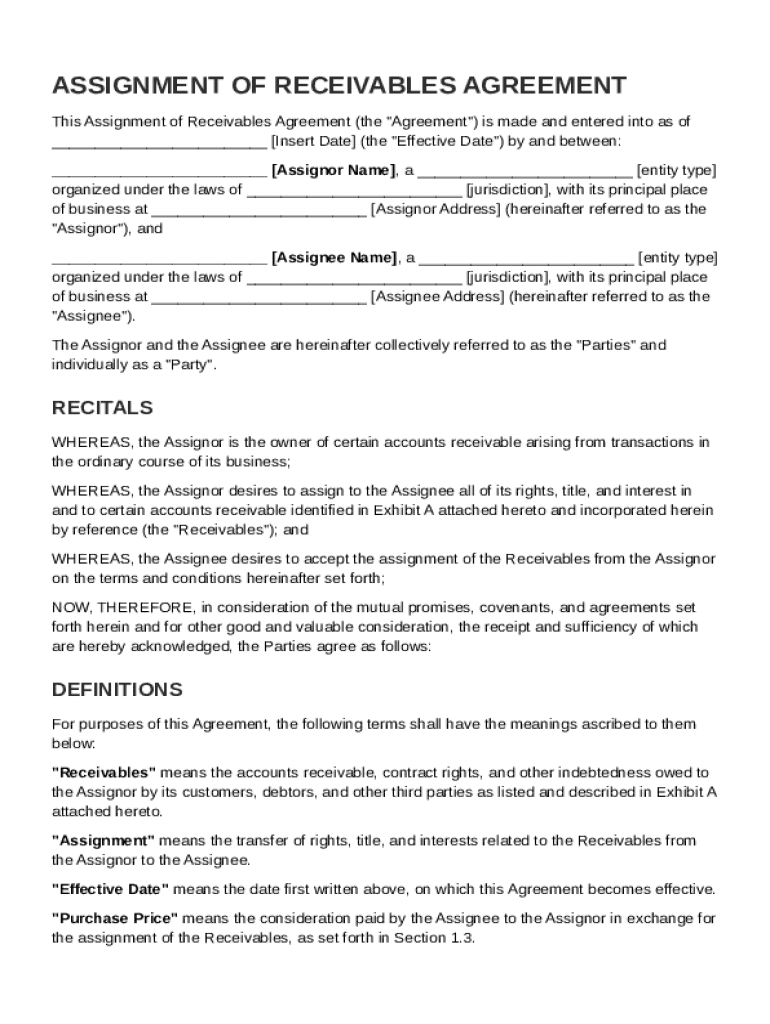
The Assignment of Receivables Agreement Template serves as a legal document outlining conditions under which an assignor transfers its rights to specified accounts receivable to an assignee. Essentially, the agreement enables one party (assignor) to assign outstanding payments due from customers to another party (assignee), often for security purposes or sales transactions. This document is crucial in financial and business transactions where businesses require immediate liquidity or wish to mitigate credit risk.
Key Components
- Assignor and Assignee Details: Clearly identifies the parties involved.
- Accounts Receivable Description: Specifies which receivables are being transferred.
- Effective Date: Indicates when the assignment becomes binding.
- Purchase Price: Details monetary consideration for the transfer.
- Rights and Obligations: Covers who will manage collections and responsibilities involved.
How to Use the Assignment of Receivables Agreement Template
Navigating the template involves understanding your obligations and ensuring all necessary information is correctly filled.
Steps for Effective Use
-
Identify the Parties:
- Clearly state the assignor and assignee names along with addresses.
-
Detail the Receivables:
- Specify accounts being transferred, including customer details and total amounts.
-
Assign Effective Dates and Conditions:
- Clearly define when the agreement starts and under what conditions.
-
Include Financial Details:
- Outline the purchase price and payment terms.
-
Review Legal Clauses:
- Make sure to include representations, warranties, and indemnification clauses to protect both parties.
Steps to Complete the Assignment of Receivables Agreement Template
Completing the form requires attention to each section to ensure completeness and compliance with legal standards.
Detailed Procedure
-
Fill Out Identifying Information:
- Complete all relevant fields for parties’ contact information and company identifiers.
-
Specify Assigned Receivables:
- Clearly document which receivables are assigned, using itemized lists if necessary.
-
Clarify Payment Terms:
- Define how and when payments will be made by the assignee.
-
Add Legal Provisions:
- Insert necessary legal terms concerning defaults, disputes, and indemnification.
-
Review and Finalize:
- Multiple reviews, ideally by legal counsel, to ensure accuracy and legal sufficiency.
Key Elements of the Assignment of Receivables Agreement Template
Understanding the primary elements is essential to implement the agreement effectively.
Critical Sections
- Definitions: Explain all key terms used throughout the document.
- Purchase Price and Payment: Detailed explanation of consideration and payment structure.
- Representations and Warranties: Statements of fact that both parties rely on.
- Indemnification: Protects each party from damages arising from misrepresentations.
- Termination Conditions: Outline scenarios where agreement may be terminated.
Business Types that Benefit Most from the Assignment of Receivables Agreement Template
This document is particularly favored among certain business models for its utility in gaining liquidity.
Strategic Advantages
- Small Businesses: Often use the agreement to manage cash flow.
- Corporations: Utilize for financing and risk management.
- Service Providers: Benefit from quicker access to funds from receivables.
Legal Use of the Assignment of Receivables Agreement Template
Ensuring legal compliance in creation and execution of the agreement is vital.
Legal Considerations
- Compliance with the UCC: Adheres to Article 9 provisions for secured transactions.
- State-Specific Variations: Some elements might require modification to fit local laws.
- Tax Implications: Assignments may affect taxable income and require careful accounting.
Examples of Using the Assignment of Receivables Agreement Template
Concrete examples illustrate the practical application of the agreement in business transactions.
Real-World Scenarios
- Factoring: Businesses sell their accounts receivable to a factor for immediate cash.
- Collateral for Loans: Used as security in securing loans for working capital.
- Debt Consolidation: To streamline and manage debt collections through a formal agreement.
Important Terms Related to the Assignment of Receivables Agreement Template
Familiarity with essential terminology is crucial for proper use and understanding.
Glossary
- Assignor: Party transferring rights to the receivables.
- Assignee: Party receiving rights to collect on the receivables.
- Effective Date: The date upon which the assignment becomes active.
- Indemnification: Protection against loss or damage specified in the agreement.