







Definition and Meaning
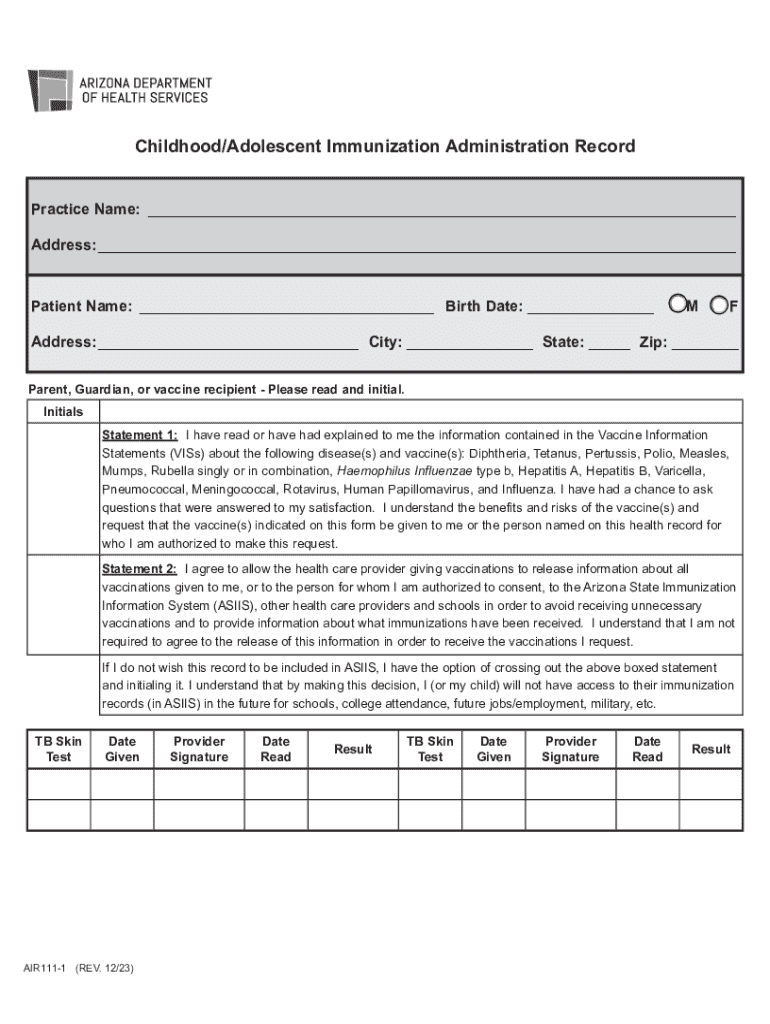
The Childhood/Adolescent Immunization Administration Record is a comprehensive document used to capture detailed information regarding the immunization of children and adolescents. This form is an essential tool for healthcare providers as it records patient demographics, vaccine details, consent for sharing vaccine information, and records of prior immunizations. Additionally, it assists in complying with the Vaccines for Children (VFC) program by including specific codes that facilitate tracking and reporting.
Key Elements of the Childhood-Adolescent Immunization Administration Record
This form comprises several critical sections that ensure a complete record of immunizations:
- Patient Details: Includes name, date of birth, gender, and contact information for accurate identification.
- Consent Statements: Documents patient or guardian consent for vaccination and permission to share information with health systems.
- Vaccination Details: Details the vaccines administered, including dates, manufacturers, and lot numbers for precise tracking.
- Previous Immunizations: Records any vaccinations the patient has previously received to avoid duplication.
- VFC Program Specific Codes: Used to record data for children eligible for the VFC program, a federal initiative to provide vaccines at no cost.
Steps to Complete the Childhood-Adolescent Immunization Administration Record
Accurate completion of this form requires careful attention to each section:
- Fill in Patient Information: Start by entering the patient's personal details, ensuring all information is accurate.
- Review Consent Statements: Ensure that all relevant consent statements are read and agreed to by the patient or guardian.
- Document Vaccination Details: Record all administered vaccines, noting the manufacturer, lot number, and administration date.
- Record Historical Immunizations: Reference past medical records to include any previous vaccinations.
- Include VFC Codes: If applicable, enter any VFC program specific codes for eligible patients.
Who Typically Uses the Childhood-Adolescent Immunization Administration Record
The form is primarily used by:
- Healthcare Providers: Including pediatricians, family doctors, and clinics administering vaccines.
- Public Health Departments: For record-keeping and ensuring compliance with immunization programs.
- Schools and Childcare Facilities: To ensure students meet state immunization requirements.


Important Terms Related to the Childhood-Adolescent Immunization Administration Record
Understanding terms commonly used in this form is crucial:
- Vaccine Manufacturer: The entity producing the vaccine, pivotal for tracking vaccine efficacy and recalls.
- Lot Number: A unique identifier for each batch of vaccines, important for tracking and quality control.
- Immunization Schedule: Refers to the recommended timing for vaccine doses.
Legal Use of the Childhood-Adolescent Immunization Administration Record
The form is used in a legal context to:
- Verify Compliance: Ensure children meet state and federal immunization requirements for school or daycare entry.
- Track Public Health: Provide data for public health agencies to monitor vaccination rates and prevent outbreaks.
- Support Legal Protections: Document informed consent and vaccination history to protect healthcare providers legally.
How to Obtain the Childhood-Adolescent Immunization Administration Record
The form can be obtained through:
- Healthcare Providers: Typically available at pediatric offices and clinics.
- Public Health Departments: Local health departments often provide these forms as part of vaccination programs.
- Online Resources: Many states offer downloadable versions from public health department websites.
Examples of Using the Childhood-Adolescent Immunization Administration Record
- Case Study: School Enrollment: A child enrolling in public school uses the form to prove compliance with state vaccination laws.
- Clinical Usage: A pediatric clinic uses the record to maintain up-to-date immunization records for all patients, ensuring efficient vaccine administration and tracking.
- Public Health Reporting: Health departments compile data from these records to analyze community vaccination trends and inform policy decisions.
State-Specific Rules for the Childhood-Adolescent Immunization Administration Record
Different states may have specific requirements regarding:
- Mandatory Vaccines: Each state has a unique list of required immunizations for school-aged children.
- Documentation Format: States may dictate the format and necessary inclusions in immunization records.
- Data Reporting Guidelines: Differing rules on how immunization data should be reported to state health departments.
By understanding these elements and their interconnections, individuals and organizations can effectively manage and utilize the Childhood/Adolescent Immunization Administration Record for legal compliance, health monitoring, and patient care.




