






Definition and Meaning of the Notice Designating Record on Appeal
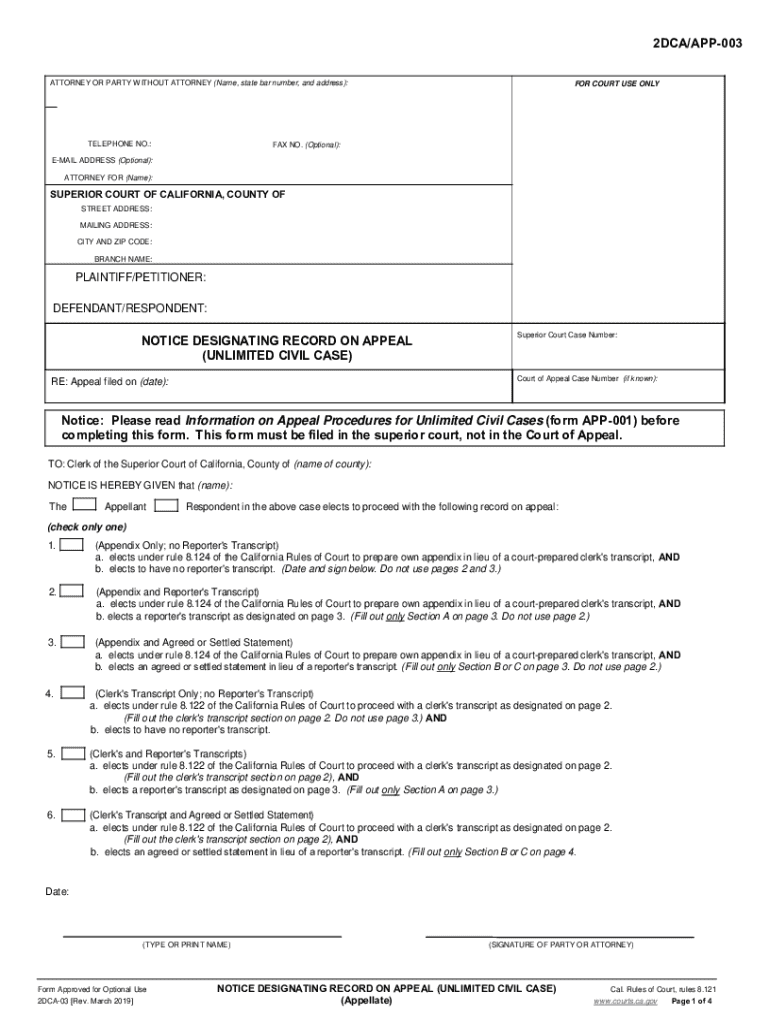
The "Notice Designating Record on Appeal" is a critical legal document used primarily in the state of California. This form is an instrumental component in the appellate process of unlimited civil cases, where the parties involved notify the court about the documents and transcripts that should be included in the record on appeal. As part of the appeal process, this document outlines choices and requirements for the preparation of the necessary records, such as clerk's transcripts, reporter's transcripts, or an appendix. It serves to ensure that all pertinent materials are compiled accurately for the appellate court's review.
Steps to Complete the Notice Designating Record on Appeal
Completing the Notice Designating Record on Appeal requires careful attention to detail, as the process involves several steps:
-
Identifying the Case Information:
- Begin by providing the case name, court docket number, and other identifying information related to the appeal.
-
Selecting the Record Components:
- Choose which records will be included in the appeal. This may involve selecting between a clerk's transcript, a reporter's transcript, or an appendices-based record.
-
Listing Specific Documents:
- List out particular documents and sections that are relevant to the appeal. Accuracy here is vital, as these documents will form the basis of the appellate court's review.
-
Payment Arrangements:
- Address any payment or waiver requirements associated with obtaining the transcripts. Different financial arrangements may apply, depending on the party’s circumstances.
-
Review and Submission:
- Once filled out, review the form for completeness and accuracy before submitting it to the appropriate court for filing.
Why the Notice Designating Record on Appeal Is Essential
The importance of the Notice Designating Record on Appeal cannot be overstated. It plays a pivotal role in the appellate process by ensuring that the appellate court has all necessary documents to make an informed decision. This notice prevents misunderstandings during the appeal and helps streamline the review process by clearly specifying which records the appellant believes are crucial to the case. Failing to accurately complete and submit this form can lead to delays or adverse judgments due to an incomplete appellate record.
Key Elements of the Notice Designating Record on Appeal
Several critical elements must be accurately addressed within the Notice Designating Record on Appeal:
-
Case Identification:
- Includes all relevant case details such as the court, case number, and involved parties.
-
Record Selection:
- Specifies the type of records needed for the appeal, whether it is the clerk's transcript, reporter's transcript, or appendices.
-
Document Listing:
- A comprehensive list of all documents and evidence required for reviewing the appeal.
-
Payment Details:
- Information regarding payment for the preparation of the transcripts or any associated waiver requests.
-
Submission Deadline:
- Ensures that the notice is filed within the specified timeline to avoid any procedural issues.
State-Specific Rules for the Notice Designating Record on Appeal
While the Notice Designating Record on Appeal is used in California, it is critical to understand that each state may have its own specific rules regarding appeal processes:
-
California Specifics:
- In California, the notice is a standardized form, with specific instructions on how to list records and handle payments.
-
Filing Timelines:
- The deadlines for submission often vary and must be carefully adhered to in order to ensure the appeal's viability.
Examples of Using the Notice Designating Record on Appeal
Consider a scenario where a judgment in an unlimited civil case is being appealed. The appellant uses the Notice Designating Record on Appeal to specify all relevant court records and transcripts necessary for the appellate court to adequately review the case. This might include detailed evidence such as previous trial transcripts, submitted motions, and other crucial documentation that would influence the appellate court's decision.
Filing Deadlines and Important Dates
Adhering to the filing deadlines for the Notice Designating Record on Appeal is essential to maintain the appeal’s integrity:
-
Typical Timeline:
- Generally, this notice must be filed within a specified period after the notice of appeal has been lodged, which is often dictated by state-specific rules.
-
Consequences for Missing Deadlines:
- Missing the designation deadline can result in forfeiting the right to provide additional records, affecting the appeal's success rate.
Required Documents for the Notice Designating Record on Appeal
Completing this form requires the concurrent submission of several documents:
-
Original Trial Transcripts:
- Detailed documentation from the original court proceedings is often essential.
-
Select Evidence:
- Specific pieces of evidence cited in the appeal need to be included.
Form Submission Methods: Online, Mail, or In-Person
There are typically three methods for submitting the Notice Designating Record on Appeal:
-
Online:
- Digital submission is often available, streamlining the filing process.
-
Mail:
- The notice can be mailed to the court, though this may take longer for processing.
-
In-Person:
- Direct submission at the court can ensure immediate receipt and address any filing queries instantly.
For those navigating the appellate process, understanding and accurately completing the Notice Designating Record on Appeal is essential, ensuring that all critical records accompany the appeal for a complete judicial review.