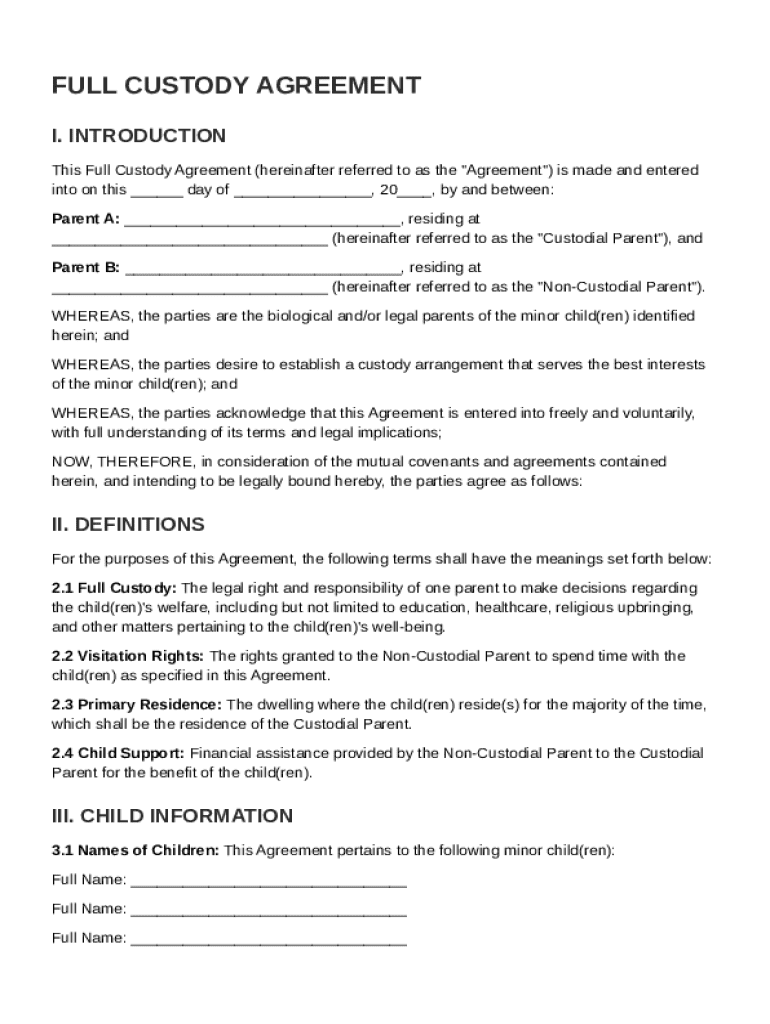







Definition and Meaning of Full Custody Agreement
A Full Custody Agreement, also known as a sole custody agreement, is a legal document that grants one parent exclusive legal and physical custody of their minor child(ren). This type of agreement outlines the responsibilities and rights of the custodial parent while delineating the visitation rights of the non-custodial parent. The agreement typically includes provisions regarding the child’s living arrangements, educational decisions, healthcare, and other aspects of the child's welfare. Financial responsibilities, including child support and shared expenses, are also detailed within the document to ensure each parent understands their obligations. Additionally, it may address issues around communication and dispute resolution, which can be crucial when modifying the terms of custody or when disagreements arise.
How to Use the Full Custody Agreement Template
Using a Full Custody Agreement Template involves several steps to ensure that the agreement is comprehensive and legally sound. The template serves as a structured guide to record important details such as the names of both parents, the child(ren), and specific custody arrangements. To start, you should identify all necessary sections relevant to your situation, including custody terms, visitation schedules, and financial responsibilities. Carefully review each section to ensure all legal requirements are captured. It is advisable to consult with a family law attorney to verify the agreement complies with state-specific laws and adequately protects your rights. Once completed, both parents should sign the document to formalize the agreement.
Steps to Complete the Full Custody Agreement Template
-
Gather Necessary Information: Begin by collecting basic information such as the names and contact details of both parents, and details about the child(ren).
-
Outline Parenting Plan: Clearly define the primary custodian, residence, and visitation rights for the non-custodial parent.
-
Specify Financial Responsibilities: Detail the child support arrangement, including payment amounts, schedules, and any shared expenses.
-
Include Legal Provisions: Add clauses for communication, dispute resolution, and any potential modifications to the agreement.
-
Review and Finalize: Have both parties review the agreement for accuracy and completeness. Consult with a family law attorney if necessary.
-
Sign and Notarize: Once agreed upon, both parents should sign the document, ideally in the presence of a notary public to verify authenticity.
Key Elements of the Full Custody Agreement Template
A comprehensive Full Custody Agreement Template should include the following key elements:
- Custody Details: Clearly delineate legal and physical custody responsibilities.
- Visitation Rights: Establish a schedule for the non-custodial parent, including holidays and vacations.
- Child Support: Define the amount, frequency, and method of child support payments.
- Decision-Making Authority: Specify who will be responsible for making major decisions regarding the child’s education, health, and welfare.
- Dispute Resolution Mechanisms: Outline procedures for handling disputes or modifications to the agreement.
- Legal Jurisdiction: Indicate the jurisdiction governing the agreement, usually the state where the custodial parent resides.
Legal Use of the Full Custody Agreement Template
The legal use of a Full Custody Agreement Template involves adhering to state-specific regulations regarding child custody arrangements. The agreement must comply with laws concerning the child’s best interests, which take precedence over the parents’ preferences. It should be clear, concise, and comprehensive, ensuring that all situations are adequately addressed. Legal enforcement may require the agreement to be filed with the appropriate family court. It's essential to acknowledge that while the template provides a structured format, legal advice is critical to navigating any nuances present in state laws or specific family circumstances.
State-Specific Rules for the Full Custody Agreement Template
State-specific rules can significantly influence the drafting and enforceability of a Full Custody Agreement. Each state has its own family law guidelines and criteria for awarding custody, usually focusing on the child’s best interests. Conditions such as the parents' living situations, the child’s current living arrangements, and each parent's relationship with the child can impact custody determinations. Some states require parenting courses or mediation before finalizing a custody agreement. It's crucial to consult local family law statutes or seek legal counsel to ensure the agreement aligns with the jurisdiction's requirements and procedures.
Examples of Using the Full Custody Agreement Template
There are various scenarios where a Full Custody Agreement Template may be utilized. For example, in a situation where parents live in separate states, a well-defined visitation schedule ensures the child maintains a relationship with both parents. In cases where one parent has a more stable environment, granting full custody to provide the child with consistency may be suitable. Additionally, if one parent is more financially capable, they may assume more extensive responsibilities under the child support section of the agreement. Each application of the template should be tailored to fit the unique circumstances of the family involved.
Required Documents for the Full Custody Agreement Template
Several important documents should accompany a Full Custody Agreement Template to ensure its validity and effectiveness:
- Birth Certificates: For each child involved to verify parentage.
- Financial Statements: Supporting documents to establish financial responsibilities, such as income statements or tax returns.
- Proof of Residency: Establishes living arrangements and supports claims for geographical jurisdiction.
- Existing Court Orders: Any prior custody or visitation orders that could impact the current agreement.
- Identification: Valid identification cards for both parents to confirm identities.
- Legal Judgments or Orders: Particularly in cases where past legal rulings may influence current custody decisions.
These documents facilitate a comprehensive review and streamline the agreement process, contributing to the creation of a thorough and effective custody arrangement.