Definition and Meaning
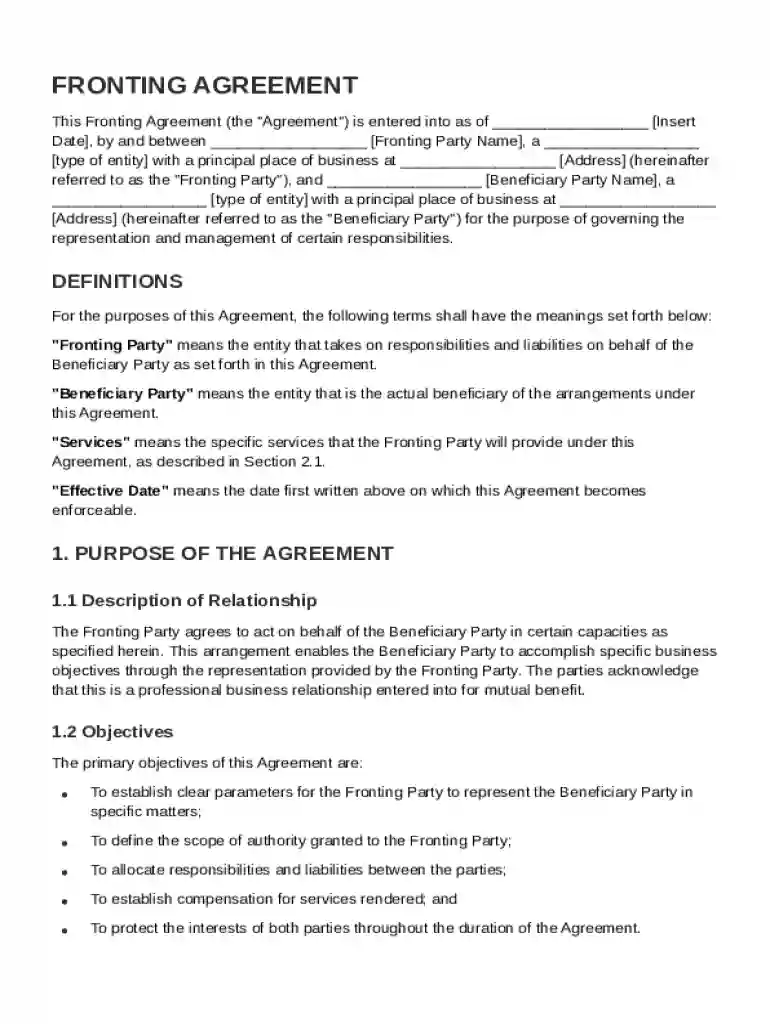
A Fronting Agreement is a contractual arrangement where a Fronting Party, such as an insurance company, agrees to act on behalf of a Beneficiary Party to fulfill specific business objectives while bearing responsibility for meeting these obligations. This type of agreement is commonly used in situations where a party with a defined operational capacity, like issuing policies or fulfilling logistics, acts as a front executing tasks on behalf of another entity lacking the necessary licenses or resources. Not only does it delineate responsibilities clearly, but it also ensures that both parties are aligned in terms of liabilities and representation, emphasizing the mutual benefits of shared goals and deliverables.
Practical Examples
- Insurance Companies: A U.S.-based insurance company might use a fronting agreement to issue policies in a country where it lacks the required licenses.
- Multinational Corporations: Businesses may establish fronting agreements with local entities to manage operations legally in regions with stringent regulatory requirements.
Variations and Nuances
- Cross-border Fronting Agreements: Often requires careful navigation of international regulatory landscapes and local laws.
- Sector-specific Fronting: Different sectors such as shipping or financial services may have distinct stipulations in their agreements to address industry-specific compliance.
Key Elements of the Fronting Agreement Template
The Fronting Agreement Template includes numerous critical sections that ensure clarity and thorough documentation of responsibilities and expectations between the Fronting Party and the Beneficiary Party.
Agreement Components
- Responsibilities: Clear definitions of roles and tasks each party must perform under the agreement.
- Compensation: Terms outlining how and when the Fronting Party will be compensated for its services.
- Confidentiality: Clauses to protect sensitive data exchanged between parties.
- Dispute Resolution: Procedures for addressing and resolving any potential disagreements that may arise.
- Liability Management: Clauses specifying how liability is addressed, potentially including insurance coverage or financial guarantees.
Practical Applications
- Logistics Companies: Define who is responsible for transport liabilities and asset management across borders.
- Service Agreements: Clarify scope and performance metrics in outsourced service agreements.
Steps to Complete the Fronting Agreement Template
Completing a Fronting Agreement Template requires careful consideration of the specific needs of the involved parties and careful documentation of the terms agreed upon.
- Identifying Parties: Clearly define the Fronting Party and the Beneficiary Party.
- Outline Objectives: Document the main objectives each party aims to achieve through the agreement.
- Define Deliverables: Specify the required deliverables, including quality and timing.
- Determine Compensation: Detail the method and schedule of compensation.
- Legal Review: Engage legal experts to ensure compliance with jurisdictional requirements.
Considerations for Completion
- Ensure transparency and clarity in defining roles and responsibilities.
- Review compliance with local and federal laws before finalizing.
Legal Use of the Fronting Agreement Template
Using a Fronting Agreement Template legally requires adherence to applicable laws governing contracts and the specific industry.
Compliance and Regulations
- Federal Law: Ensure the agreement adheres to national regulations, like disclosure and privacy laws.
- State-specific Requirements: Review local laws that may affect the enforceability or structure of the agreement.
Industry-specific Standards
- Insurance Sector Compliance: Requires understanding regulatory conditions concerning the issue of insurance policies in different jurisdictions.
- Financial Regulations: Observe regulations in financial transactions, particularly with cross-border dealings.
Industry Examples
- Insurance Companies: Use fronting agreements to underwrite policies in locations where they aren't licensed directly.
- Multinational Corporations: Often utilize these templates to maintain compliance while operating in foreign markets.
- Service Providers: Firms offering financial, legal, or IT services may engage in fronting agreements to deliver services under different jurisdictions.
Business Types Benefiting from Fronting Agreements
- LLCs and Corporations: Engage in fronting to navigate international market entry barriers.
- Partnerships: Utilize fronting to manage operations without directly establishing a local presence.
Important Terms Related to Fronting Agreement Template
Understanding the terminology within a Fronting Agreement is crucial for ensuring clarity and mutual understanding.
Key Terms
- Fronting Party: The entity acting on behalf of another to fulfill essential functions.
- Beneficiary Party: The entity benefiting from the services provided under the agreement.
- Indemnity: A contractual promise to compensate for potential losses or damages.
Term Clarifications
- Confidentiality: Involves the protection of sensitive information shared between parties.
- Compensation: May include fees, commissions, or a pre-agreed percentage of revenue generated.
State-specific Rules for the Fronting Agreement Template
State-specific rules can significantly impact the structure and enforceability of a Fronting Agreement.
Regional Considerations
- California: Might have unique data privacy laws requiring specific clauses in the agreement.
- Texas: States like Texas may have distinct business operation laws impacting agreements.
Jurisdictional Adjustments
- Tailor contracts to include state-specific clauses that address particular requirements or limitations.
Scenario Examples
- Insurance Operations: Need to account for state insurance regulations if the agreement relates to policy issuance.
- Manufacturing: Address different labor laws and operational standards that might affect compliance and execution.
Examples of Using the Fronting Agreement Template
Real-world use cases of Fronting Agreements provide insight into the practical application of these templates.
Example Scenarios
- International Expansion: A tech company entering a new market may use a fronting agreement to operate under the license of an established local partner.
- Insurance Model: An insurer uses a fronting agreement to issue policies in a region where direct operations aren't feasible due to licensing restraints.
Lessons from Examples
- Operational Efficiency: Fronting agreements can streamline entry into new markets by leveraging existing local capabilities.
- Risk Management: Properly structured agreements help mitigate risks associated with non-compliance and liability exposures.
These thorough insights into the Fronting Agreement Template empower businesses to navigate complex operations with strategic planning and legal foresight.