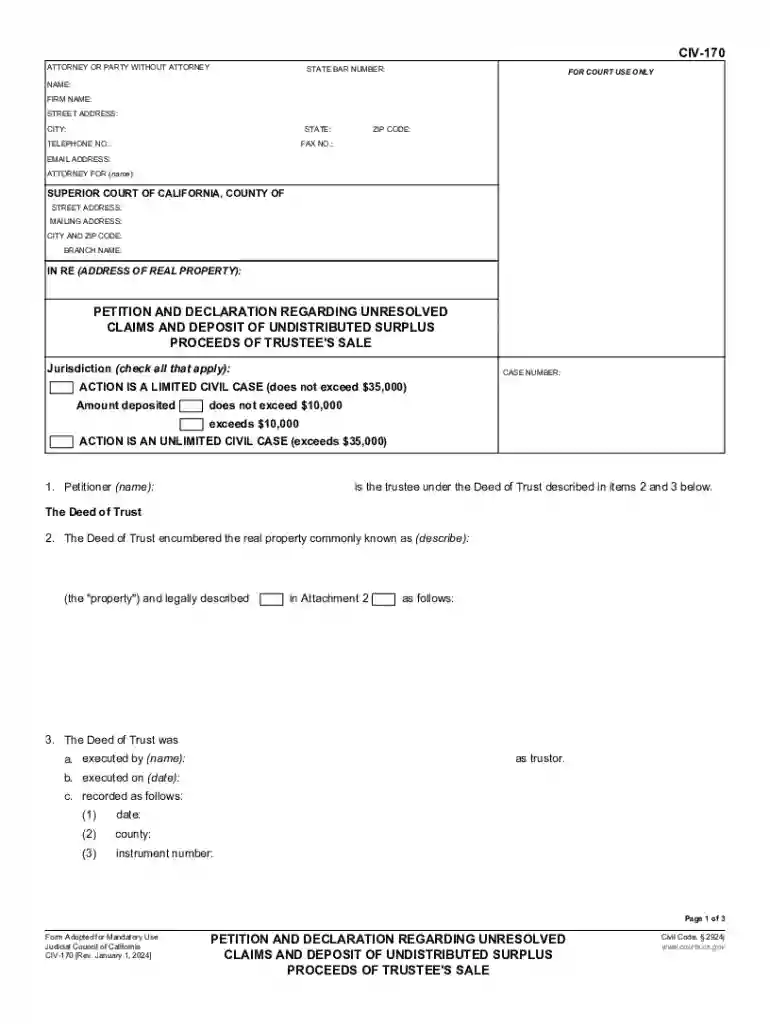
Definition and Meaning
The CIV-170 form, known as the Petition and Declaration Regarding Unresolved Claims and, is primarily utilized by the Superior Court of California. It is specifically designed for situations involving surplus proceeds from the trustee's sale of real property. This legal document is employed to articulate unresolved claims associated with these proceeds.
Background Context
- Purpose: The form serves to detail the involvement of various parties—trustee, deed of trust, and potential claimants—in the context of a trustee's sale.
- Legal Framework: The CIV-170 petition is grounded in the legal regulations governing surplus funds after foreclosure sales, helping streamline proceedings in the event of such sales.
How to Use the CIV-170 Petition and Declaration
Completing a CIV-170 form involves several steps to ensure that all necessary legal criteria are met.
Step-by-Step Process
- Identify the Trustee: Begin by providing accurate information regarding the trustee involved in the sale of the property.
- Detail the Deed of Trust: Include particulars such as the execution date, recording information, and any amendments or modifications.
- Report on Trustee's Sale: Document relevant details of the sale, including sale date, sale price, and notifying parties.
- Claims Received: List every claim received from potential claimants, ensuring that each is supported by adequate information.
- Calculations and Distribution: Outline any fees, expenses, and calculations pertinent to the distribution of the surplus funds.
Steps to Complete the CIV-170 Petition and Declaration
Filling out the CIV-170 form requires attention to detail and accuracy.
Completion Guidelines
- Collect Information: Gather all necessary documentation such as sales records, trustee details, and claims history.
- Follow Legal Instructions: Adhere to specific procedures laid out in the court guidelines, ensuring each step is performed correctly.
- Verification: Double-check all entered data for accuracy before submission to prevent processing delays.
Key Elements of the CIV-170 Petition and Declaration
The CIV-170 form contains critical sections that need to be filled:
Important Sections
- Claimant Information: This section captures the demographics and identification of each person or entity claiming a share.
- Financial Breakdown: Document any financial implications, including outstanding fees and potential disbursals.
- Legal Affirmations: Ensure declarations made in the form conform to the legal statements required by the court.
Legal Use of the CIV-170 Petition and Declaration
Compliance and Legal Relevance
- Legal Implications: The form functions within a strict legal framework, aimed at maintaining transparency and fairness in surplus fund allocation.
- Authorized by California Law: It aligns with state laws regulating foreclosure processes, making it an authoritative document.
Primary Users
- Trustees: Responsible for managing and executing the sale.
- Potential Claimants: Individuals or entities that have lodged claims against the surplus proceeds.
- Legal Practitioners: Attorneys specializing in real estate or foreclosure law often assist in form completion.
Form Submission Methods
CIV-170 can be submitted through several methods, depending on personal preference or court requirements.
Options for Submission
- Online: Utilizing electronic filing systems where available.
- Mail: Sending a printed version via postal mail.
- In-Person: Direct delivery to the court for those desiring to ensure receipt and get immediate feedback.
State-Specific Rules for the CIV-170 Petition and Declaration
Variations by Jurisdiction
- California Focus: Given the document’s use within California, variations in local court requirements can exist, and users should be aware of any specific mandates.
Required Documents
Submission of the CIV-170 form demands accompanying documents to ensure completeness.
Necessary Attachments
- Trustee Sale Records
- Claimant Identification
- Financial Calculations: Providing transparency and accountability in fund distribution processes.