






Definition & Meaning
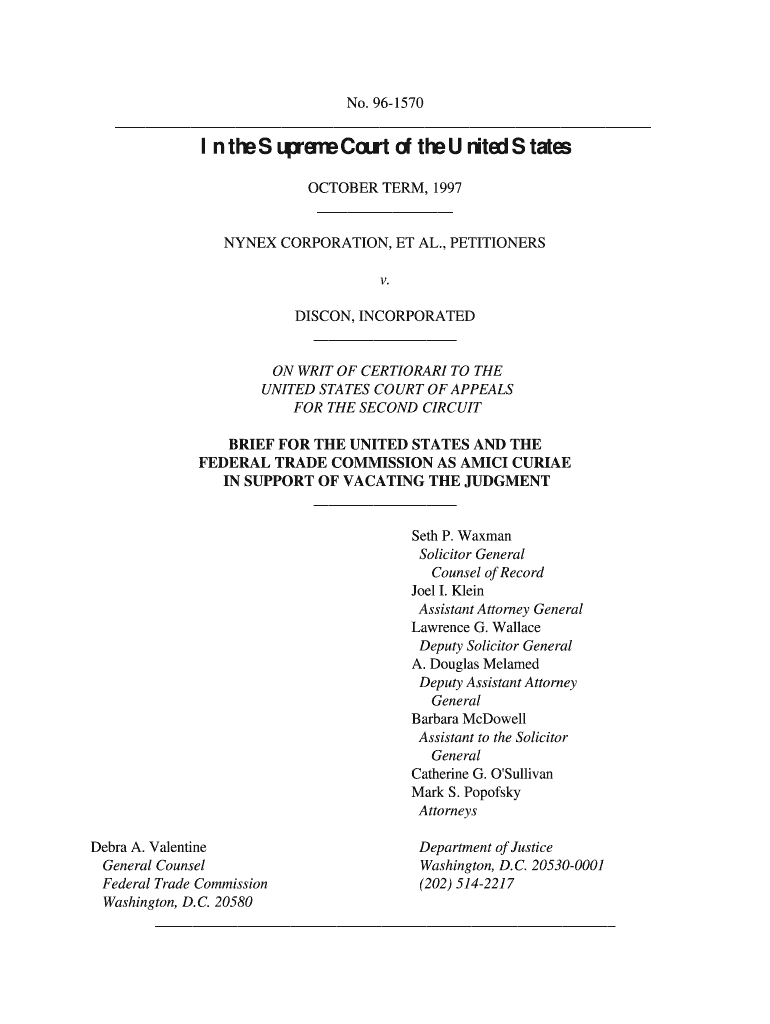
The "In the Supreme Court of the United States - Federal Trade Commission" refers to a type of legal document submitted in the context of cases involving the Federal Trade Commission (FTC) and their proceedings before the Supreme Court. This form plays a critical role in outlining the legal positions, arguments, and precedents relevant to a specific case involving the FTC, particularly those related to antitrust laws and consumer protection regulations.
How to Use the In the Supreme Court of the United States - Federal Trade Commission
Legal practitioners utilize this form to present evidence and arguments before the Supreme Court in cases where the FTC is a party. The document is crafted to address the main issues at dispute in the case, referencing statutory provisions, prior rulings, and policy considerations that dictate how the Court should rule. Each section may include detailed legal analysis supported by expert testimony or empirical data that underscores the arguments presented.
Step-by-Step Process:
- Identify the Legal Issues: Outline the central questions of law that the Supreme Court needs to address.
- Research Relevant Precedents: Incorporate previous Supreme Court and appellate decisions related to FTC jurisdiction and enforcement actions.
- Draft Legal Arguments: Clearly form arguments based on statutory interpretation, legislative history, and economic analysis.
- Submit Supporting Documents: Assemble additional briefs, affidavits, and testimony that strengthen the case.
Key Elements of the In the Supreme Court of the United States - Federal Trade Commission
Several components typically structure such legal submissions:
- Opening Statements: Introduction of the principal facts of the case.
- Legal Arguments: Detailed examination of why the lower court's decision should be upheld or overturned.
- Case Law References: Specific rulings that bolster the argument.
- Conclusion: A concise summary urging a particular outcome.
Legal Use of the In the Supreme Court of the United States - Federal Trade Commission
This form is indispensable in ensuring that the Supreme Court receives a comprehensive view of the legal landscape surrounding a case involving the FTC. It allows lawyers to argue for or against regulatory actions by the FTC and whether these actions adhere to statutory guidelines. This form is especially important in cases involving questions of federal jurisdiction, antitrust enforcement, and consumer protection.
Important Terms Related to In the Supreme Court of the United States - Federal Trade Commission
Understanding contextual terminology is crucial:
- Sherman Act: A foundational statute in antitrust law, central to many FTC cases.
- Monopolization: Illegal practices aimed at achieving or maintaining monopolistic control of a market.
- Rule of Reason: A judicial approach in antitrust cases that considers the pro-competitive vs. anti-competitive effects of business practices.
Examples of Using the In the Supreme Court of the United States - Federal Trade Commission
Consider a case where the FTC challenges a company for anticompetitive behavior. Lawyers for both the FTC and the company submit briefs articulating their positions. The FTC might argue that the company’s conduct stifles competition under the Sherman Act, while the company could counter that its actions are permissible under the rule of reason. The Supreme Court then evaluates these arguments to reach a decision.
State-Specific Rules for the In the Supreme Court of the United States - Federal Trade Commission
While Supreme Court decisions have nationwide implications, certain FTC-related issues may be rooted in state-specific consumer protection laws. Legal practitioners must often demonstrate how federal statutes harmonize or conflict with state laws, especially in areas where state agencies enforce parallel regulations.
Digital vs. Paper Version
In modern legal practice, submissions to the Supreme Court, including FTC-related cases, are increasingly filed electronically to streamline the process and maintain comprehensive digital records. This evolution ensures greater accessibility and a standardized approach to filing legal documents, although paper versions might still be required for formal records or archival purposes.
Filing Deadlines / Important Dates
Meeting statutory deadlines is crucial in the Supreme Court process. Submissions regarding FTC cases must adhere to strict timelines, typically dictated by the Court's docket and procedures. Missing deadlines can result in critical delays or even dismissal of the case.
Who Issues the Form
The form is generated by legal teams representing either party involved in the case (i.e., the FTC and their opposition). These documents are filed with the Clerk of the Supreme Court who manages submission protocols and ensures compliance with procedural standards.