






Definition & Meaning
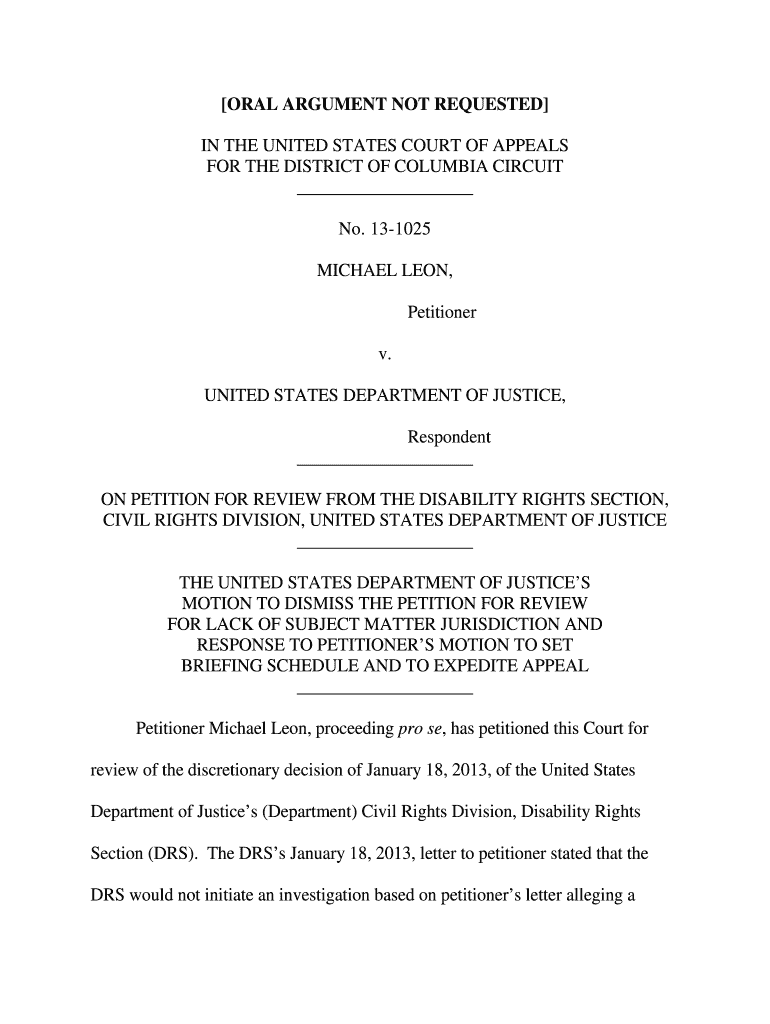
The "Leon v Department of Justice Motion to Dismiss" refers to a legal motion filed by the United States Department of Justice (DOJ) as a response to Michael Leon's petition. Leon alleges a violation of the Americans with Disabilities Act (ADA), claiming that the Disability Rights Section failed to investigate his complaint. The DOJ contends that the court lacks jurisdiction to review this decision, arguing that such determinations are within the agency's discretion and are thus not subject to judicial review under the Administrative Procedure Act.
How to Use the Leon v Department of Justice Motion to Dismiss
To effectively utilize the "Leon v Department of Justice Motion to Dismiss," it's important to understand its legal context and purpose. This document is typically used by the DOJ to argue for the dismissal of a case based on jurisdictional grounds. Individuals or legal representatives seeking to respond to this motion should prepare a counter-argument that addresses the jurisdictional claims. Key steps include:
- Reviewing the motion thoroughly to understand the DOJ's arguments.
- Gathering evidence or arguments that support the notion that the court does have jurisdiction.
- Preparing a legal response that clearly outlines why the motion to dismiss should be denied.
Key Elements of the Leon v Department of Justice Motion to Dismiss
Critical components of the motion involve the arguments about jurisdiction and agency discretion. Key elements include:
- Jurisdictional Argument: The DOJ asserts that the court does not have the authority to review certain agency decisions.
- Agency Discretion: Emphasis on the notion that the decision not to investigate Leon's complaint falls under the agency's discretionary powers.
- Citing Legal Precedents: References to previous rulings and statutes that reinforce the DOJ's position.
Legal Use of the Leon v Department of Justice Motion to Dismiss
This motion is used in a legal context primarily to challenge the court's authority over specific types of cases. Legal use includes:
- Preventing cases from proceeding to trial if they fall outside the court's jurisdiction.
- Using procedural arguments to highlight the boundaries of judicial review under administrative law.
- Leveraging legal precedents that limit judicial interventions in administrative agency decisions.
Steps to Complete the Leon v Department of Justice Motion to Dismiss
If one were seeking to respond or challenge a motion to dismiss, consider these steps:
- Document Review: Carefully analyze the DOJ's filing to understand their arguments.
- Research: Identify relevant legal precedents and statutes that may counter the DOJ's claims.
- Draft Response: Write a detailed legal response that addresses each point in the motion.
- Legal Representation: Engage an attorney well-versed in administrative law and ADA claims.
- File Response: Submit the legal response within the court's deadline, ensuring compliance with procedural rules.
Who Typically Uses the Leon v Department of Justice Motion to Dismiss
This type of motion is generally used by legal practitioners, including:
- Department of Justice Attorneys: To efficiently manage case loads by dismissing claims lacking legal merit.
- Private Defense Attorneys: When representing clients in similar scenarios where agency discretion is at play.
- Public Interest Lawyers: Particularly in civil rights and administrative law cases.


Important Terms Related to the Leon v Department of Justice Motion to Dismiss
Understanding associated legal terminology is crucial:
- Subject Matter Jurisdiction: The authority of a court to hear cases of a particular type or cases relating to a specific subject matter.
- ADA (Americans with Disabilities Act): Federal legislation that prohibits discrimination based on disability.
- Administrative Procedure Act: A U.S. federal statute that governs how federal administrative agencies may propose and establish regulations.
Examples of Using the Leon v Department of Justice Motion to Dismiss
Various scenarios showcase the application of such legal motions:
- Case Dismissals: When claims are deemed outside the purview of judicial review, leading to dismissal.
- Legal Precedents: Instances where the DOJ successfully argued for dismissal based on administrative discretion.
- Court Challenges: Situations where petitioners have contested dismissals, arguing for an expanded interpretation of jurisdiction.
Required Documents for Response
When responding to the motion, certain documents are usually essential:
- Legal Counter-Motion: A comprehensive document that addresses each argument posed by the DOJ.
- Supporting Evidence: Documents and testimonies that support the jurisdictional claim.
- Precedential Citations: Case law and statutory references that bolster the counter-argument.
Form Submission Methods (Online / Mail / In-Person)
Responses to the motion can be submitted through various channels depending on court protocols:
- Online Platforms: E-filing systems used by many courts facilitate electronic submission.
- Mail: Traditional postal methods may be required in jurisdictions without e-filing.
- In-Person: Direct submission to the court clerk’s office may be necessary in some cases.