
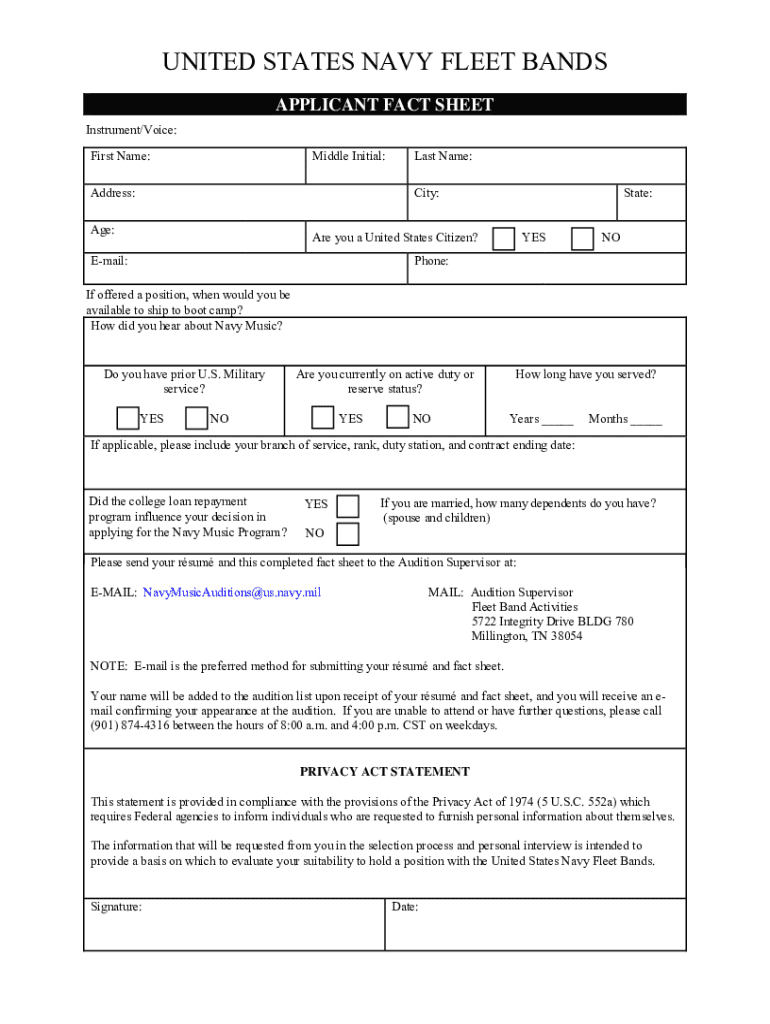







Definition and Meaning of U.S. Navy Fleet Bands Keyboard Auditions
The U.S. Navy Fleet Bands Keyboard Auditions serve as a specialized selection process to identify and recruit skilled pianists and keyboardists for positions within the U.S. Navy Fleet Bands. This audition primarily focuses on assessing the candidate’s musical proficiency, versatility across various genres, and overall suitability for military band performance. The auditions are critical to maintaining the high standards of excellence expected from Navy musical ensembles.
How to Use the U.S. Navy Fleet Bands Keyboard Auditions
Participation in the U.S. Navy Fleet Bands Keyboard Auditions involves several key steps. Prospective applicants must initially express their interest through email registration, which includes providing basic personal details and a resume highlighting relevant experience. Once registered, candidates prepare a setlist of musical pieces demonstrating their skills and versatility. During the audition, applicants perform these selections and complete sight-reading tasks in front of an audition panel. Successful candidates may receive a conditional offer of appointment, pending final approval.
Steps to Complete the U.S. Navy Fleet Bands Keyboard Auditions
- Registration: Initiate the process by sending an email registration to the designated Navy recruitment contact. The email should include a brief biography, contact information, and a summary of musical experience.
- Preparation: Select and rehearse seven pieces from various musical genres. Include both classical and commercial styles to exhibit comprehensive musicianship.
- Audition Day: On the day of the audition, arrive with your own equipment and music. Execute the prepared pieces and participate in accompaniment and sight-reading exercises.
- Assessment: Await feedback from the audition panel. This usually includes an evaluation of both technical performance and stylistic adaptability.
- Finalization: If successful, complete the necessary administrative formalities and await instructions for any further assessment or training.
Key Elements of the U.S. Navy Fleet Bands Keyboard Auditions
- Personal Preparation: This involves practicing a diverse repertoire and preparing both technically and mentally for a demanding performance.
- Repertoire Selection: Choose a balanced mix of genres to reflect a wide range of musical expertise.
- Sight-Reading: Demonstrate proficiency in reading and performing music that has not been previously practiced, highlighting adaptability.
Who Typically Uses the U.S. Navy Fleet Bands Keyboard Auditions
The auditions are primarily targeted at pianists and keyboardists seeking a career within military music. This may include college-trained musicians, professional performers seeking stability, or military veterans with a strong musical background. The auditions can also attract young musicians interested in combining military service with their passion for music.


Important Terms Related to U.S. Navy Fleet Bands Keyboard Auditions
- Repertoire: A set list of pieces prepared for the audition, encompassing a variety of musical styles.
- Sight-Reading: The ability to read and perform music on sight without prior preparation.
- Military Ensemble: A group of musicians performing as part of a military organization, requiring discipline and collaboration.
Eligibility Criteria for U.S. Navy Fleet Bands Keyboard Auditions
To be eligible, applicants must meet specific criteria set by the U.S. Navy. These include age and citizenship requirements, physical fitness standards, and a deep commitment to both the Navy’s mission and musical excellence. A thorough background check and potential clearance for military service are also prerequisites.

Examples of Using the U.S. Navy Fleet Bands Keyboard Auditions
Several successful candidates have leveraged these auditions to springboard their careers in music, combining their passion with service. For instance, a conservatory-trained pianist might use the opportunity to secure a stable career with benefits, while also gaining unique performance experiences not available in civilian music careers.




